New physics explains how odor changes on its journey through the air
Wind reshapes the timing of odor whiffs, potentially giving animals clues about where a scent originated.
 UC Boulder Writer: Scott Franz

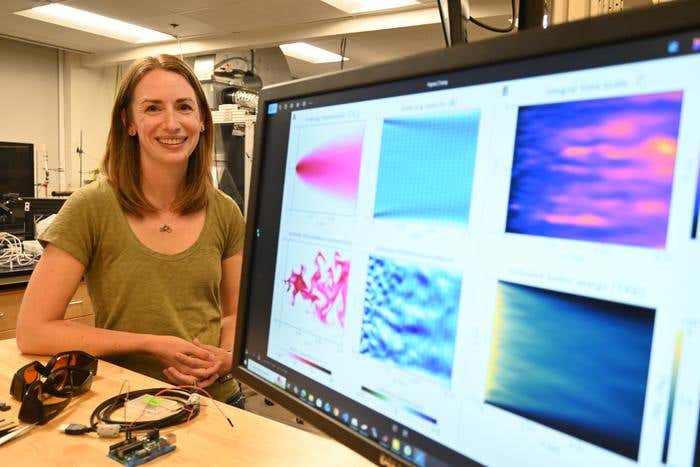
Wind reshapes the timing of odor whiffs, potentially giving animals clues about where a scent originated. (CREDIT: Scott Franz/CU Boulder Today)
- Turbulent air changes odor signals before they reach an animal, filtering some frequencies, spreading others, and creating new fluctuations.
- Computer simulations showed that high-frequency odor information fades with distance, while lower-frequency patterns survive farther from the source.
- Researchers do not yet know whether animals actually use these frequency changes for navigation, but the framework offers a way to test that idea.
An odor drifting through the air does not arrive at a nose in the same form it left its source. Turbulence reshapes the signal along the way, potentially giving animals clues about where the smell began.
Researchers at the University of Colorado Boulder developed a mathematical framework describing how turbulent air changes the frequency content of odor signals.
The analysis identified three major transformations: frequency filtering, frequency spreading, and frequency production. Together, they remove some information, redistribute other parts, and generate fluctuations that were absent at the source.
The work connects fluid mechanics with questions about how animals navigate using smell.
“By understanding how air and wind transform odor signals, we can better understand animal navigation behavior and eventually mimic it, in applications from search and rescue to locating hazardous chemical leaks,” said lead author Elle Stark, a postdoctoral researcher at CU Boulder.
Turbulence Breaks an Odor Plume into Pieces
An odor released by a flower, animal, or chemical source travels within moving air.
Turbulent eddies stretch the plume into filaments that twist, fold, separate, and mix. An animal therefore does not encounter a steady stream of scent.
Instead, it may receive a brief burst, followed by clean air, then another burst.
“There might be a burst of odor, a short whiff, and then empty air for a while, and animals somehow make sense of all of that, to be able to navigate to the source,” Stark said.
The researchers focused on the frequencies contained in those fluctuations.
Just as a sound can contain different frequencies, an odor signal can vary rapidly or slowly over time. Its power spectrum describes how strongly those frequencies appear.
Earlier work discussed in the study shows that some animals can respond to remarkably rapid odor changes. Mice can distinguish signals fluctuating as fast as 40 hertz, while insects can respond to frequencies reaching 1,000 hertz.
High-Frequency Information Fades with Distance
The first major transformation is frequency filtering.
As odor molecules move downstream, turbulence and molecular diffusion spread their arrival times apart.
Fast fluctuations therefore become blurred more quickly than slow ones.
The process acts like a low-pass filter. Lower-frequency signals survive more easily, while high-frequency details tend to disappear.
Distance strengthens the effect.
The farther an odor travels, the more time turbulent motion has to alter the timing of individual packets. High-frequency information about the original source therefore becomes increasingly difficult to preserve.
The second process, frequency spreading, works differently.
Instead of simply weakening one frequency, turbulence spreads its energy into nearby frequencies. Eddies moving at many different scales cause an originally narrow signal to broaden during transport.
Turbulence Can Create New Frequencies
The third transformation may be the most surprising.
Turbulence can generate fluctuations that were never present in the original odor signal.
The researchers demonstrated this using an idealized source that continuously released odor at a constant rate.
Such a source has no meaningful fluctuations of its own. Yet downstream sensors detected a broad range of frequencies after turbulent transport.
Those new frequencies came from the airflow itself.
Large and small eddies continually reorganized the plume, adding their own timing patterns to the odor signal.
The result means that an odor arriving at an animal contains information about both its source and the turbulent air through which it traveled.
“These transformations are likely important ingredients in how animals interpret odor signals to determine distance and direction to the odor source,” said John Crimaldi, a CU Boulder professor and co-author of the research.
Simulations Follow Odor Through Chaotic Flow
To examine the transformations in detail, the team created a two-dimensional computer simulation of turbulent air.
Air moved at 0.1 meters per second through an array of cylinders that created chaotic flow.
The simulated region measured 0.75 by 0.6 meters. Researchers generated 180 seconds of data at 50 hertz with a spatial resolution of 500 micrometers.
They released virtual odor particles from one point and positioned seven sensors downstream, ranging from 0.05 to 0.40 meters from the source.
The simulations showed all three processes occurring together.
High-frequency source information weakened with distance. Individual frequencies spread into broader ranges, while turbulence generated an underlying spectrum even when those fluctuations did not exist at the source.
Sensor size also changed what was detected.
Larger sensors intercepted more particles as the plume spread sideways and captured stronger correlated fluctuations.
That finding could matter biologically because sensory structures vary greatly in size. A long insect antenna, for example, may encounter turbulent odor patterns differently from a much shorter one.
Frequency Changes May Become Navigation Clues
The results raise a possibility about how animals locate odor sources.
Far from a source, much of its fast frequency information has disappeared. Closer to the source, more of that original pattern remains intact.
An animal familiar with the normal structure of a particular odor signal might therefore use those changes as a clue to distance.
The researchers have not demonstrated that animals perform such calculations.
Instead, the framework creates a way to test whether animals respond to spectral changes produced by turbulent transport.
Odor processing also continues after the airflow has done its work.
Animals move through odor plumes, sniff, flick their antennae, beat wings, and alter their own position. Those behaviors further change the signal reaching sensory receptors.
“Animals engage in what we call active sensing, which involves moving around through the plume, flicking their antenna, sniffing or other behaviors that modify the odor signal,” Stark said.
Neural processing then transforms the information again.
Dig deeper into odor plumes and olfactory navigation
These studies explore turbulent scent transport, biological odor processing and strategies animals or machines can use to locate odor sources.
Odor Landscapes in Turbulent Environments: This study developed a quantitative description of intermittent odor plumes and the statistics of the brief scent encounters experienced by navigating animals. (Physical Review X, 2014)
Bifurcation Enhances Temporal Information Encoding in the Olfactory Periphery: A theoretical model shows how fruit fly olfactory neurons can efficiently encode the timing, duration and intensity of rapidly fluctuating odor signals. (PRX Life, 2024)
Olfactory search at high Reynolds number: This influential work examined how turbulent odor information could be used to infer a source location and proposed strategies relevant to both animals and robots. (Proceedings of the National Academy of Sciences, 2002)
Moth-inspired navigation algorithm in a turbulent odor plume from a pulsating source: Researchers developed an odor-search strategy inspired by moth flight behavior in intermittent turbulent pheromone plumes. (PLOS ONE, 2018)
Fine-scale structure of odor plumes in relation to insect orientation to distant pheromone and other attractant sources: Classic field experiments showed that odor arrives downwind as intermittent bursts rather than as a continuous signal. (Physiological Entomology, 1981)
Research findings are available online in the journal PRX Life.
The original story "New physics explains how odor changes on its journey through the air" is published in The Brighter Side of News.
Related Stories
- Smelling chocolate before lifting weights could make your workout easier
- Harvard researchers discover how the human nose decodes smells
- AI-powered electronic nose can 'smell' early signs of ovarian cancer in the blood
Like these kind of feel good stories? Get The Brighter Side of News' newsletter.
Joshua Shavit
Writer and Editor
Joshua Shavit is a NorCal-based science and technology writer with a passion for exploring the breakthroughs shaping the future. As a co-founder of The Brighter Side of News, he focuses on positive and transformative advancements in technology, physics, engineering, robotics, and astronomy. Having published articles on AOL.com, MSN, Yahoo News, and Ground News, Joshua's work highlights the innovators behind the ideas, bringing readers closer to the people driving progress.