Scientists outline how spacecraft could reach a nearby black hole within a century
A gram-scale probe traveling at one-third light speed could turn a nearby black hole into a direct laboratory for Einstein’s gravity.

 Edited By: Joshua Shavit

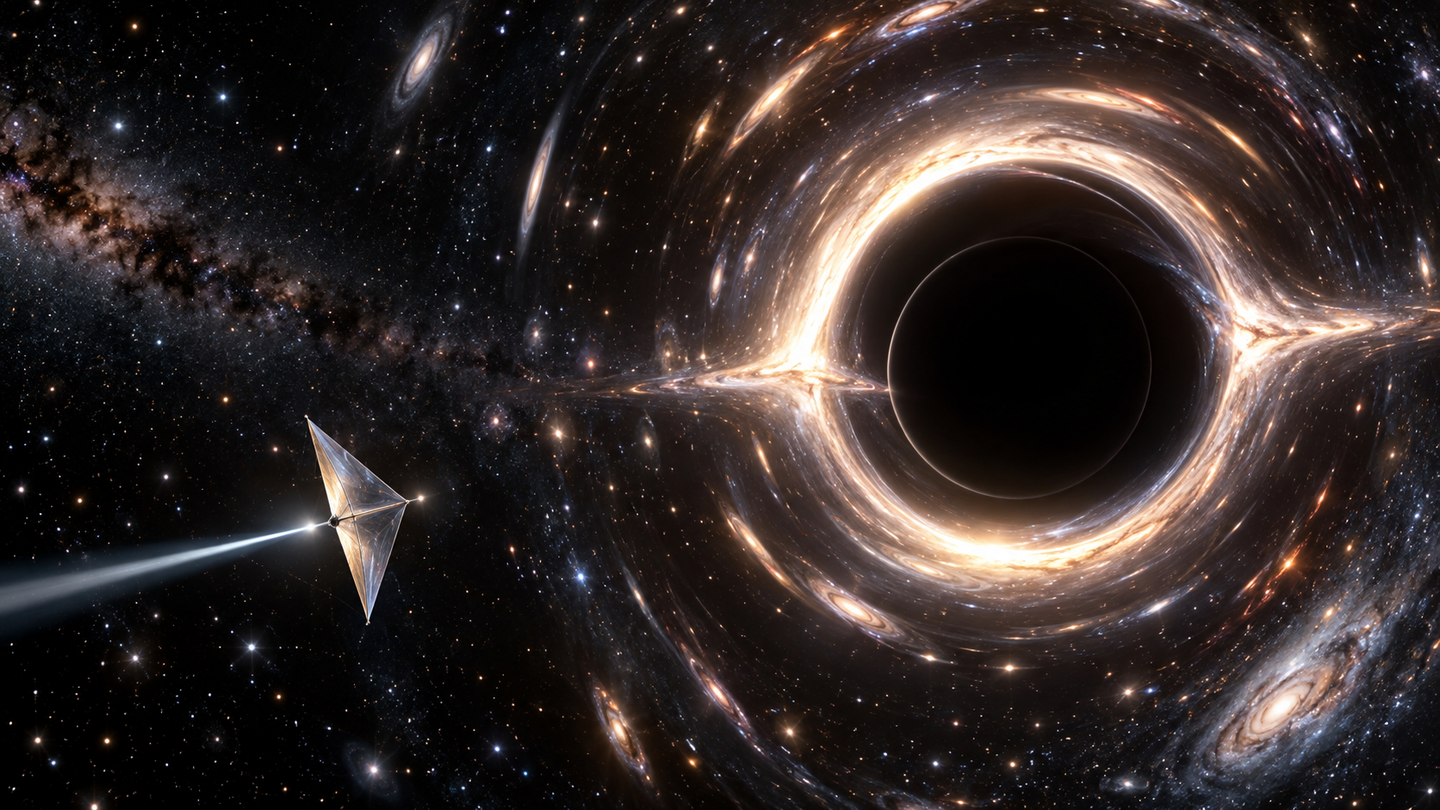
A physicist outlines how laser-driven nanocraft could someday reach a nearby black hole and test gravity directly. (CREDIT: Wikimedia / AI-Generated / CC BY-SA 4.0)
- A speculative mission concept proposes sending laser-powered, gram-scale spacecraft to a black hole that could potentially exist within 20 to 25 light-years of Earth.
- Traveling at roughly one-third the speed of light, a nanocraft could reach such a target in 60 to 75 years, with data returning to Earth after another 20 to 25 years.
- Multiple probes near the black hole could test the Kerr description of spacetime, investigate whether an event horizon exists and search for changes in fundamental constants.
Humanity may someday attempt something considerably more ambitious than photographing a black hole: sending a spacecraft directly to one.
The idea would require a suitable black hole to be discovered surprisingly close to Earth, along with technologies that do not yet exist. But calculations suggest the journey is not forbidden by physics.
Cosimo Bambi of Fudan University explores the concept in iScience, describing gram-scale spacecraft propelled by enormous ground-based laser arrays. If a black hole exists 20 to 25 light-years away, a probe traveling at one-third the speed of light could reach it in 60 to 75 years.
Signals carrying its results would require another 20 to 25 years to return.
The proposal remains highly speculative. Yet it outlines what would be necessary to move black-hole science from remote observation toward direct experimentation in extreme gravity.
The first problem is finding the destination
No suitably nearby black hole is currently known.
Gaia BH1, one of the closest confirmed stellar-mass black holes, lies roughly 1,560 light-years away. Sending even a relativistic probe there would be impractical for the proposed mission.
Bambi instead estimates that an undiscovered black hole might lie only 20 to 25 light-years away. The figure is a rough statistical estimate based on the expected populations of stars, white dwarfs and stellar-mass black holes in the Milky Way.
Most nearby black holes could be extremely difficult to detect because they may travel alone. More than 90% of black holes in the Galactic disk could be isolated, according to estimates cited in the paper.
An isolated black hole produces no light of its own. Astronomers may instead find one through gravitational microlensing, faint emission from material it captures, or potentially gravitational waves triggered when transient radiation disturbs the surrounding spacetime.
Bambi argues that improved searches could eventually uncover a nearby candidate. Until that happens, however, the mission has no destination.
Lasers could replace an impossible rocket
Conventional rockets cannot approach the necessary speeds.
Instead, the concept borrows from laser-sail proposals developed for interstellar missions. A nanocraft could contain a roughly gram-scale electronic wafer connected to an extremely thin, reflective sail several meters across.
A powerful laser array on Earth would fire at the sail. Radiation pressure from the photons would accelerate the spacecraft without requiring it to carry enormous quantities of fuel.
For a craft traveling at one-third of light speed, Bambi estimates that the main acceleration could last roughly 1,000 seconds, or about 17 minutes. The probe would cover approximately 50 billion meters during that acceleration before beginning its long coast through interstellar space.
A target 20 light-years away would then require about 60 years of travel. At 25 light-years, the journey would take roughly 75 years.
Existing proposals such as Breakthrough Starshot have examined similar technology for sending gram-scale probes toward Alpha Centauri at about 20% of light speed. A black-hole mission would add far more demanding navigation and scientific requirements.
Two probes could test Einstein near a black hole
The greatest scientific payoff would begin after arrival.
Bambi proposes using at least two nanocrafts, possibly created when one arriving spacecraft separates into multiple smaller probes. One could remain farther from the black hole while another approaches the region of extreme gravity.
The inner probe could transmit a stable electromagnetic signal to its companion. Changes in the signal would reveal the spacecraft's motion and gravitational redshift.
General relativity predicts that an isolated rotating black hole should be described by the Kerr metric. By tracking the probe through many orbits, researchers could compare its measured behavior with those predictions.
The paper estimates that observations lasting days, weeks or months could potentially provide exceptionally sensitive tests if a small probe could maintain an orbit close to a roughly 10-solar-mass black hole.
Such measurements could avoid a limitation faced by Earth-based observations. Telescopes must interpret light passing through turbulent gas and other complicated material around astrophysical black holes. A spacecraft near an isolated black hole could instead probe a much cleaner gravitational environment.
A probe could investigate the event horizon itself
Another experiment would address a deeper question: does the compact object possess a true event horizon?
One nanocraft could watch another fall toward the black hole.
Under general relativity, the falling probe's signal would become progressively more redshifted as it approached the horizon. To the distant observer, the signal would eventually become too weak or shift outside the receiver's detectable frequency range.
Some speculative alternatives predict compact objects without conventional horizons. One example is the fuzzball concept inspired by string theory.
A horizonless object could produce a different signal as the probe reached its surface or underlying structure. The paper stresses that such alternatives do not yet provide sufficiently precise predictions for a simple decisive test.
The mission could also compare atomic transitions near the black hole. Differences beyond the expected gravitational redshift might indicate that quantities such as the fine-structure constant vary in strong gravitational fields.
Getting there may be easier than stopping
The proposal faces enormous engineering problems.
A laser system powerful enough to propel the craft could cost around one trillion euros using present technology. Bambi argues that continued declines in the cost of coherent laser power could eventually lower that figure dramatically.
Light sails would need to survive intense laser irradiation. Gram-scale electronics would have to navigate autonomously, withstand decades of interstellar travel and send useful data across tens of light-years.
Finding the black hole accurately enough presents another major obstacle. A slight targeting error at launch could become an enormous miss after traveling for decades.
Perhaps the hardest problem comes at arrival. A probe racing toward a black hole at a substantial fraction of light speed must somehow alter its trajectory enough to enter orbit. The paper identifies the transition from an unbound trajectory to a bound orbit as one of the mission's most difficult unresolved challenges.
If orbital capture proves impossible, a high-speed flyby could still perform some measurements.
The concept is therefore not a mission proposal ready for construction. It is closer to a roadmap for questions future generations would have to solve.
But it changes the scale of what can at least be considered. Black holes are currently objects humanity studies from afar. A sufficiently advanced civilization might someday send an experiment directly into the gravitational environment surrounding one.
Dig deeper into interstellar probes and black-hole tests
These resources explore the propulsion, detection and strong-gravity physics that would underpin any future mission to a nearby black hole.
The Breakthrough Starshot system model: This engineering study examines how laser-driven gram-scale spacecraft could reach about 20% of light speed and identifies major cost and design challenges. (Acta Astronautica, 2018)
A Sun-like star orbiting a black hole: The discovery paper for Gaia BH1 describes a nearby stellar-mass black hole identified through the motion of its Sun-like companion. (Monthly Notices of the Royal Astronomical Society, 2023)
OGLE-2011-BLG-0462: An Isolated Stellar-mass Black Hole Confirmed Using New HST Astrometry and Updated Photometry: Long-term Hubble observations confirmed an isolated stellar-mass black hole detected through gravitational microlensing. (The Astrophysical Journal, 2025)
First Sagittarius A* Event Horizon Telescope Results. VI. Testing the Black Hole Metric: Event Horizon Telescope observations constrain departures from the Kerr description around the Milky Way's central black hole. (The Astrophysical Journal Letters, 2022)
The Breakthrough Starshot system model: Breakthrough Starshot outlines the broader concept of using ground-based lasers and lightweight sails to send nanocraft across interstellar distances. (Breakthrough Initiatives, 2017)
Research findings are available online in the journal Cell Press iScience.
The original story "Scientists outline how spacecraft could reach a nearby black hole within a century" is published in The Brighter Side of News.
Related Stories
- Scientists develop laser-powered graphene propulsion for next-generation space travel
- Worm experiments expose hidden health risks of deep space travel
- Space travel accelerates stem cell aging - threatening astronaut health
Like these kind of feel good stories? Get The Brighter Side of News' newsletter.
Joseph Shavit
Writer, Editor-At-Large and Publisher
Joseph Shavit, based in Los Angeles, is a seasoned science journalist, editor and co-founder of The Brighter Side of News, where he transforms complex discoveries into clear, engaging stories for general readers. With vast experience at major media companies like The Los Angeles Times, Times Mirror and Tribune Publishing, he writes with both authority and curiosity. His writing focuses on space science, planetary science, quantum mechanics, geology. Known for linking breakthroughs to real-world markets, he highlights how research transitions into products and industries that shape daily life.