New ultra-black, carbon and nanotube car paint absorbs 99.90% of visible light
A new ultra-black coating could give luxury cars a deeper black finish while still meeting key durability tests.

 Edited By: Joseph Shavit

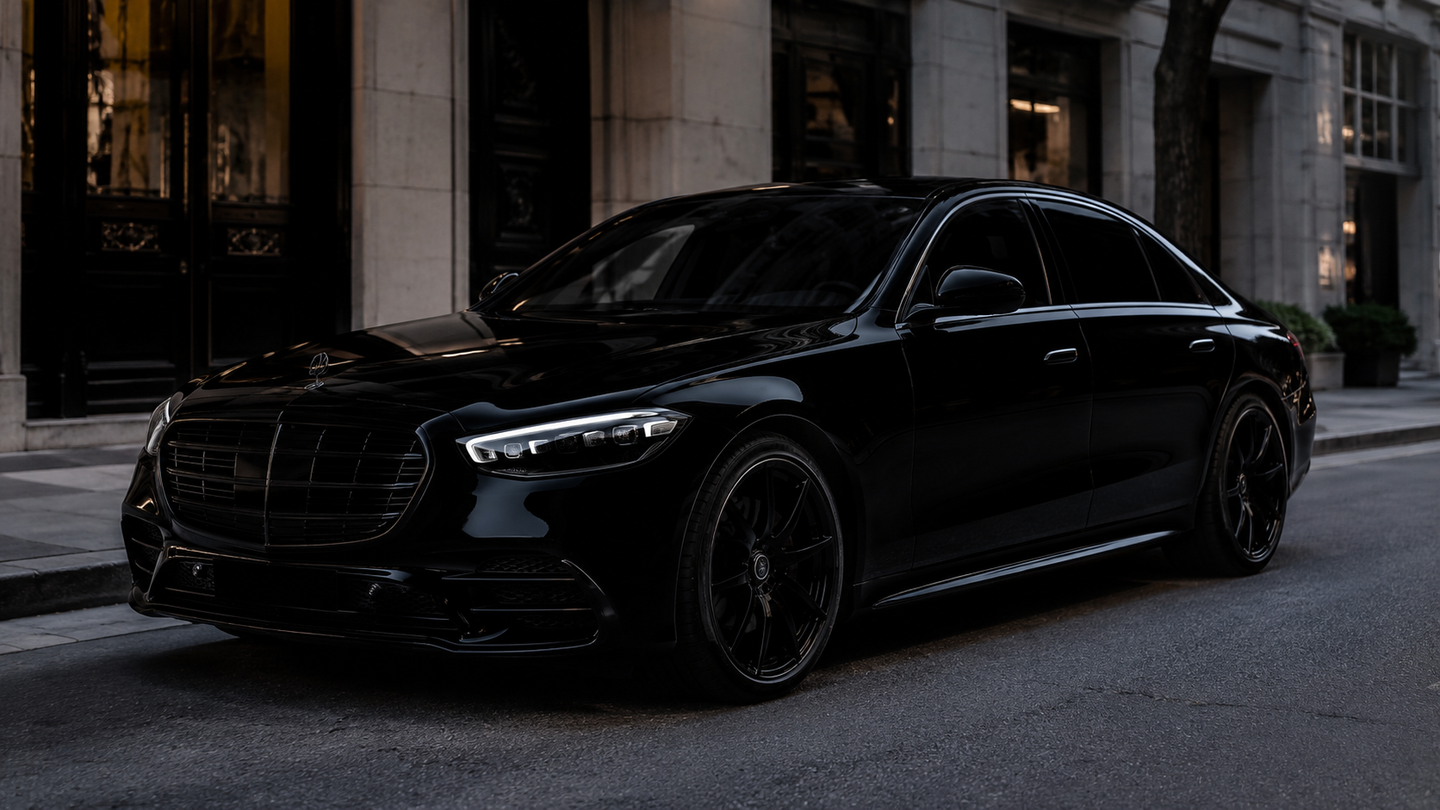
A new carbon black and nanotube coating absorbs 99.90% of visible light and could bring ultra-black car finishes closer to production. (CREDIT: AI-generated image / The Brighter Side of News)
A car painted in deep black already carries a certain message, sleek, expensive, a little intimidating. Now researchers say they have found a more practical way to push that look even further, creating an ultra-black automotive coating that absorbs almost all visible light while still holding up under tests that matter to carmakers.
The new coating combines carbon black pigment with carbon nanotubes, producing a finish that absorbed an average of 99.90% of visible light in the team’s measurements. Just as important, the material was designed to work in a form that can actually be processed into automotive paint, rather than remaining a striking but impractical lab demonstration.
“In China, car color has become a key selling point,” said Zhiwei Liu, a research chemist with Color Technology, Group Core R&D Shanghai, Nipsea Group. “Deep black finishes have long been the premium choice and signature color for luxury cars due to their elegant appearance, powerful visual impact, and luxurious undertone.”
That appetite for darker and more dramatic finishes has grown in the years since a 2019 BMW concept car, coated with vertically aligned carbon nanotube arrays, drew global attention for its near light-swallowing appearance. But turning that kind of effect into something suitable for mass automotive production has proved far harder than making a one-off concept vehicle.
A darker black, built for paint lines
Most black automotive coatings rely on carbon black dispersions. They work because carbon black is already very good at absorbing light. But there is a limit. Tiny particles tend to clump together, which reduces how effectively they absorb light and makes it harder to push a coating into the ultra-black range.
Liu and his colleagues tried a different route. They dispersed crude carbon black pigment together with carbon nanotubes using dispersants and high-energy sand milling, then mixed that black dispersion into a coating binder and sprayed it as an automotive coating.
What formed was not just a darker pigment blend. Under microscopy, the team found that the carbon black particles tended to distribute themselves along the nanotubes, creating what the authors described as a “connecting-the-dots” structure. That arrangement appears to help the coating trap light through its surface morphology, giving it a second way to darken beyond the pigment’s intrinsic absorption.
The team called this “structural absorption.” Instead of relying only on the material’s chemistry, the coating’s tiny peaks, valleys, and internal trapping features encourage multiple scattering and repeated absorption of light. In practical terms, that means less light escapes back to the eye.
Compared with a standard carbon black coating, the new version showed lower reflectance across all five viewing angles tested. Its minimum specular reflectance was about 0.05%, compared with about 0.11% for the conventional carbon black coating at 15 degrees. Across the visible range, its average reflectance was about 0.08%, putting it close to the performance associated with vertically aligned carbon nanotube arrays, but in a form meant to be more usable for industry.
Why nanotubes help, and why they complicate things
The nanotubes do more than darken the coating. They also appear to help organize the carbon black into a finer, more uniform dispersion. Transmission electron microscopy showed that the carbon black particles in the combined dispersion were smaller and more even than those in carbon black alone.
The researchers linked that effect to strong π-π interactions between the carbon black and the nanotubes. Those interactions seem to reduce the tendency of the particles to gather into larger clumps and settle out, which is a serious issue for coatings meant to be stored, shipped, and applied on an industrial scale.
That stability showed up in testing. In an accelerated analytical centrifugation test meant to simulate long-term storage, the dispersion ended with an instability index of 0.027, a sign of strong stability. Oscillatory rheology tests also suggested a robust internal network structure that stayed largely intact even under heavy strain.
Still, the same nanotubes that help produce the darker finish also create one of the biggest manufacturing headaches.
As the share of nanotubes rises, the coating becomes more viscous, making it harder to process in large volumes. The authors said that even at relatively low nanotube ratios, viscosity climbed sharply. That leaves manufacturers with a tradeoff: more nanotubes can produce stronger light absorption, but they can also make the material much harder to handle in real production.
“With the rapid development of dispersing technology and equipment, there is still room for improvements in practical processability of carbon-nanotube-containing nanomaterials,” Liu said.
Luxury appeal meets industrial reality
In automotive coatings, extreme darkness alone is not enough. Paints also have to survive humidity, water exposure, adhesion testing, and the many stresses built into automotive finishing standards. A color that looks stunning on a display sample but fails after exposure to moisture is not likely to make it onto a production vehicle.
That is where the new coating appears to make its strongest case.
The researchers subjected coated panels to 14 days at 40 degrees Celsius and 95% humidity, and separately to 10 days in a 40-degree water bath. After those tests, the panels showed no major visible paint defects and passed cross-cut adhesion testing, with no detachment seen in the tape test.
The coating also reached strong color-performance benchmarks used in the automotive industry. Its highest jetness value, Mc, was about 328.7, and its highest blackness value, My, was about 315.0. For comparison, the standard carbon black coating in the study reached about 304.3 and 296.4. Those gains matter because jetness and blackness are the numbers coating makers use to judge whether a finish delivers the rich, high-end darkness expected in premium vehicles.
The demonstration model coated with the material showed what the numbers are chasing, a glossy, extremely deep black with the kind of visual weight luxury automakers tend to prize.
The study, published in Matter & Light, frames the advance less as a single record-setting stunt than as a balancing act. The coating does not beat every ultra-black material ever reported, and the authors are clear that more validation is needed before it is ready for road cars. But it moves closer to something the automotive industry has been missing, an ultra-black finish that is not just visually dramatic, but processable and durable.
From concept-car spectacle to something usable
That distinction may be the most important part of the work.
For years, ultra-black surfaces have attracted attention because of how surreal they look, flattening contours, swallowing detail, and giving objects an almost unreal silhouette. But many of the darkest materials are difficult to scale, fragile, or poorly suited to real-world coating systems.
This coating was built with those constraints in mind. The authors said they selected the carbon black to nanotube ratio not simply to chase the darkest possible number, but to balance color performance with mass-production feasibility.
That leaves the project in a familiar middle ground for industrial materials research: promising, impressive, but not finished. The team said the manufacturing process has reached a technical proof of concept, while the next steps will focus on verifying the application window and carrying out broader film-performance validation.
If those hurdles are cleared, the result could give automakers a new way to market black not just as another paint option, but as a signature finish.
Practical implications of the research
This work suggests ultra-black car coatings may be moving closer to commercial reality, especially for luxury vehicles where color itself can influence buying decisions.
The main advance is not just that the coating looks darker, but that it was designed around processability and passed key stability, humidity, water-resistance, and adhesion tests. That makes it more relevant to real automotive production than many earlier ultra-black materials.
Even so, the coating still needs broader validation before it can be considered road-ready, and the tradeoff between darker finishes and large-scale manufacturability remains a central challenge.
Research findings are available online in the journal Matter & Light.
The original story "New ultra-black, carbon and nanotube car paint absorbs 99.90% of visible light" is published in The Brighter Side of News.
Related Stories
- Scientists turn everyday wool into record-breaking ultrablack fabric
- Eco-friendly roof paint cools homes and extracts fresh water from the air
- The whitest paint is here – and it’s the coolest. Literally.
Like these kind of feel good stories? Get The Brighter Side of News' newsletter.
Joshua Shavit
Writer and Editor
Joshua Shavit is a NorCal-based science and technology writer with a passion for exploring the breakthroughs shaping the future. As a co-founder of The Brighter Side of News, he focuses on positive and transformative advancements in technology, physics, engineering, robotics, and astronomy. Having published articles on AOL.com, MSN, Yahoo News, and Ground News, Joshua's work highlights the innovators behind the ideas, bringing readers closer to the people driving progress.