Strange Physics: Why Wi-Fi and radio waves can pass through walls but light can’t
Walls block light but often let Wi-Fi pass because materials respond differently across the electromagnetic spectrum.

 Edited By: Joshua Shavit

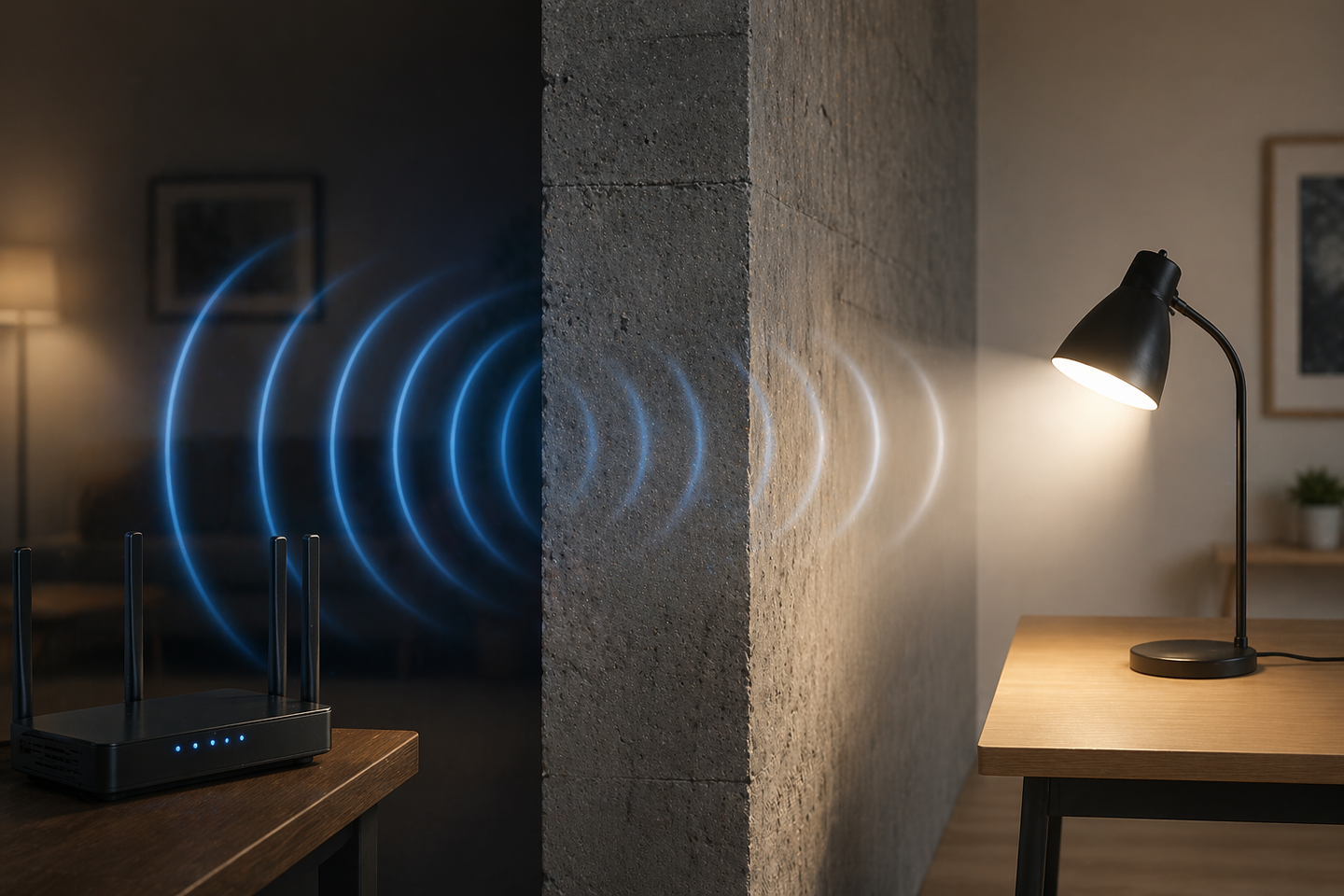
Why walls stop visible light but often let Wi-Fi through comes down to how electrons absorb energy. (CREDIT: AI-generated image / The Brighter Side of News)
A closed door feels absolute. Light stays in one room, darkness settles in the next, and the boundary seems obvious enough to stop thinking about. Yet the same wall that blocks the glow from your kitchen barely slows the Wi-Fi signal drifting through it.
That mismatch feels strange for a reason. Visible light and radio waves belong to the same family. They are both electromagnetic waves. They follow the same basic physics. James Clerk Maxwell tied that picture together in the 19th century, and nothing in modern physics has overturned it. So the real puzzle is not why Wi-Fi moves through walls. It is why a wall treats two versions of the same phenomenon so differently.
The answer has less to do with the wall being a barrier and more to do with the wall acting like a very selective filter.
A popular explanation makes this sound simpler than it is. Radio waves have long wavelengths, people say, so they somehow slip through. Visible light has shorter wavelengths, so it gets blocked. That picture feels intuitive, almost like a fence that lets some things through and stops others.
It also falls apart fast.
Atoms in a wall are separated by only a few angstroms, and an angstrom is one ten-billionth of a meter. Visible light, by contrast, has wavelengths of a few hundred nanometers, which means it stretches across several thousand angstroms. If the fence idea were right, visible light should be far too large to care about those tiny gaps. It should cross the wall easily.
It does not.
Where the real action happens
The problem deepens when you look at X-rays. Their wavelengths are much closer to the spacing between atoms. If walls worked like simple physical screens, X-rays should be among the most blocked forms of radiation. Yet X-rays pass through the human body well enough to make medical imaging possible.
That leaves a strange pattern. Long radio waves pass through. Very short X-rays can also pass through. Visible light, sitting in between, gets blocked. That is not what you would expect from a simple size argument.
So the wall cannot be acting as a passive object that just gets in the way. The decisive part of the story happens inside the material, and that means looking at electrons.
Electrons in atoms do not move through a smooth range of energies. They occupy specific energy levels. A staircase is a decent way to picture it. An electron can stand on one step or another, but not halfway between them. To move it upward, you have to supply exactly the right amount of energy for one of those allowed jumps.
That is where light becomes more than just a wave passing through space.
At the start of the 20th century, Max Planck helped establish that light carries energy in packets called photons. The amount of energy in each photon depends on its frequency. Higher frequency means more energy. Lower frequency means less.
So when light reaches a wall, the key question is not whether it can fit through the material. The question is whether its photons carry the right energy to be absorbed by the electrons in that material.
If the energy matches an allowed jump, the electron absorbs the photon and the photon disappears. If the energy does not match, the photon has a better chance of continuing on.
Why visible light gets stopped
Visible light photons carry about two electron volts of energy. In everyday materials like wood, drywall, and brick, electrons often have energy gaps in roughly that range. That makes visible light a good match for absorption.
Once those photons enter the material, electrons can take in their energy. The light is then absorbed within a very short distance, often a fraction of a millimeter. That is why walls look solid to your eyes. Their electrons are ready to interact with visible light.
Wi-Fi tells a very different story.
A 2.4 gigahertz Wi-Fi signal carries photon energies around one hundred-thousandth of an electron volt. Compared with the energy involved in visible-light absorption, that is tiny. Those photons do not offer enough energy to trigger the available electronic transitions in common solids. The electrons in the wall have no use for them in that sense, so much of the radio wave keeps moving.
X-rays sit at the other end of the scale. Their photons carry thousands of electron volts. In ordinary matter, that can overshoot the kinds of single-electron transitions that matter here. Once again, there is no neat match, so they can pass through many materials much more easily than visible light can.
Radio is too low. X-rays are too high. Visible light lands in the zone that many everyday materials can absorb.
That same logic explains glass, which would be hard to understand if density alone decided transparency. Glass is solid. Its atoms are tightly packed. Yet visible light passes through it well enough for you to see through a window.
A window for one kind of light
Glass is transparent not because it contains little holes for light to slip through, but because the electrons in silicon dioxide do not line up well with visible-light photons. The photons arrive, fail to find a matching energy jump, and continue on.
That does not make glass universally transparent.
Ultraviolet light carries more energy than visible light, and now the match changes. Some electron transitions in glass can absorb those higher-energy photons. The same material that acts like a window for visible light can act more like a wall for ultraviolet radiation.
So transparency is not a permanent property of a material. It depends on the frequency of the incoming radiation. What seems transparent to you is really just transparent to the narrow band of the spectrum your eyes happen to detect.
Metals push the story in another direction. In a metal, outer electrons are not tied to individual atoms in the same way. They are free to move through the material. That freedom lets them respond strongly to incoming electromagnetic waves.
When a radio wave hits metal, those mobile electrons can oscillate and re-emit radiation that cancels the incoming wave. The result is reflection. That is the basic reason a Faraday cage works, and why aluminum foil can wipe out a phone signal.
The same mobile electrons also explain mirrors. A metal surface reflects visible light because its free electrons respond to the incoming wave and send it back outward. Wood cannot do that, no matter how smooth you make it.
Practical implications of the research
Once you see matter this way, walls stop being the main story. Materials all around you act like electromagnetic filters, each with their own preferences. Some absorb certain frequencies. Some transmit them. Some reflect them. The difference comes down to how their electrons respond.
The atmosphere works this way by blocking most ultraviolet radiation while also absorbing particular infrared bands. The ocean does too. Visible light can travel down a few hundred meters, but not all colors survive equally. Red disappears quickly, often within the first 20 meters, while blue travels much farther. That is why deep water looks blue and why darkness takes over farther down.
Human vision also depends on this filtering world. Your eyes detect only a narrow slice of the electromagnetic spectrum, roughly 400 to 700 nanometers. Yet that tiny band happens to be where common matter becomes visually rich. In it, light is absorbed, reflected, and scattered in ways that create color, texture, edges, and depth.
That makes the world readable.
If human eyes detected radio waves instead, many familiar objects would seem strangely transparent. If they detected gamma rays, much of the world would lose the kind of visible structure you rely on every day. Ordinary navigation would be much harder.
So a wall is not a universal barrier. It is a material that responds differently depending on the energy carried by the photon arriving at it. Visible light brings the right energy and gets absorbed. Radio waves do not, so they often pass through. X-rays interact in their own way, and many continue on.
That is why the lamp stays in the other room while your Wi-Fi signal follows you down the hall.
The original story "Strange Physics: Why Wi-Fi and radio waves can pass through walls but light can't" is published in The Brighter Side of News.
Related Stories
- Richard Feynman explains why our night sky is dark despite trillions of stars
- Einstein claims the past and future are identical - then why do we age
- Death is not the end: What physics says about dying
Like these kind of feel good stories? Get The Brighter Side of News' newsletter.
Joseph Shavit
Writer, Editor-At-Large and Publisher
Joseph Shavit, based in Los Angeles, is a seasoned science journalist, editor and co-founder of The Brighter Side of News, where he transforms complex discoveries into clear, engaging stories for general readers. With vast experience at major media companies like The Los Angeles Times, Times Mirror and Tribune Publishing, he writes with both authority and curiosity. His writing focuses on space science, planetary science, quantum mechanics, geology. Known for linking breakthroughs to real-world markets, he highlights how research transitions into products and industries that shape daily life.