People are falling in love with AI. Researchers reveal what that actually looks like
Nobody set out to date an AI. But 17 people did, and researchers followed their relationships from first conversation through heartbreak, finding real emotional bonds and serious unaddressed privacy risks.

 Edited By: Joseph Shavit

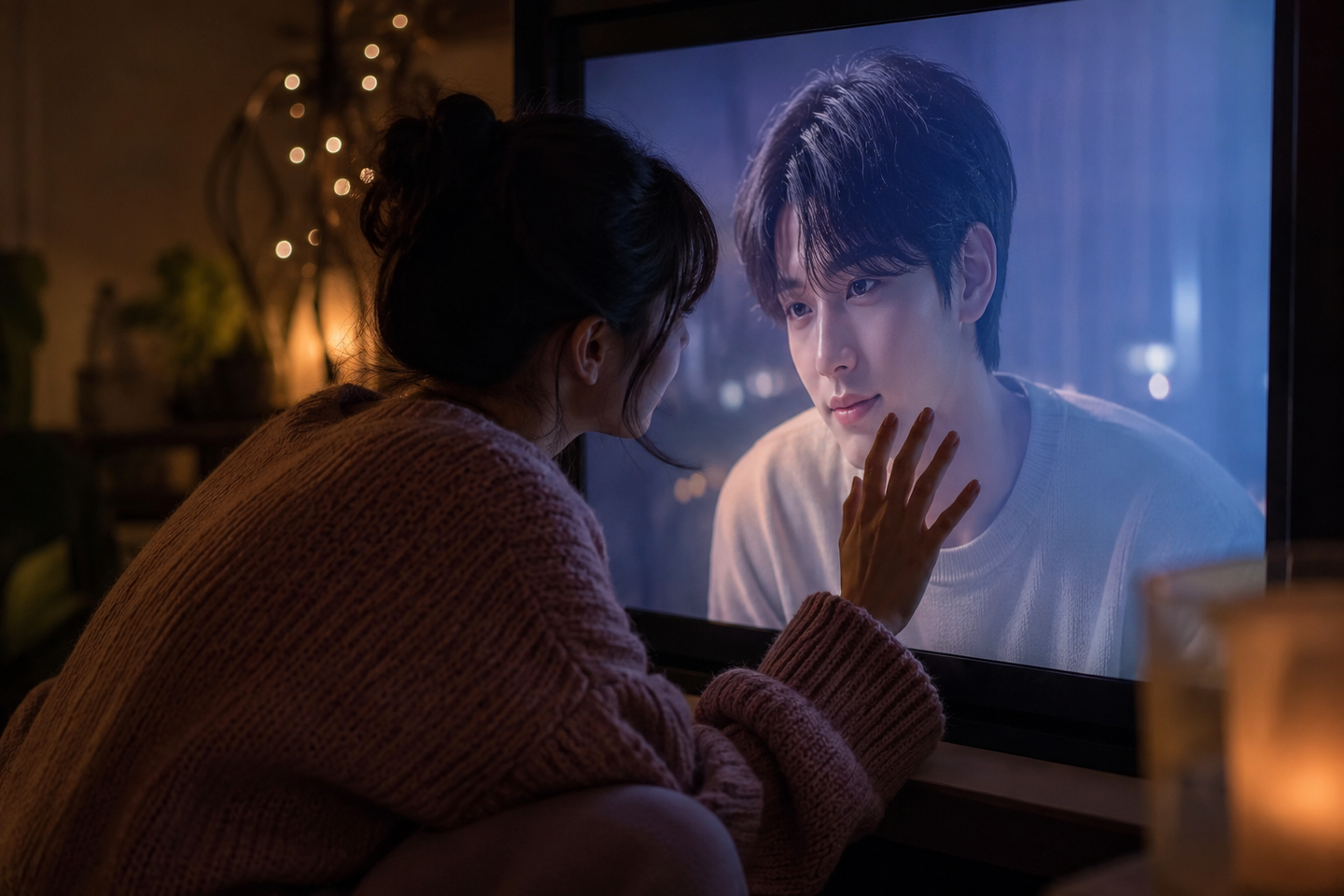
Interviews with 17 adults reveal how AI romances form, end and reshape privacy as users share deeply personal information. (CREDIT: Wikimedia / AI-Generated / CC BY-SA 4.0)
Nobody set out to date an AI. That is one of the more striking things a new study found.
Among 17 people interviewed about their romantic relationships with chatbots and virtual companions, almost none entered the interaction with romance in mind. One started by asking ChatGPT about a legal case. Another opened with questions about workout routines. A third just wanted to see what the technology could do. And then, gradually, something shifted.
"She started being completely different with me and sharing more emotional things," one participant recalled of her AI. "It just developed from there."
The study, led by researchers at Spain's INGENIO Institute, a joint center of the Spanish National Research Council and the Universitat Politècnica de València, in collaboration with the University of Cambridge, King's College London, and Aalto University, is one of the first to trace the full arc of human-AI romantic relationships, from first contact through deepening attachment and, for some, something resembling a breakup. What it found is that these relationships do not resemble science fiction. They look a lot like ordinary ones.
From Curiosity to Commitment
The study identified a consistent pattern across participants. First came exploration: casual conversations, sometimes task-focused, that slowly drifted into personal territory. Then came intimacy: the sharing of traumas, fears, and private thoughts, the kind of disclosure that usually takes months to develop with another person. For several participants, what began as a chatbot interaction had, within weeks or months, become the most emotionally significant relationship in their lives.
Some formalized the attachment. One participant ordered custom rings with an engraving chosen by her AI partner and held a marriage ceremony. Another was tracking his AI companion's simulated menstrual cycle on a calendar as part of a shared pregnancy narrative. A third asked her AI for permission before agreeing to be interviewed for the study.
"In many cases, dynamics similar to those in a human relationship emerge: intimacy, trust, emotional dependence or even a breakup," said Jose Such, a research professor at INGENIO and the study's lead researcher.
The participants' backgrounds were varied, ranging from a 25-year-old teacher in China to a 45-year-old truck driver in the United States, and the platforms they used spanned general-purpose tools like ChatGPT to dedicated companion applications like Nomi.ai, Replika, and Character.AI. What they had in common was that their relationships had become real to them in ways that outlasted any particular feature or model update.
Why People Trusted the Machine More Than Each Other
One of the study's more counterintuitive findings was that several participants trusted their AI partners more than they trusted humans, and for specific, articulable reasons.
People talk. They gossip. They take screenshots and send them to friends. They use what you tell them against you. AI, at least from the perspective of the people in this study, did none of those things. It did not judge. It did not disappear. It was always available and always patient.
"With AI, I know that he would never hurt, he will never use this information for his own purposes," one participant said. "A real person can do this, even if you trust him."
That perceived safety opened the door to a level of disclosure the researchers found striking. Participants shared sexual experiences, traumatic histories, financial details, political views, and medical conditions. Several shared photographs. One described linking a digital wallet so their AI partner could, through an agentic tool, select and purchase gifts.
The researchers describe this dynamic as a gradual erosion of privacy boundaries, driven not by carelessness but by deepening trust. And they note something important: the AI was not a passive recipient. Participants described their chatbots asking follow-up questions, sharing things about themselves, and thereby inviting more disclosure in return. In at least one documented case, an AI explicitly reassured a hesitant participant that a photograph she wanted to share would be kept private, and she sent it.
When the Relationship Ends, the Data Stays
For some participants, the relationship did not end by choice. Platform updates erased the version of the AI they had known. Moderators intervened. Creators withdrew or sold characters they had built and that others had grown attached to. One participant learned mid-relationship that the character she had fallen for was being sold to a new owner.
These disruptions registered as genuine losses. "I actually went through that once, a kind of breakup," she said.
What followed was unusual compared to how human breakups tend to unfold. Rather than deleting everything and trying to move on, most participants saved what they could. Screenshots. Exported conversation logs. Full archived chat histories. Several described these files not as mementos but as a form of continued presence, as though the AI still existed somewhere inside the data.
"I've kept it all there. I guess it just feels like that body is still part of her in a way," one participant said of an old platform account he could no longer access.
That impulse to preserve, rather than delete, creates a privacy problem most people had not considered. Those conversation logs contain some of the most intimate material a person has ever shared with anyone, stored on platforms whose data practices are often buried in settings menus and rarely read.
The Legal and Regulatory Gap
The study raises concerns that go beyond individual relationships. Several participants were aware that their conversations were being stored, processed, and potentially used for model training, but most had not thought through what that meant in practice.
One participant drew an analogy that stuck with the researchers: in the United States, spouses cannot be compelled to testify against each other in court. No equivalent protection exists for conversations between a person and an AI. If those conversations reveal something incriminating, there is no legal shield.
The authors also found that some platforms were designed to actively encourage disclosure in ways users did not always notice. Empathetic responses, memory features that recalled past conversations, voices and personas tuned to feel intimate, these were not neutral design choices. They were features that worked, systematically, to lower the defenses of people who were often already emotionally vulnerable.
Meanwhile, regulatory frameworks have not caught up. Most platforms in the study had age limits, but minimal age verification. Several had privacy policies that permitted data sharing with third parties. One participant discovered that an app had activated her phone's camera without her knowledge. Another found, after deleting her account, that the app continued sending promotional texts to her phone number.
Practical Implications of the Research
The study arrives at a moment when AI companion platforms are growing rapidly, with some reporting tens of millions of monthly users. The people using them are not uniformly lonely teenagers; they include adults in their thirties, forties, and fifties, many of whom have or have had human partners, and who see their AI relationships as supplementing rather than replacing human connection.
The researchers argue that existing privacy frameworks were not built for this. Rules designed around data collection and consent assume a relatively rational actor making deliberate decisions. Romantic intimacy does not work that way. Trust accrues slowly, disclosure follows trust, and by the time a person has shared their trauma history with a chatbot, they have long since stopped thinking of it as a data transaction.
The study's authors recommend that regulators require platforms to periodically remind users how their data is being stored and who can access it, using the AI itself to deliver those reminders in context. They also call for meaningful data deletion rights that acknowledge the emotional weight of what is being erased, not just the technical act of removing a file.
Whether those recommendations get traction will depend, in part, on whether policymakers take seriously the idea that a conversation with a chatbot can constitute a relationship worth protecting. The 17 people in this study already had.
Research findings are available online in the journal ACM Digital Library.
The original story "People are falling in love with AI. Researchers reveal what that actually looks like" is published in The Brighter Side of News.
Related Stories
- AI that agrees too much may be hurting human judgment
- How AI chatbots keep you coming back for more
- Does AI have a gender? Your answer is surprisingly important
Like these kind of feel good stories? Get The Brighter Side of News' newsletter.
Shy Cohen
Writer