Astronomers are finding space junk too small to track, and it’s getting dangerous
Five-centimeter fragments of space junk, tumbling silently 36,000 kilometers up in an orbit that never clears itself.
 Edited By: Joshua Shavit

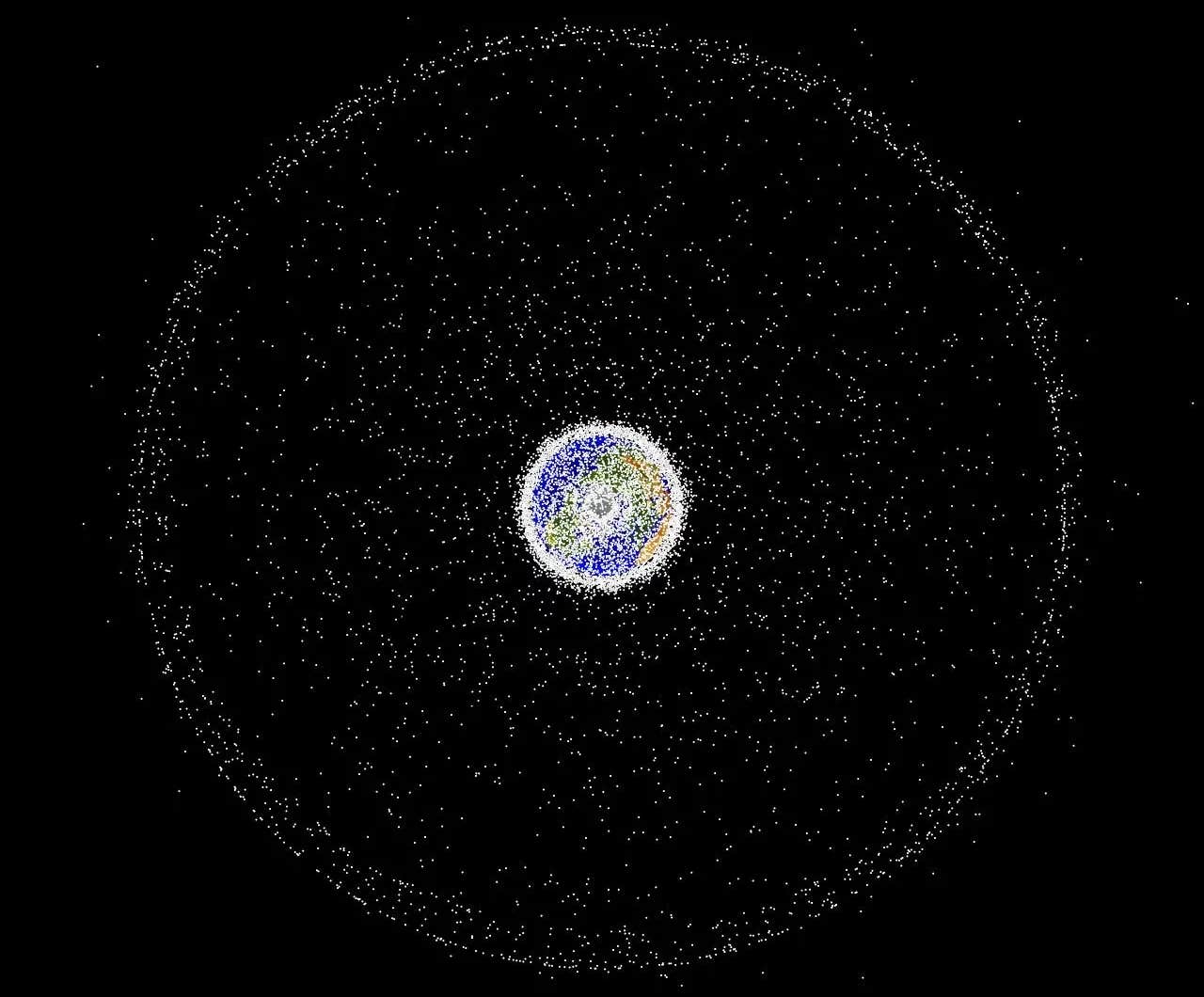
The GEO Polar images are generated from a vantage point above the north pole, showing the concentrations of satellites in LEO and in the ring-like geosynchronous region. (CREDIT: NASA/ODPO)
The satellites that run your weather forecasts, your television, and a significant portion of global communications all occupy a narrow band of space 36,000 kilometers above the equator. They share that neighborhood with debris. Some of it is the size of a bus. Some of it, as a new study reveals, is the size of a hand.
Researchers led by the University of Warwick have used a novel image processing technique to detect some of the faintest fragments ever observed in geosynchronous orbit, finding pieces as small as 5 centimeters across in a region so distant that the debris will stay there, undisturbed, essentially forever.
Nearly 80 percent of the faint objects they found did not appear in any publicly available catalogue.
The Orbit That Never Clears Itself
Geosynchronous orbit is unusual. A satellite placed there moves at exactly the right speed to keep pace with Earth's rotation, which is why weather satellites seem to hover in one spot and why a single satellite can beam signals to an entire continent. That fixed geometry makes the geostationary belt some of the most commercially and strategically valuable real estate in the solar system.
It is also a place where junk accumulates and never leaves. Low Earth orbit has a natural cleaning mechanism: atmospheric drag gradually pulls debris downward until it burns up on reentry. Geosynchronous orbit sits far above the atmosphere. Anything placed there, whether an operational satellite, an abandoned rocket stage, or a fragment from a collision, will remain in orbit indefinitely, circling the Earth for millions of years.
"The debris in geosynchronous orbit is a potential minefield," said Dr. Stuart Eves of SJE Space Ltd., a co-author of the study. "No-one in their right mind would enter a terrestrial minefield without a mine detector. Similarly, no-one in their right mind should launch a satellite to GEO without an adequate debris survey."
The problem is that detecting small debris at that altitude is extraordinarily difficult. The distance involved means that a 5-centimeter fragment reflects almost no light. Standard observation methods, even with large telescopes, struggle to find anything that faint.
A Technique Borrowed From Astronomy
The breakthrough came from applying a method called blind stacking to archival images originally collected in 2018 with the Isaac Newton Telescope in La Palma, Canary Islands. The telescope is 2.54 meters across, a serious instrument, but the original analysis of those images had missed a significant portion of the faintest targets.
Blind stacking works by testing large numbers of possible paths through a sequence of images, looking for signals that only become visible when frames are combined along the correct trajectory. A single image of a dim, fast-moving object might show nothing above the noise. Stack several images along the path that object was traveling, and a real signal begins to emerge.
"The blind stacking technique is a very powerful method for improving the sensitivity limit of astronomical datasets," said Dr. Ben Cooke, a Research Fellow at Warwick. "It involves testing many potential paths in an image sequence along which hidden targets might be moving and stacking the images to help bring those targets above the noise floor."
Applying the updated technique to data that had already been analyzed, the team uncovered 25 additional detections that the original processing had missed. None of them appeared in public debris catalogues.
The researchers also extracted high-cadence light curves from the trailing images that moving objects leave as they cross the telescope's field of view. Those brightness records revealed something telling: many of the faint objects were tumbling as they moved, their reflected light flickering in patterns consistent with uncontrolled rotation.
An Orbit Full of Unknowns
Lead author Dr. James Blake, a Research Fellow at Warwick's Centre for Space Domain Awareness, was direct about the stakes involved.
"Pieces of space junk can be moving very quickly relative to one another, as much as several kilometres every second," he said. "The energies involved are really high, and even small debris can cause a lot of damage to very expensive satellites, so small things really matter."
A 5-centimeter fragment traveling at several kilometers per second carries enough kinetic energy to punch through a satellite's outer structure and disable critical systems. Unlike collisions in low orbit, where the resulting debris might reenter the atmosphere within years or decades, a collision at geosynchronous altitude would produce a cloud of fragments that would remain in that orbit indefinitely, each one becoming its own potential hazard for future satellites.
The geostationary belt has a finite number of usable positions. Each orbital slot is defined by its longitude above the equator, and neighboring satellites must be spaced far enough apart that their signals do not interfere. There are only so many slots available, and demand for them, from communications companies, military operators, and weather agencies, continues to grow. Any significant debris event could render portions of the belt unusable for operational purposes for an extremely long time.
Going Global
The Warwick-led team did not stop at reanalyzing the old data. A follow-up observation campaign between 2022 and 2023 extended the survey to telescopes in Australia, at the Siding Spring Observatory, and Japan, at the Bisei Space Guard Center, in collaboration with the Australian National University and the Japan Aerospace Exploration Agency.
The geographic spread mattered. Telescopes in different locations can observe different portions of the geostationary belt. The original La Palma observations could not see the geopotential well above the Himalayas, where debris from old fragmentation events tends to collect. Instruments in Australia and Japan have a direct view of it.
"This really highlights the importance of multinational collaboration for solving global problems such as space domain awareness," said Prof. Will Feline of the UK's Defence Science and Technology Laboratory.
The team is now working to fully analyze the data from those follow-up campaigns, totaling more than 300 hours of observing time.
Practical Implications of the Research
The most immediate consequence is a clearer picture of how much untracked material occupies one of Earth's most important orbital regions. Cataloguing debris is the first step toward avoiding it, and the finding that nearly 80 percent of the faintest objects in this study were previously unknown suggests that existing surveys have been missing a substantial portion of the population.
That gap matters for satellite operators who must decide whether to perform evasive maneuvers based on conjunction warnings. If a large fraction of real debris is invisible to current tracking systems, collision risk calculations are systematically underestimated.
The blind stacking technique itself has broad applications. Any dataset involving moving objects can in principle benefit from it, and the team is now using telescopes across multiple continents to build coverage of orbital longitudes that single-observatory campaigns cannot reach.
The broader goal, as Dr. Blake put it, is straightforward: "There are a finite number of orbital slots in the GEO belt, so it's important that we know how much debris is out there, how it behaves, what risks are posed to the active satellites we rely on."
Right now, the answer is that there is more out there than the catalogues show, some of it spinning silently in an orbit it will never leave.
Research findings are available online in The Journal of the Astronautical Sciences.
The original story "Astronomers are finding space junk too small to track, and it's getting dangerous" is published in The Brighter Side of News.
Related Stories
- 1.7 million satellites and space mirrors may put the night sky at risk
- Researchers believe a satellite crash could happen in 5.5 days
- Six-satellite 'StormWall' could stop dangerous solar storms before they hit Earth
Like these kind of feel good stories? Get The Brighter Side of News' newsletter.
Joseph Shavit
Writer, Editor-At-Large and Publisher
Joseph Shavit, based in Los Angeles, is a seasoned science journalist, editor and co-founder of The Brighter Side of News, where he transforms complex discoveries into clear, engaging stories for general readers. With vast experience at major media companies like The Los Angeles Times, Times Mirror and Tribune Publishing, he writes with both authority and curiosity. His writing focuses on space science, planetary science, quantum mechanics, geology. Known for linking breakthroughs to real-world markets, he highlights how research transitions into products and industries that shape daily life.