Physicists discover the upper limit of electrical resistance in metals
Ultracold potassium atoms showed that stronger collisions stop raising resistivity past a point, offering a cleaner view of transport.
 Edited By: Joseph Shavit

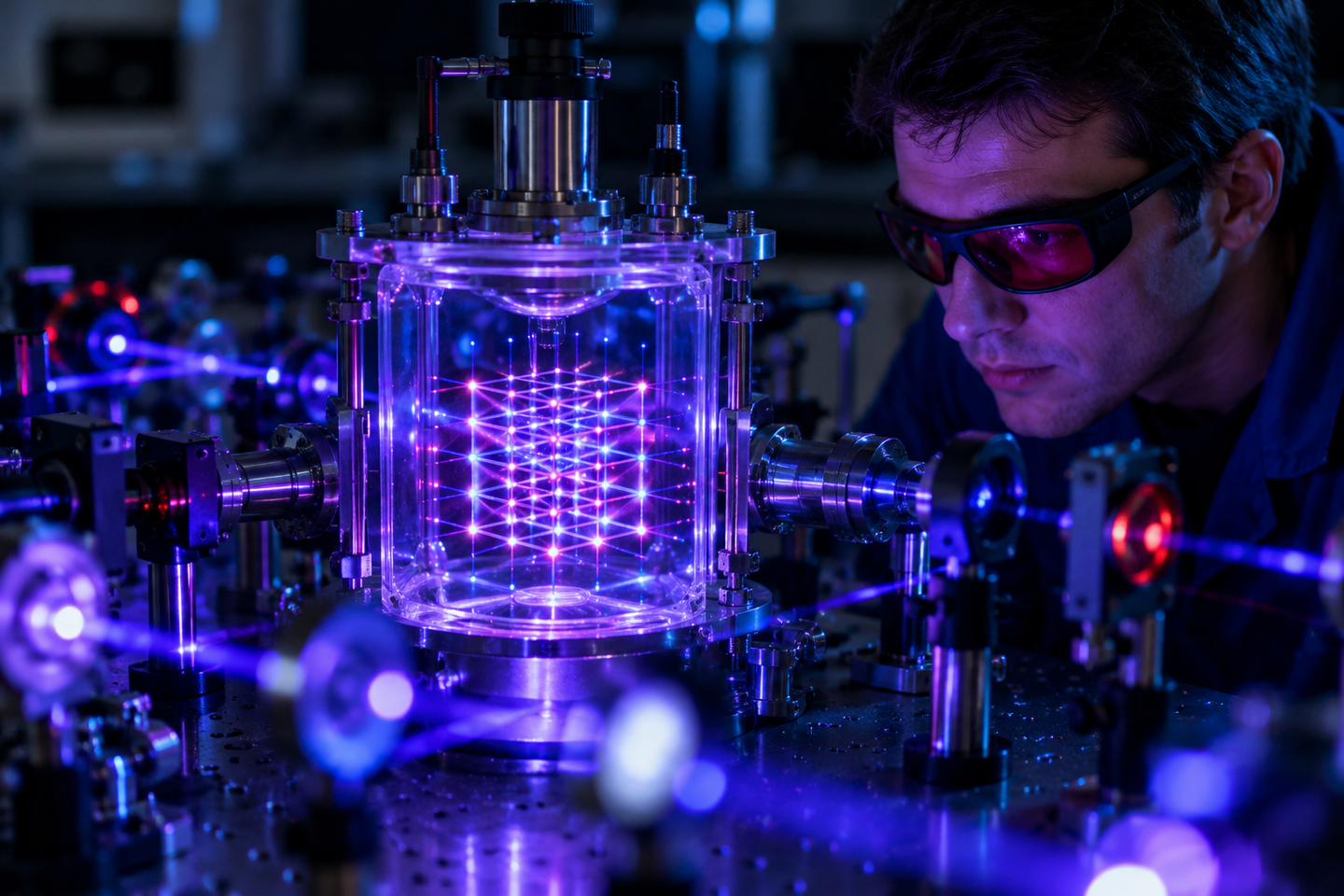
Ultracold potassium atoms reveal that collision-driven resistivity can saturate, clarifying a long-running puzzle in transport physics. (CREDIT: AI-generated image / The Brighter Side of News)
Electrical resistance is easy to notice and hard to pin down. Power lines shed energy as heat, and metals warm up when current passes through them. However, physicists still argue over exactly how those losses build from countless microscopic collisions. Now a group working with ultracold atoms has found that one source of resistance does not keep climbing without end.
Using potassium atoms cooled to nearly absolute zero, the team found that stronger and stronger collisions eventually stop adding more resistivity. The effect appeared in a carefully controlled optical lattice. This lattice is a grid of laser light that traps atoms and makes them behave like electrons moving through a solid.
The result gives researchers a rare clean look at a problem that is usually tangled up in real materials by vibrations, disorder and structural changes. It also offers a clearer microscopic picture of how resistivity arises in low-density metals. This is especially notable when particles interact strongly.
“Electron-on-electron collisions are known to increase resistivity in some pure materials,” said Professor Joseph Thywissen of the University of Toronto’s Department of Physics and Centre for Quantum Information and Quantum Control, senior author of the study published in Physical Review Letters. “The energy produced by electrical resistance shows up as heat. Transmission lines, for instance, lose up to eight per cent of generated electrical power. Resistivity is also interesting to study because it can be a signature of new physics in materials.”
A solid made of light
The experiment centered on fermionic potassium-40 atoms placed in a three-dimensional cubic lattice with a period of 0.53 micrometers. Instead of sending electricity through a metal, the researchers used atoms as stand-ins for electrons. Then they watched how their motion slowed when interactions were tuned upward.
That tuning came from a magnetic Feshbach resonance, which lets physicists adjust the strength of the short-range interaction between atoms. In ordinary solids, changing interactions so cleanly is impossible. In the lattice, it allowed the team to isolate atom-atom scattering as the main brake on transport.
The measurements were carried out in a low-filling regime, with the average occupation staying well below one atom per site. That choice mattered. It kept the system strongly interacting but only weakly correlated. This made it possible to compare the data directly with a nonperturbative solution of the two-body problem rather than relying only on broad many-body approximations.
To probe conductivity, the team applied a sinusoidal force by displacing the optical dipole trap. They then imaged the cloud in situ and tracked its center-of-mass motion. From that response, they extracted the real and imaginary parts of the conductivity and, from there, the complex resistivity.
When harder collisions stop mattering
At modest interaction strengths, the behavior followed the usual expectation: more interaction led to faster current dissipation and higher resistivity. But that trend broke down in the strongly interacting regime.
The conductivity spectra broadened sharply as the interaction strength rose from about U/t = 1 to U/t = 4, signaling a reduced current lifetime due to scattering. Yet pushing the interaction to about U/t = 6 produced almost no further broadening. A simple perturbative picture would have predicted a much larger rise, scaling with U squared. Instead, the increase flattened.
The same pattern appeared when the researchers examined the real part of the resistivity directly. Rather than continuing to grow with interaction strength, it leveled off. The team identified that flattening as the main result of the work: collisional resistivity saturation.
“We observed that the atoms, which are only a few nanometres in size, bump into each other as if they were much larger,” said Thywissen. “This quantum enhancement of the effective atom size makes collisions on a given lattice site much more likely, increasing the resistivity of the system.”
That quantum enhancement did not produce unlimited resistance. The key insight was that the scattering amplitude itself becomes bounded in the lattice. Even in the limit of very large on-site interaction U, the transition matrix that sets the scattering strength cannot grow without limit. In the strong-collision regime, the system crosses over from interaction-limited dissipation to tunneling-limited dissipation.
A bounded kind of disorder
The paper frames this upper limit as “lattice unitarity.” In free space, the unitarity of the scattering matrix prevents the cross section from diverging when the scattering length becomes infinite. In the lattice, a similar bound exists. However, it depends on momentum and energy in a more complicated way.
That distinction matters. The authors found that even at infinite U, a thermal ensemble cannot fully reach the upper bound on the scattering cross section because the transition matrix depends on momentum. At the highest interaction strengths in the experiment, the inferred dissipation rate reached only about one third of the lattice-unitary bound.
The researchers built a dissipation model based on kinetic theory and the full two-body transition matrix, then compared it with the measurements. The agreement was strong and did not rely on free parameters in the transport calculation. That is unusual for resistivity work, where experiments often outpace first-principles explanations.
The model also helped separate the role of current dissipation from changes in static susceptibility or effective mass. The saturation, the team argues, is dynamical. It comes from the scattering rate itself, not from a trivial saturation of another quantity hiding inside the transport signal.
Temperature added another layer. At fixed strong interaction, resistivity rose steadily with temperature across the accessible range, by roughly a factor of ten. The analysis showed that in this regime resistivity is dominated by umklapp events. These scattering processes transfer momentum from the moving particles to the lattice.
“Our results provide a clear microscopic understanding of how resistivity works in low-density metals and open the door to new studies of strongly correlated atomic systems and quantum materials,” said Thywissen.
Practical implications of the research
This work does not promise a new wire or a near-term device. Its value is more basic, and in some ways more durable. By showing that collision-driven resistivity can saturate, the study sharpens one of the central questions in condensed-matter physics. In particular: what really sets the limit on how much interactions alone can impede transport?
Because the optical lattice strips away phonons, structural changes and disorder, it gives physicists a cleaner reference point for thinking about resistivity in metals. The findings also suggest that in low-density, strongly interacting systems, rising collision strength does not automatically mean ever-rising resistance.
That could help researchers interpret puzzling transport measurements in quantum materials, especially where strong interactions are present but conventional explanations fall short. It also establishes ultracold atoms as a more precise test bed for transport theory. This includes questions about hydrodynamics, dilute Fermi liquids and the boundary between weakly and strongly correlated behavior.
Research findings are available online in the journal Physical Review Letters.
The original story "Physicists discover the upper limit of electrical resistance in metals" is published in The Brighter Side of News.
Related Stories
- Physicists build a quantum Newton’s cradle where energy flows without resistance
- Scientists develop space-age metal that doesn't expand when heated
- Scientists discover atomic shield that keeps gold from tarnishing
Like these kind of feel good stories? Get The Brighter Side of News' newsletter.
Joseph Shavit
Writer, Editor-At-Large and Publisher
Joseph Shavit, based in Los Angeles, is a seasoned science journalist, editor and co-founder of The Brighter Side of News, where he transforms complex discoveries into clear, engaging stories for general readers. With vast experience at major media companies like The Los Angeles Times, Times Mirror and Tribune Publishing, he writes with both authority and curiosity. His writing focuses on space science, planetary science, quantum mechanics, geology. Known for linking breakthroughs to real-world markets, he highlights how research transitions into products and industries that shape daily life.