Snake blood proteins could lead to a more powerful antivenom treatment
Carefully chosen snake proteins blocked lethal viper venom, pointing toward a recombinant alternative to antibody antivenoms.
 UMD Writer: Jennifer Holland

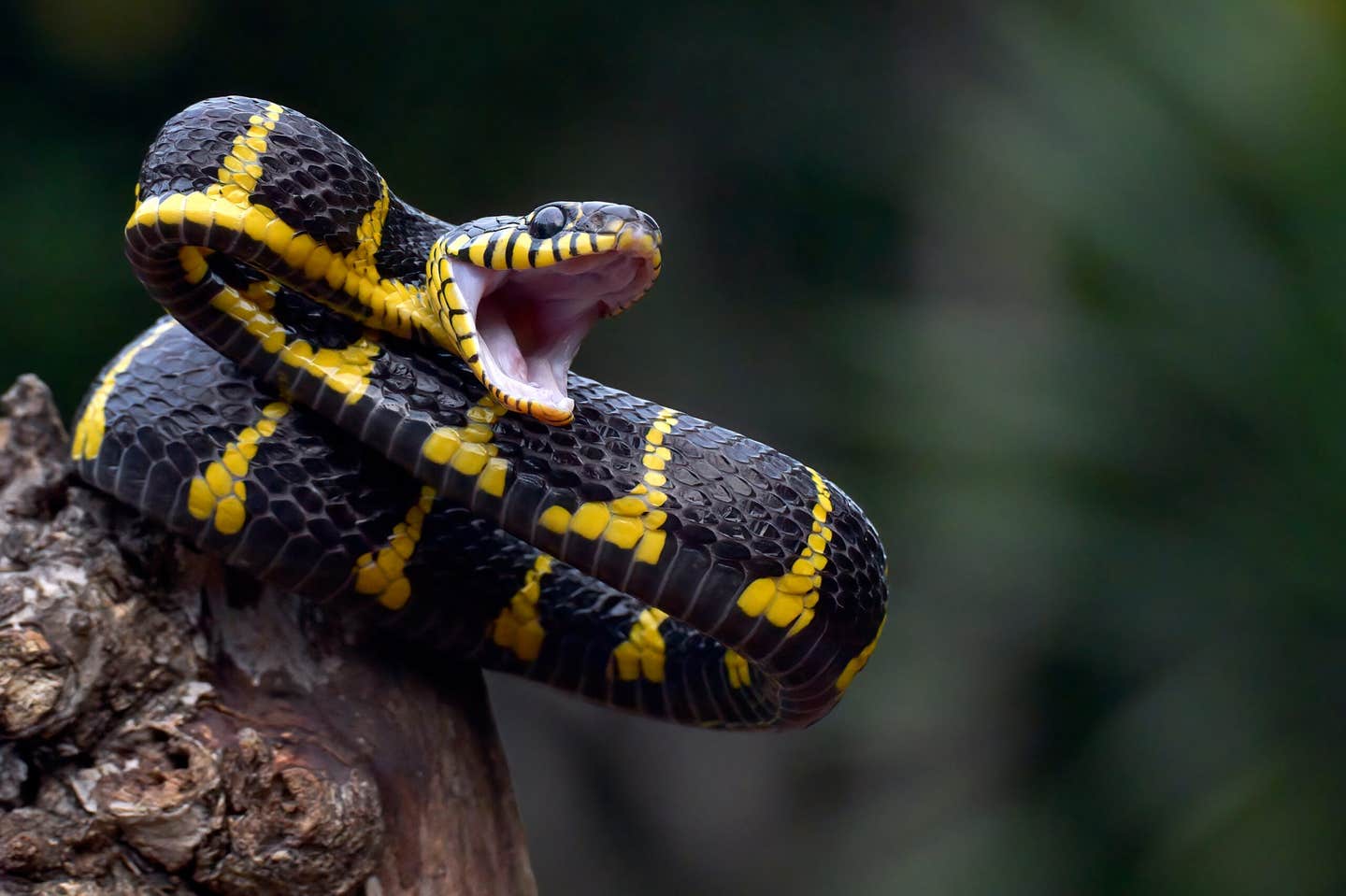
Carefully chosen snake proteins blocked lethal viper venom, pointing toward a recombinant alternative to antibody antivenoms. (CREDIT: Shutterstock)
- Western diamondback rattlesnake blood contains FETUA proteins that can neutralize different venom toxins when combined in precise mixtures.
- Optimized protein combinations completely protected laboratory mice from several viper venoms and were up to 10 times more potent by weight than commercial CroFab antivenom.
- The findings could support safer, cheaper recombinant antivenoms, but researchers must still prove the treatment works after a bite and against additional toxin families.
For more than a century, scientists knew that vipers often survive exposure to their own venom.
What protected them remained unclear.
The answer now appears to involve several proteins circulating in snake blood. When combined in the right proportions, those proteins can block damaging venom components with striking power.
Carroll is a Distinguished University Professor of Biology at the University of Maryland.
University of Maryland researchers tested blood proteins from western diamondback rattlesnakes against venoms from several viper species. Optimized mixtures completely neutralized lethal rattlesnake venom in laboratory animals.
By weight, one combination was about 10 times more potent than a commercial sheep-derived rattlesnake antivenom.
“This is one of those great stories when nature has already solved a problem we’ve been grappling with for decades,” said Sean B. Carroll.
A Treatment Built Around Antibodies
Venomous snakebites kill an estimated 80,000 to 140,000 people each year, according to the World Health Organization.
Hundreds of thousands more survive with permanent disabilities.
Many victims live in rural areas where effective antivenom can be difficult to obtain. Snakebite remains one of the world’s most neglected tropical diseases.
Current antivenoms begin with large animals, often horses or sheep. Manufacturers inject those animals with snake venom. The animals produce antibodies, which are later collected and processed into treatment.
These products save lives, but they carry important weaknesses.
They can be costly to manufacture. Their effectiveness varies across toxins and snake species, and they can cause severe immune reactions.
Venoms also differ greatly. A single venom may contain about 100 toxin proteins from several protein families. No two snake species produce exactly the same mixture.
That variation makes a broadly effective treatment difficult to design.
Carroll’s team turned away from antibody production and looked directly at the snakes.
The Protein Behind an Old Observation
“We’ve known from anecdotes for 100 years that vipers tend to be resistant to their own venom,” Carroll said.
“But for a long time, nobody knew what exactly was circulating in their blood that protected them.”
His laboratory identified part of the answer in 2022.
The team found a protein called FETUA-3 in western diamondback rattlesnake blood. It blocked many metalloproteinases in the snake’s venom. Metalloproteinases form a major toxin family in viper venoms. They can contribute to bleeding, tissue damage, and problems with blood clotting.
FETUA-3 also bound to toxins from several other rattlesnakes.
“Here was evolution’s way for snakes to protect themselves from accidental self-envenomation,” Carroll said.
That finding raised a practical question.
“Why rely on horse antibodies when nature has packaged an effective antidote right there in the snake?”
The new study widened the search beyond one protein.
No Single Protein Could Do Everything
The researchers examined five related FETUA proteins from the western diamondback rattlesnake, Crotalus atrox. Each behaved differently.
FETUA-3 blocked certain enzyme activity in laboratory tests. Yet it did not prevent bleeding or death by itself.
FETUA-2 completely stopped venom-induced hemorrhaging in mice. FETUA-5 reduced bleeding, though it did not eliminate it.
FETUA-1 and FETUA-4 offered no protection under the tested conditions. They increased hemorrhagic activity instead.
Those uneven results pointed toward a broader lesson. One inhibitor could block one part of a venom while leaving another dangerous component active.
FETUA-2 alone provided only partial protection against lethal western diamondback venom. Adding FETUA-5 offered little improvement.
A mixture of FETUA-2 and FETUA-3 changed the outcome.
That pairing completely protected mice from lethal venom exposure. The animals survived without obvious signs of poisoning. The proteins appeared to complement each other by targeting different toxins.
“The ingredients are there,” Carroll said. “We just have to keep testing various mixtures.”
A Different Recipe for Another Rattlesnake
The eastern diamondback required another combination.
FETUA-2 and FETUA-5 each reduced hemorrhaging from its venom. Neither stopped the bleeding completely on its own.
Together, they prevented hemorrhage. That still did not guarantee survival.
Complete protection required three proteins: FETUA-2, FETUA-3, and FETUA-5.
Two-protein mixtures failed to neutralize the full venom. The three-part treatment protected the experimental animals from lethal exposure.
Its effective dose measured 5.6, plus or minus 1.9, milligrams per kilogram.
By weight, the mixture was about three times more potent than whole rattlesnake serum. It was about 10 times more potent than CroFab, a commercial antivenom. On a per-molecule basis, it was roughly seven times more potent than CroFab.
Those comparisons concern laboratory potency. They do not yet establish how the proteins would perform in human patients.
Protection Across Millions of Years
The researchers then tested venoms from more distant relatives.
FETUA combinations blocked metalloproteinases from several North American and Asian pit vipers. Some of those Asian snakes split from rattlesnakes about 34 million years ago.
The three-protein mixture completely protected mice from lethal Malayan pit viper venom. It also improved survival after exposure to Chinese moccasin venom.
The team next studied true vipers, which separated from the rattlesnake branch more than 40 million years ago.
Genetic analysis found related FETUA proteins in those snakes.
“The fact that parts of these inhibitors have been perfectly conserved over 50 million years of snake evolution tells you just how real a risk this is for these animals,” Carroll said.
Exactly how snakes poison themselves remains uncertain. Possible routes include injuries inside the mouth, eating envenomated prey, cannibalism, or some combination of those events.
Against true viper venoms, the protein mixtures blocked many metalloproteinase activities.
They significantly protected mice from Echis carinatus sochureki venom.
They did not prevent death from Bitis arietans venom. The researchers suggest that toxins outside the metalloproteinase family may play a larger role in that species.
The Limits of the Current Experiments
The study focused on one major toxin family.
Viper venoms contain other dangerous proteins, so blocking metalloproteinases alone may not neutralize every bite. The experiments also mixed the inhibitors with venom before administering them.
A real patient receives treatment after a bite. Future studies must determine whether FETUA proteins can stop damage after envenomation has already begun.
Scientists must also identify effective mixtures for different regions and snake species. Safety, movement through the body, and long-term effects require careful study.
The proteins may eventually need to work alongside inhibitors aimed at other toxin families.
“We’re getting remarkably close to having effective solutions for the three major toxin families in vipers,” Carroll said.
“What we’ve learned here, together with research we’re doing now, gives us real confidence that nature-based recombinant [lab-produced] antivenoms are within reach.”
From Snake Blood to Manufactured Medicine
Future treatments would not require collecting large quantities of snake blood.
Scientists could produce recombinant versions of the protective proteins in laboratories. Such manufacturing might offer more consistent mixtures than traditional animal-derived antivenoms.
Carroll expects veterinary products could arrive before treatments for people.
Human medicines face a longer path of safety testing and clinical evaluation.
He believes later antivenoms could offer broader protection while becoming safer, cheaper, and easier to produce at large scale.
“We could make train cars-worth of this stuff and help solve a massive global health problem,” Carroll said.
“Many of our most important medicines have come from nature. I’m delighted that the components for a better-than-commercial antivenom were in these snakes all along.”
Practical Implications of the Research
The study offers antivenom developers a new set of biological building blocks.
Instead of producing broad antibody mixtures in large animals, manufacturers could combine selected recombinant proteins against known toxin families.
Regional formulas could match the snakes responsible for local bites.
A modular approach may also let scientists replace or add inhibitors as venom knowledge improves. Before that happens, researchers must prove the treatment works after a bite, not only when mixed with venom beforehand.
They must also address toxins that FETUA proteins do not block.
The larger shift is conceptual.
Snakes have spent millions of years evolving defenses against their own chemical weapons. Medicine may now be able to borrow that solution.
Research findings are available online in the journal PNAS.
The original story "Snake blood proteins could lead to a more powerful antivenom treatment" is published in The Brighter Side of News.
Related Stories
- At 23ft and 8 inches, 'The Baroness' is the world’s longest wild snake
- Scientists discover colossal 50-foot long snake from 47 million years ago
- Man injected by 856 snake bites helps create universal antivenom
Like these kind of feel good stories? Get The Brighter Side of News' newsletter.
Rebecca Shavit
Writer
Based in Los Angeles, Rebecca Shavit is a dedicated science and technology journalist who writes for The Brighter Side of News, an online publication committed to highlighting positive and transformative stories from around the world. Having published articles on MSN, AOL News, and Yahoo News, Rebecca's reporting spans a wide range of topics, from cutting-edge medical breakthroughs to historical discoveries and innovations. With a keen ability to translate complex concepts into engaging and accessible stories, she makes science and innovation relatable to a broad audience.