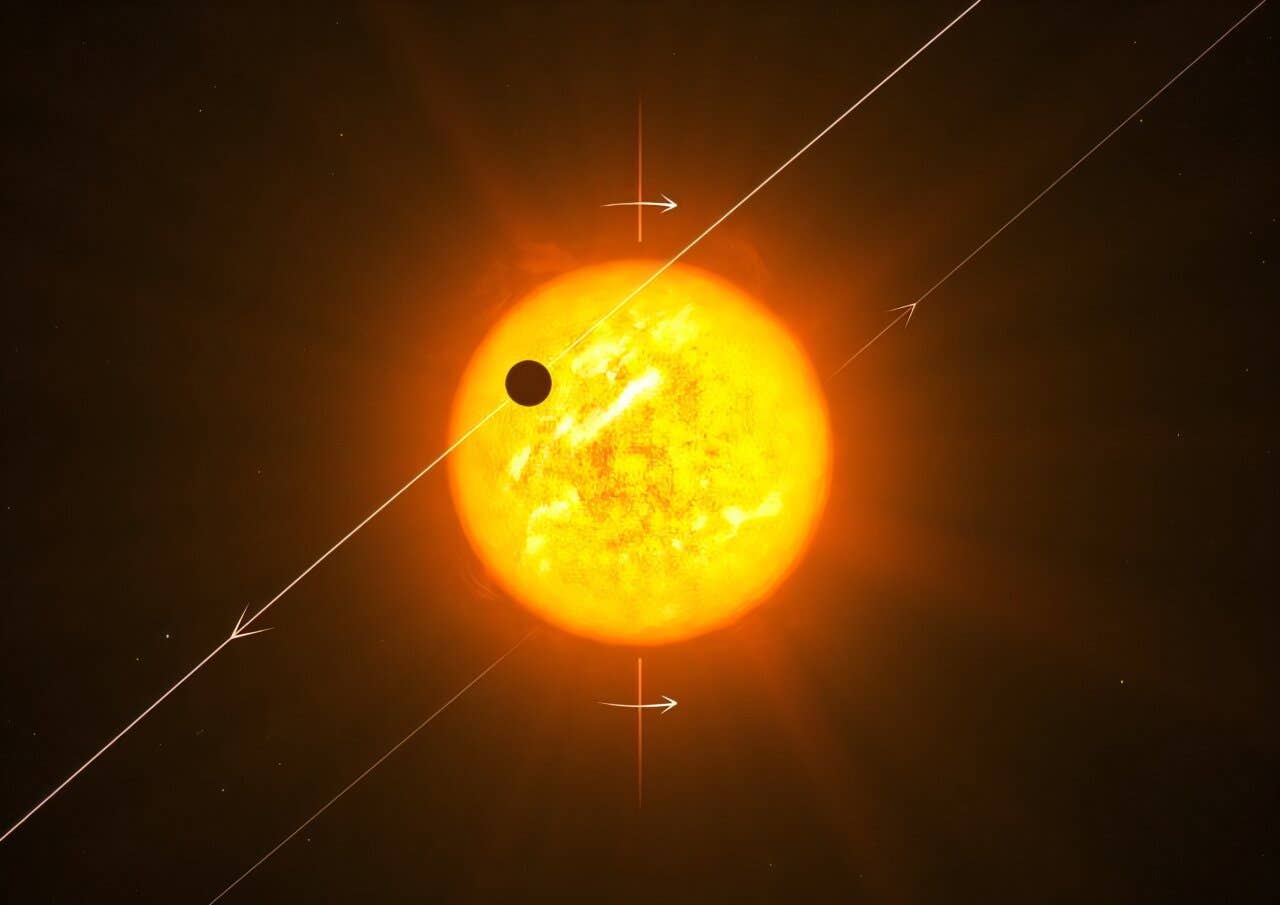
Physicists rewrite Einstein’s equations to define spacetime evolution
Physicists found that some gravitational structures may stay connected as spacetime changes.

 Edited By: Joshua Shavit

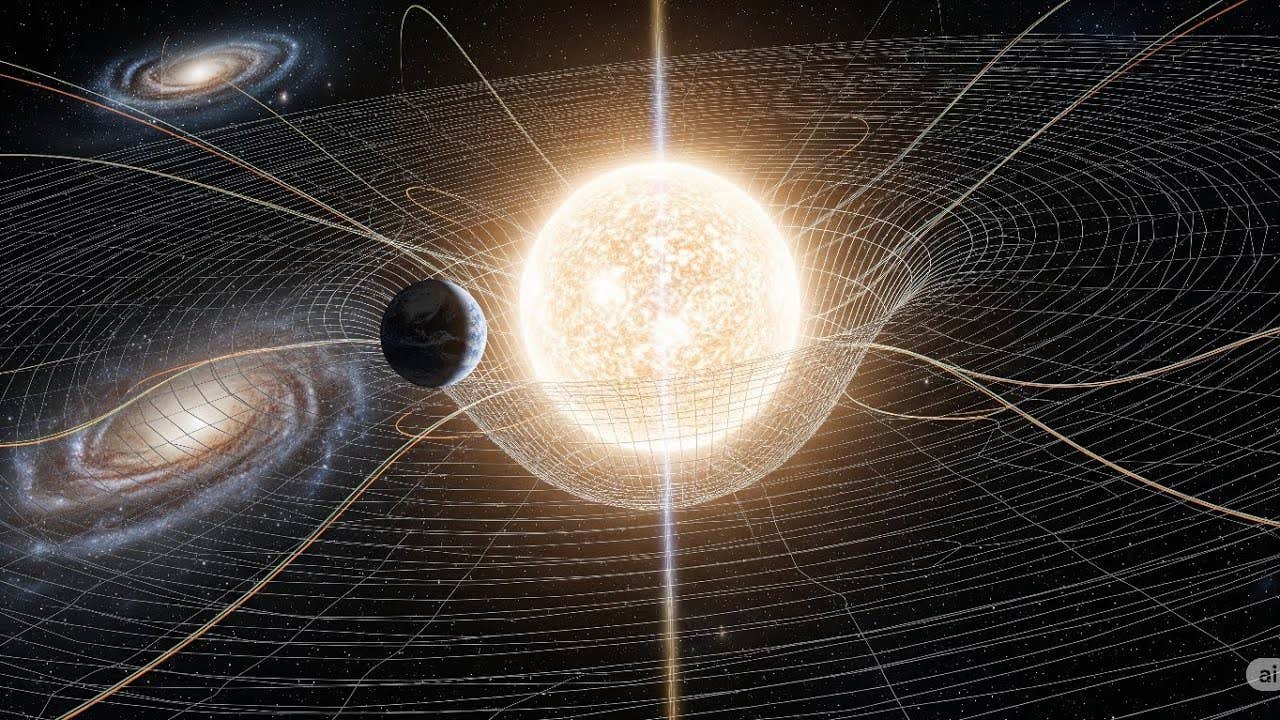
New physics research suggests spacetime may preserve some gravitational structures as it evolves. (CREDIT: Wikimedia / CC BY-SA 4.0)
Spacetime is often described as the stage on which the universe unfolds, a four-dimensional blend of space and time that bends, stretches and shifts as matter and energy move through it. However, despite more than a century of work since Einstein introduced general relativity, physicists still struggle to describe how that stage evolves when gravity becomes violent, nonlinear and hard to predict.
A new theoretical study points to a different way of looking at the problem. Instead of treating spacetime only as geometry, researchers found that some of its structures may behave more like features in an electrically conducting fluid. In this view, these structures stay connected as spacetime changes.
That idea comes from researchers at Adolfo Ibáñez University in Chile and Columbia University, whose work was published in Physical Review Letters. Using tools borrowed from electrodynamics and plasma physics, they argue that spacetime can contain what they call gravitational field connections. Additionally, they describe conserved quantities that place topological limits on how curved spacetime can evolve.
In plain terms, topology deals with what stays the same when shapes are bent or stretched without being torn apart. The team’s analysis suggests that certain gravitational structures do not simply dissolve or reconnect at will. Under the conditions they studied, some of those structures remain preserved as spacetime evolves.
“We have carried out several studies together focusing on relativistic plasma dynamics,” Felipe A. Asenjo, a co-author of the paper, told The Brighter Side of News.
“In these works, we have shown that general topological structures of the magnetic field and other fluid-like quantities are preserved in general curved spacetimes. The mathematical framework we employed is general, so we have applied it to analyze the preservation of topological structure, the curved spacetime metric itself.”
When gravity starts to look like a fluid
The work grew partly out of an analogy that has been gaining traction in gravitational physics. Luca Comisso, another co-author, said the spark came after a talk by Kip Thorne at Columbia University. At that talk, Thorne discussed parallels between gravity and fluid motion.
“That talk strongly influenced us and led us to ask whether the same fundamental rules that preserve structure in an electrically conducting fluid could also apply to gravity itself,” Comisso said. “Following that idea, we found that some geometric structures of the gravitational field remain preserved as spacetime evolves.”
The team rewrote Einstein’s standard equations of general relativity into a form that resembles equations used in nonlinear electrodynamics and magnetohydrodynamics, the physics of electrically conducting fluids such as plasmas. As a result, that let them ask a very specific question: if magnetic field lines in a plasma can remain connected under ideal conditions, could something similar happen in gravity?
Their answer is yes, at least mathematically and under an ideal Ohm-type condition built into their framework.
“With this approach, we can use the same procedure used to demonstrate that magnetic field lines remain connected in a plasma fluid when Ohm's law holds, to look for the analog behavior for gravitational field structures,” Asenjo said. “We show that analogous gravitational field structures also remain frozen into the dynamics when an ideal Ohm-type condition is fulfilled.”
That phrase, “frozen into the dynamics,” is central to the study. In plasma physics, a magnetic field can become locked into the motion of the fluid. This means its field lines move with the flow rather than breaking apart freely. The new analysis suggests a gravitational version of that effect.
Field lines, flux and a new invariant
The researchers describe spacetime as containing gravitational two-surfaces and associated field lines whose connectivity can persist over time. Furthermore, they also identify a conserved “gravitational magnetic” flux. This means the amount of this field passing through a comoving surface remains constant in their idealized setup.
That is not all.
The study also introduces a conserved quantity called gravitational helicity. In the language of topology, helicity tracks how field lines twist around themselves, coil through space and link with one another. Notably, in the team’s formulation, that quantity stays fixed under the same ideal condition.
“I think we have opened an interesting form of understanding for the evolution of the whole nonlinear dynamics of curved spacetimes,” Asenjo said. “We have demonstrated the existence of interesting topological invariants, such as gravitational helicity, that can be useful as a new approach to open problems in relativity.”
In the paper, the authors say this conserved helicity has a direct interpretation in terms of twist, writhe and linkage of gravitational field lines. That matters because it ties an abstract mathematical quantity to geometric structure. As a result, this gives researchers a more visual and potentially more intuitive way to think about dynamical spacetime.
The broader motivation is easy to see. The evolution of spacetime curvature lies behind black hole mergers, neutron star collisions, core-collapse supernovae and the growth of large-scale structure across the cosmos. Even now, numerical relativity simulations remain the main tool for studying those extreme events. Simulations do not always provide the clearest physical picture, however.
This work offers a complementary route. By framing the Einstein equations in a Maxwell-like form, the analysis tries to uncover organizing rules beneath the chaos.
A possible organizing principle for curved spacetime
The paper places the new results in the tradition of geometrodynamics, an approach that aims to understand spacetime evolution through its geometric structures. Importantly, earlier work had already recast some aspects of gravity in terms resembling electric and magnetic fields. This includes visual tools such as tendex and vortex lines for strong-gravity systems.
The new contribution pushes that line of thinking further by arguing that connectivity itself can be preserved. If the required conditions hold, then spacetime is not just evolving freely in every possible way. Some transitions between topological configurations are forbidden.
That is a striking claim, because it suggests the nonlinear behavior of gravity may be constrained by deeper structural rules.
The researchers are careful, however, about the scope of the result. Their conclusions apply under an ideal Ohm-type condition. They also note that the tetrad-projected Einstein tensor does not obey a strict frozen-in analog in general. Nevertheless, special directions can still be identified where the source term vanishes. It is a theoretical framework, not a direct observation, and the study does not claim that all gravitational evolution will preserve these structures under every circumstance.
Even so, the framework could help physicists think more clearly about how spacetime organizes itself in extreme settings. If some structures are preserved while others can change, that distinction may become useful in future work on highly dynamical systems and on long-standing problems in general relativity.
Practical implications of the research
The immediate value of the study is conceptual. It gives physicists a new language for describing spacetime evolution, one built around preserved connections, conserved flux and helicity rather than geometry alone.
That could matter for research on black holes, gravitational waves, neutron star mergers and the universe’s large-scale evolution. All of these depend on the nonlinear behavior of curved spacetime.
The framework may also help researchers interpret complex numerical simulations by highlighting which structures should remain intact under ideal conditions and which changes are not allowed.
Just as important, it points to situations where those topological constraints might fail. This could reveal new physics in strongly dynamical gravitational systems.
Research findings are available online in the journal Physical Review Letters.
The original story "Physicists rewrite Einstein's equations to define spacetime evolution" is published in The Brighter Side of News.
Related Stories
- Astronomers discover spacetime drag around a supermassive black hole — as predicted by Einstein
- Microscopic wormholes may be warping reality all around us
- Groundbreaking new theory rewrites quantum view of the Big Bang
Like these kind of feel good stories? Get The Brighter Side of News' newsletter.
Joseph Shavit
Writer, Editor-At-Large and Publisher
Joseph Shavit, based in Los Angeles, is a seasoned science journalist, editor and co-founder of The Brighter Side of News, where he transforms complex discoveries into clear, engaging stories for general readers. With vast experience at major media companies like The Los Angeles Times, Times Mirror and Tribune Publishing, he writes with both authority and curiosity. His writing focuses on space science, planetary science, quantum mechanics, geology. Known for linking breakthroughs to real-world markets, he highlights how research transitions into products and industries that shape daily life.