Physics-trained AI reveals how Earth’s deep interior changed over time
AI mantle convection research shows how physics-guided models may reconstruct hidden flow deep inside Earth.
 University of Tsukuba Writer: Yamashina Naoko

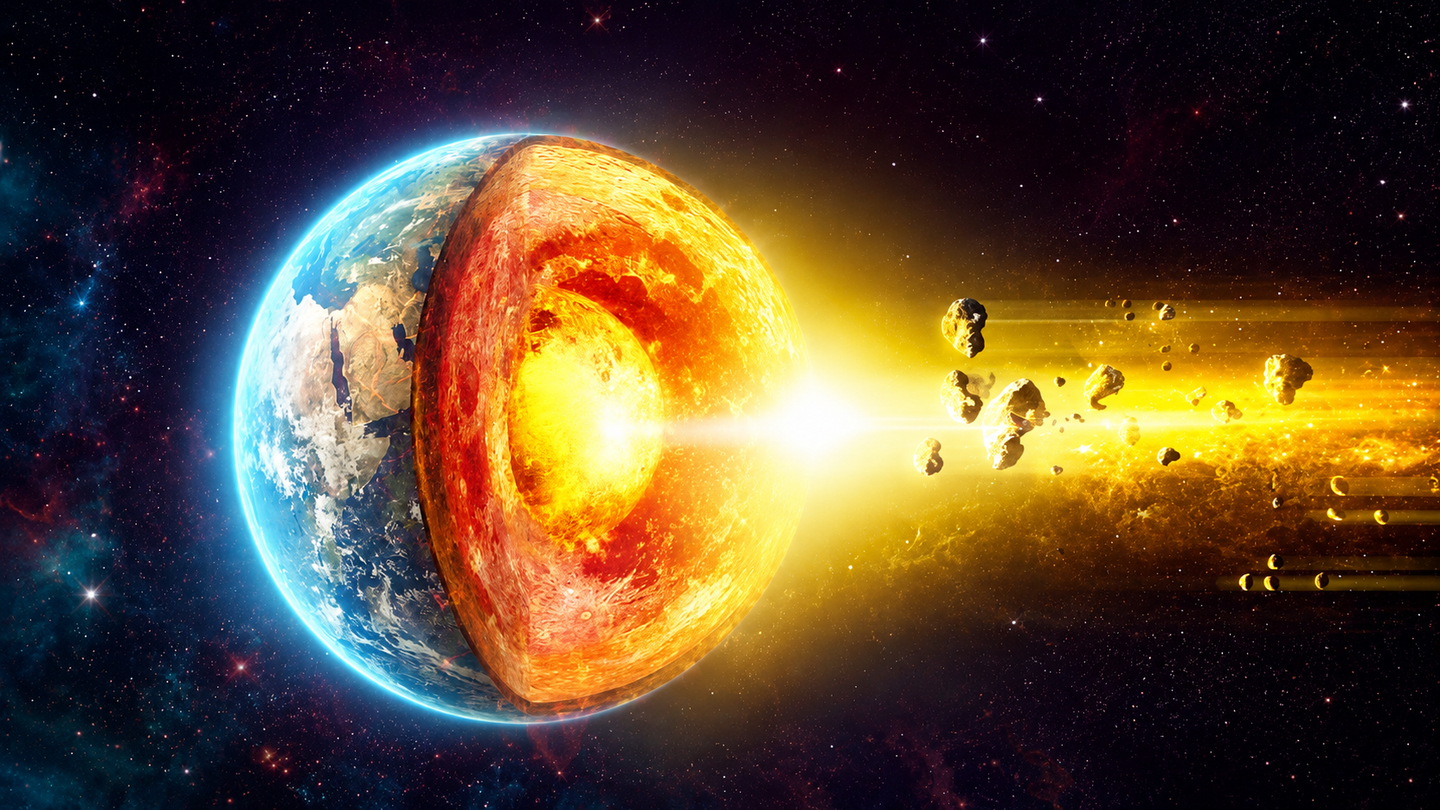
A physics-informed neural network rebuilt simulated mantle flow from limited surface and temperature clues. (CREDIT: Journal of Geophysical Research Machine Learning and Computation)
- Earth’s mantle moves only a few centimeters each year, but that slow motion helps drive plate tectonics, earthquakes and volcanic activity.
- A physics-guided AI model reconstructed hidden mantle flow in a controlled simulation using limited surface motion and present-day temperature clues.
- The work is an early test, not a real-Earth reconstruction, but it could help scientists study how the deep planet changed over time.
Deep inside Earth, rock moves at the pace of growing fingernails. That slow circulation shapes plates, feeds volcanoes and influences earthquakes, yet much of its past remains hidden from direct view.
The mantle, a rocky layer that accounts for more than 80 percent of Earth’s volume, circulates only a few centimeters per year. Over geological time, that movement helps drive plate tectonics and major surface activity.
But scientists cannot simply watch the deep mantle move. They must rely on surface geology and geophysical imaging, including seismic observations, to infer what lies below.
A new study by the University of Tsukuba tested whether artificial intelligence could help reconstruct that missing history. The researcher developed a physics-informed neural network, a type of AI model trained to fit data while also following physical laws.
Teaching AI the rules of slow rock flow
The model did not learn from observations alone. It also had to satisfy equations that govern heat transport and fluid flow in the mantle.
That matters because mantle circulation is a physical process, not just a pattern in data. Hotter material can rise. Cooler material can sink. Heat moves through the system. Flow must obey the rules of fluid motion, even when the “fluid” is solid rock moving over very long times.
To test the approach, the researcher first created computer simulations of two-dimensional mantle thermal convection. These simulations acted as a known answer. The AI model could then be judged by how well it reconstructed the simulated mantle’s hidden past.
This kind of test is useful because the real mantle has no complete historical record. In a simulation, however, researchers know the full temperature and flow history. They can hide parts of it, give the model limited clues and then check whether the reconstruction matches the truth.
A hidden history reconstructed from limited clues
The AI model received two kinds of synthetic observations. The first represented near-surface mantle motion. The second was a present-day snapshot of mantle temperature.
It did not receive direct information about past temperatures. It also did not receive direct information about deep-mantle flow through time.
Even with those limits, the model successfully reconstructed the hidden temperature and flow history with high accuracy. That result suggests that sparse observations can be useful when combined with the right physical constraints.
The finding also shows why one type of evidence is not enough. Near-surface motion can preserve clues about how material moved. A present-day temperature snapshot can reveal something about the mantle’s current structure. Together, they give the model a better chance of recovering a realistic history.
The study found that combining complementary geophysical information is essential for reconstructing mantle convection. Surface records and interior images can each leave gaps. The physics-informed model helps connect them.
Why the mantle is so hard to rewind
Reconstructing mantle flow is difficult because the process happens slowly and deep underground. Scientists can observe plate motions and study geological records at the surface. They can also use seismic methods to image structures inside Earth.
But these are indirect clues. They do not show every past flow pattern or temperature change. They also do not reveal the full path that produced the mantle’s present-day structure.
The challenge resembles trying to reconstruct a long movie from a few scenes. Surface movements provide part of the plot. Today’s deep structure provides the ending. The missing middle must be inferred carefully.
That is where the physics-informed approach may help. A standard AI model might fit the available observations but create a reconstruction that violates physical laws. A physics-informed neural network faces an added test. Its answer must also behave like mantle convection should.
The model therefore cannot freely invent any pattern that matches the observations. It must respect the equations that describe heat and flow.
A controlled test, not a finished Earth model
The study used a simplified two-dimensional mantle system. That choice made the problem manageable and allowed the AI reconstruction to be tested against a clear reference solution.
The real Earth is far more complicated. Its mantle is three-dimensional. Its rocks can behave differently under different temperatures and pressures. Plate boundaries, chemical variations and other geological processes add further complexity.
The study does not claim that the model has reconstructed Earth’s actual mantle history. Instead, it shows that the method can work in a controlled setting where the true answer is known.
That distinction is important. A successful simulation test is a first step, not the final proof. Applying the method to real geophysical data would require more development and careful handling of uncertainty.
Still, the result is promising because it addresses a central problem in Earth science. Scientists want to understand how the deep interior evolved, but the available observations are incomplete. A method that can combine limited data with physical laws could help close part of that gap.
Connecting surface motion to deep Earth change
Mantle circulation matters because it links Earth’s interior to its surface. The movement of mantle rock helps shape the plates above it. Plate tectonics, in turn, influences earthquakes, volcanic activity and the long-term evolution of continents and oceans.
Understanding the history of mantle flow could help scientists interpret why Earth’s surface changed in particular ways. It could also help connect present-day mantle structures to past geological events.
The new model points toward a way to recover that history more robustly. Rather than relying on a single observation type, the approach uses multiple clues together.
In the test, near-surface motion and present-day temperature worked as a pair. The surface information helped constrain movement through time. The final temperature field helped anchor the structure of the interior. The physical equations tied those pieces into one continuous reconstruction.
That combination was central to the model’s success. The study indicates that complementary data sources are not just helpful. They may be necessary for realistic mantle-history reconstructions.
Practical implications of the research
The research could give Earth scientists a stronger tool for studying the deep planet’s past. With further development, physics-informed AI may help combine geological records, seismic images and other geophysical observations into clearer reconstructions of mantle circulation.
That could improve understanding of how deep-Earth processes connect to plate tectonics, earthquakes and volcanic activity. It could also help researchers test which mantle histories are physically plausible, rather than merely possible from limited data.
The work remains at an early stage because it was tested with synthetic observations from a simplified simulation. Future applications to real data will need more complex models and careful treatment of uncertainty. Even so, the study shows how AI can support Earth science when it works with physics, not around it.
Dig deeper into mantle convection, geophysical reconstruction and physics-informed AI
These resources explore other approaches to reconstructing mantle dynamics, the observations used to infer deep-Earth flow and the broader development of machine learning constrained by physical laws.
Automatic adjoint-based inversion schemes for geodynamics: reconstructing the evolution of Earth's mantle in space and time: This study presents an automated inverse-modeling framework for reconstructing mantle evolution and demonstrates it with synthetic mantle-convection experiments. It provides a useful comparison with AI-based approaches because both tackle the problem of recovering hidden mantle histories from limited constraints. (Geoscientific Model Development, 2024)
Applications of physics-informed neural networks in geosciences: From basic seismology to comprehensive environmental studies: This review examines how physics-informed neural networks are being applied across geoscience, including geophysics, seismology and other fields governed by differential equations. It also outlines the potential and remaining limitations of combining sparse observations with physical constraints. (Open Geosciences, 2025)
Advances in Mapping Lowermost Mantle Convective Flow With Seismic Anisotropy Observations: This review examines how seismic anisotropy can reveal patterns of convective flow in the lowermost mantle. It highlights the observational challenge at the center of mantle reconstruction: deep circulation must largely be inferred from indirect geophysical measurements. (Reviews of Geophysics, 2024)
Geodynamics of a global plate reorganization from topological data analysis: Researchers combined global mantle-convection modeling with data-analysis methods to investigate large-scale reorganizations of tectonic plates. The work illustrates how computational approaches can be used to explore links between mantle dynamics and changes recorded at Earth’s surface. (Nature Geoscience, 2025)
Physics-informed machine learning: This influential review explains how machine-learning systems can incorporate mathematical physics directly into their training, allowing them to address inverse problems and situations with limited or noisy observations. It provides the broader methodological foundation for using physics-informed AI in problems such as mantle reconstruction. (Nature Reviews Physics, 2021)
Research findings are available online in the Journal of Geophysical Research Machine Learning and Computation.
The original story "Physics-trained AI reveals how Earth’s deep interior changed over time" is published in The Brighter Side of News.
Related Stories
- Water seeping into Earth’s mantle 3.1 billion years ago fueled early volcanic activity and plate tectonics
- Gold’s origins lie beneath the ocean deep inside the Earth's mantle
- Scientists create the first global map of rare, deep-mantle earthquakes
Like these kind of feel good stories? Get The Brighter Side of News' newsletter.
Joshua Shavit
Writer and Editor
Joshua Shavit is a NorCal-based science and technology writer with a passion for exploring the breakthroughs shaping the future. As a co-founder of The Brighter Side of News, he focuses on positive and transformative advancements in technology, physics, engineering, robotics, and astronomy. Having published articles on AOL.com, MSN, Yahoo News, and Ground News, Joshua's work highlights the innovators behind the ideas, bringing readers closer to the people driving progress.