Mercury’s surface chemistry reveals clues to a much hotter volcanic past
A new infrared method suggests Mercury’s surface contains only about 37% silicon dioxide, far below previous estimates.
 MPS Writer: Birgit Krummheuer

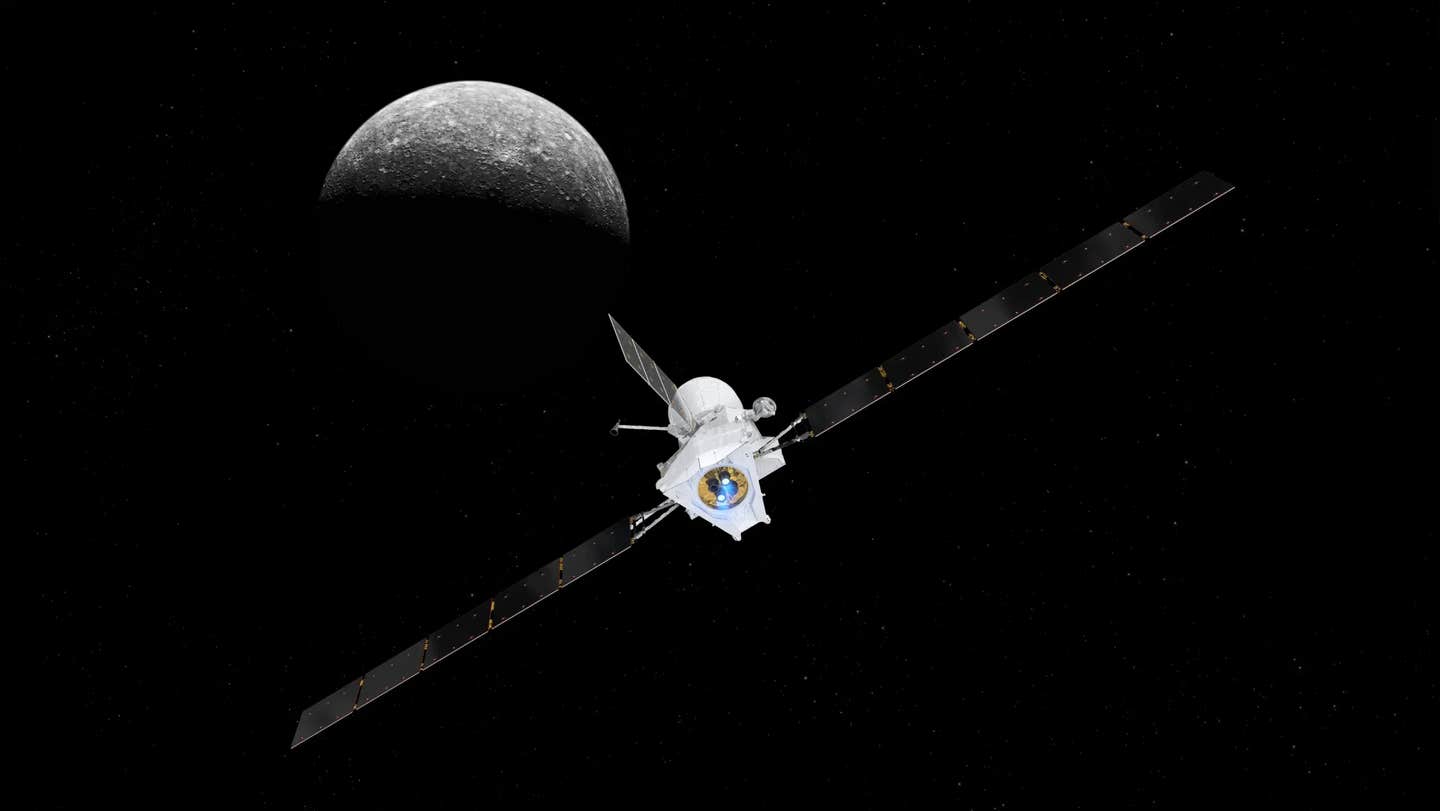
Mercury may contain far less silicon dioxide than thought, offering new clues to its volcanic past and intensely hot interior. (CREDIT: ESA/ATG medialab; Mercury: NASA/JPL)
- Mercury’s surface may contain only about 37% silicon dioxide by mass, up to 25% less than previous estimates suggested.
- The low silica level could mean Mercury’s volcanic rocks came from hotter, more deeply melted material inside the planet, or that some silicon exists in reduced metallic or carbide forms.
- A new infrared calibration, tested against samples returned from the Moon, could allow BepiColombo to map Mercury’s silica content far more accurately once its science mission begins.
Mercury and Earth began as rocky worlds, but their geological histories took very different paths. Earth remains restless, with volcanoes erupting and tectonic plates continually reshaping its surface. Mercury appears to have settled down much earlier, developing a solid outer shell as its interior cooled.
Exactly what happened inside the smallest planet remains uncertain. A new measurement of its surface chemistry, however, suggests Mercury’s volcanic past may have been hotter and more unusual than previously thought.
Researchers from the Max Planck Institute for Solar System Research, the University of Münster and the University of Göttingen have developed a new way to measure silicon dioxide on rocky planetary surfaces using infrared light. Their analysis, published in Planetary Research, puts silicon dioxide at about 37% of Mercury’s surface material by mass. That is up to 25% lower than earlier estimates.
The finding matters because silicon dioxide, or SiO2, is one of the basic chemical building blocks used to understand volcanic rocks and the history of planetary crusts.
A surprisingly silica-poor planet
Silicon dioxide is widespread on Earth. It occurs in pure form in materials such as sand and is also a major component of volcanic rocks, including basalt, andesite and granite. Some terrestrial rocks contain as much as 75% silicon dioxide.
Mercury appears very different.
“Our findings suggest that the volcanic rocks on Mercury formed from more deeply melted mantle material than previously assumed,” said Christian Renggli, lead author of the study and head of the “Experimental Laboratory Magma Ocean” research group at the Max Planck Institute for Solar System Research.
That interpretation comes from the way a young planet’s mantle changes as it cools. The first rocks to solidify remove relatively little silicon dioxide from molten material. The remaining melt therefore becomes progressively richer in the compound. Later volcanic material should carry more silicon dioxide toward the surface.
A surface that remains relatively poor in silicon dioxide can therefore point to hotter interior conditions and a greater degree of melting. The researchers also raise another possibility. Mercury may once have possessed more silicon dioxide but lost oxygen, leaving some silicon bound in metallic or carbide phases rather than as SiO2.
Measuring a world without rock samples
Unlike the Moon, Mercury has never had a lander collect material directly from its surface. Scientists have no rocks they can bring into a laboratory and analyze, so they must reconstruct its chemistry from telescopes and spacecraft.
The new technique relies on a mid-infrared spectral signal called the Christiansen Feature. Its position changes with the chemical composition of silicate materials, making it potentially useful for estimating silicon dioxide remotely.
To establish a more precise relationship, the researchers created laboratory glasses spanning an unusually broad range of compositions, from 0.5% to 97.6% silicon dioxide by weight. The materials were formed into tiny glass beads about half a millimeter across and analyzed with infrared spectroscopy.
“The glass beads serve a similar function to calibration weights on a scale,” said Iris Weber of the University of Münster. “Their weight is known precisely. They therefore allow us to correctly interpret the scale’s balance. Similarly, the glass beads allow us to draw the correct conclusions from the properties of the infrared radiation.”
The Christiansen Feature shifted systematically as the silicon dioxide concentration changed. A second-order mathematical relationship provided the strongest fit to the laboratory measurements, with the researchers estimating an uncertainty of about 3.4 percentage points in silicon dioxide abundance.
The Moon provides a crucial test
Before applying the calibration to Mercury, the team tested it on a world where scientists already know far more about the surface.
NASA’s Lunar Reconnaissance Orbiter has mapped infrared radiation across much of the Moon with its Diviner instrument. Even more importantly, Apollo, Luna and Chang’e missions have returned actual lunar material to Earth.
“The Moon is a kind of touchstone for us – and an important conceptual stepping stone on our way to Mercury,” Renggli said.
Using Diviner measurements, the researchers produced a global map of lunar silicon dioxide. The results reproduced the Moon’s major chemical divisions, with dark volcanic maria averaging about 45.8% SiO2 and highland regions averaging about 50.9%.
The calibration also identified unusually silica-rich locations. Estimates reached 60% at Hansteen Alpha, 74.2% at Aristarchus Crater and 76% at the Lassell Massif. The team compared results around several landing sites with returned lunar samples and found good agreement in many locations, although local variations and the much larger areas represented by remote measurements produced differences at some sites.
That lunar test gave the researchers greater confidence that the same infrared relationship could be applied where physical samples do not exist.
Mercury comes in far below earlier estimates
Existing Earth-based infrared observations place Mercury’s Christiansen Feature near a wavelength of 8.5 micrometers. When the researchers applied their new calibration to that measurement, they obtained an estimated surface abundance of 37.4% silicon dioxide.
Earlier estimates had placed Mercury between roughly 49% and 60%.
Those previous calculations relied largely on elemental ratios measured by instruments aboard NASA’s MESSENGER spacecraft and assumptions about how those elements combine chemically. The new infrared method provides an independent approach that directly constrains silicon dioxide rather than simply calculating it from elemental abundances.
The low value is also consistent with the possibility that Mercury’s strongly reduced chemical environment allowed some silicon to occur outside conventional silicate minerals.
BepiColombo could put the result to the test
A much sharper answer may soon arrive. The joint European Space Agency and Japan Aerospace Exploration Agency BepiColombo mission is approaching Mercury after an eight-year journey.
Its Mercury Transfer Module is scheduled to separate from the mission’s two science orbiters on September 3, 2026. The spacecraft are due to begin entering Mercury orbit on November 21, with full science operations scheduled to start in April 2027.
One instrument, the Mercury Radiometer and Thermal Infrared Spectrometer, or MERTIS, will examine Mercury between wavelengths of 7 and 14 micrometers. That range includes the Christiansen Feature used in the new calibration and will allow scientists to map Mercury’s mineralogy with much finer measurements.
“Our study lays the groundwork for deriving the most accurate information possible about the silicon dioxide content of Mercury’s surface from BepiColombo’s measurements,” Renggli said.
If MERTIS confirms the unexpectedly low silica abundance, Mercury’s surface could provide a new chemical record of how deeply its mantle melted, how its volcanic crust formed and why the planet evolved so differently from Earth.
Dig deeper into Mercury’s composition, infrared spectroscopy and planetary crusts
These resources explore Mercury’s unusual geochemistry, the infrared techniques used to determine rocky surface composition and the measurements BepiColombo will use to investigate the planet.
Global major-element maps of Mercury from four years of MESSENGER X-Ray Spectrometer observations: MESSENGER measurements produced global maps of several major elements and revealed a Mercury crust rich in magnesium and sulfur but depleted in iron compared with terrestrial and lunar materials. The results provide important chemical context for interpreting new silicon dioxide estimates. (Icarus, 2020)
Studying the Composition and Mineralogy of the Hermean Surface with the Mercury Radiometer and Thermal Infrared Spectrometer (MERTIS) for the BepiColombo Mission: An Update: This overview describes how MERTIS will use thermal infrared signatures, including the Christiansen Feature, to identify and map rock-forming minerals on Mercury. It explains why the 7-to-14-micrometer range is particularly valuable for studying the planet’s poorly understood crust. (Space Science Reviews, 2020)
The Surface Composition of Mercury: This review summarizes what MESSENGER revealed about Mercury’s unusual chemistry, including high sulfur and carbon, low iron and evidence that the planet formed under strongly reducing conditions. Those conditions are central to understanding why silicon on Mercury may not all occur as silicon dioxide. (Elements, 2019)
A Low O/Si Ratio on the Surface of Mercury: Evidence for Silicon Smelting: The authors examine Mercury’s unexpectedly low oxygen-to-silicon ratio and propose that chemical reactions involving carbon could have produced metallic silicon under the planet’s highly reducing conditions. The work offers a possible explanation for why measurements based only on silicate chemistry may miss some silicon. (Journal of Geophysical Research: Planets, 2017)
Christiansen Feature Map From the Lunar Reconnaissance Orbiter Diviner Lunar Radiometer Experiment: Improved Corrections and Derived Mineralogy: This study refined global measurements of the Moon’s Christiansen Feature and used them to map major silicate minerals and identify silica-rich regions. It provides important background for using the same infrared feature as a compositional tool on Mercury. (Journal of Geophysical Research: Planets, 2021)
Research findings are available online in the journal Planetary Research.
The original story "Mercury’s surface chemistry reveals clues to a much hotter volcanic past" is published in The Brighter Side of News.
Related Stories
- Mercury’s polar water ice may have arrived in one giant impact
- Mercury has a 10-mile-thick layer of diamonds under its surface
- JWST finds a dark, airless exoplanet covered in rock like Mercury
Like these kind of feel good stories? Get The Brighter Side of News' newsletter.
Joseph Shavit
Writer, Editor-At-Large and Publisher
Joseph Shavit, based in Los Angeles, is a seasoned science journalist, editor and co-founder of The Brighter Side of News, where he transforms complex discoveries into clear, engaging stories for general readers. With vast experience at major media companies like The Los Angeles Times, Times Mirror and Tribune Publishing, he writes with both authority and curiosity. His writing focuses on space science, planetary science, quantum mechanics, geology. Known for linking breakthroughs to real-world markets, he highlights how research transitions into products and industries that shape daily life.