Reducing city light pollution could improve urban tree and plant growth
Satellite images link urban lighting controls with darker nights and plant seasons that moved closer to long-term patterns.
 Vanderbilt University Writer: Lin Meng

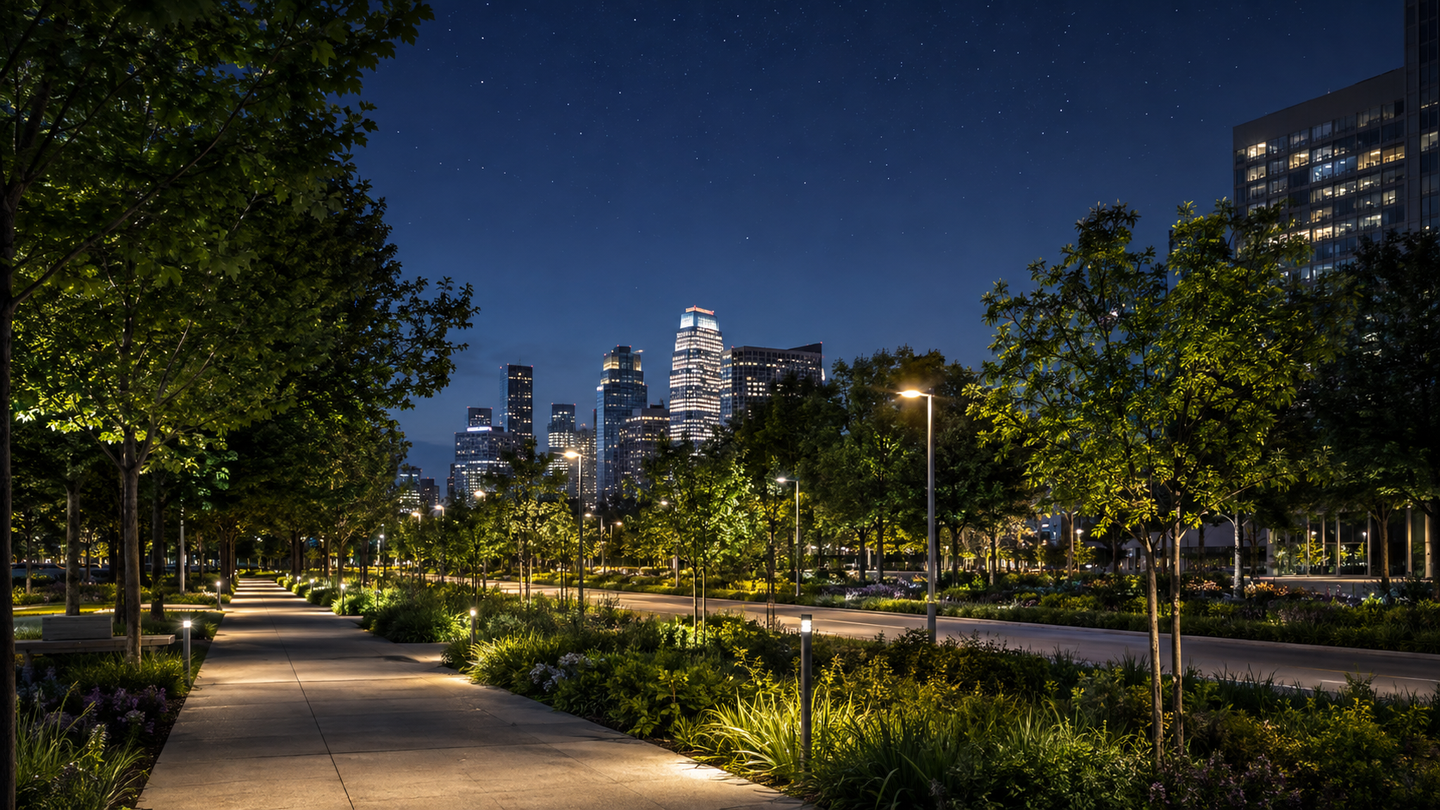
Artificial light at night fell in policy cities, alongside smaller shifts in spring green-up and autumn leaf timing. (CREDIT: Wikimedia / AI-Generated / CC BY-SA 4.0)
- New York City and Washington, DC, became darker after adopting measures to reduce artificial light at night, especially blue light.
- Satellite images showed that seasonal plant growth in those cities shifted closer to its long-term timing than in Newark and Philadelphia.
- The results are promising but exploratory, since the analysis covered only two city pairs and one year after the policies took effect.
City lights do more than brighten streets. They can alter when trees sprout leaves, when autumn color arrives, and how urban ecosystems move through the seasons.
A satellite comparison of four Northeastern cities suggests that efforts to reduce artificial light at night may ease some of those shifts. New York City and Washington, DC, showed declines in nighttime brightness after adopting mitigation measures. Nearby Newark and Philadelphia did not show the same pattern.
The clearest change appeared in blue light, a part of the spectrum known to affect plant timing. The results also aligned with differences in when vegetation greened in spring and declined in autumn.
City policies leave a visible nighttime signal
Lin Meng and colleagues from Vanderbilt University examined nighttime lighting in New York City, Newark, Washington, DC, and Philadelphia. They paired New York with Newark and Washington with Philadelphia because each pair sits in the same region and appears within the same satellite images.
New York and Washington had adopted measures to limit or reshape outdoor lighting. Newark and Philadelphia served as nearby comparisons without similar citywide policies.
The team used images from the Sustainable Development Science Satellite 1, or SDGSAT-1. Launched on Nov. 29, 2021, the satellite records nighttime light in red, green, and blue bands at 40-meter resolution.
That spectral detail matters because many older satellites combine visible light into one broad band. They cannot easily show whether one color, such as blue, is changing more than another.
Between 2022 and 2023, total artificial light at night declined in New York and Washington. Newark and Philadelphia showed little change or increases. The split appeared in total brightness and in each color band.
The strongest reductions in the policy cities appeared in blue light. Additional SDGSAT-1 images from 2023 and 2024 produced similar patterns. A separate five-year analysis using NASA’s VIIRS data also showed a decline in Washington and an increase in Philadelphia.
Brightness changed unevenly across neighborhoods
The reductions were not uniform. New York contained pockets of lower nighttime light, but Manhattan also had large connected areas where brightness increased.
The authors said the increase may reflect returning commercial activity after pandemic-related reductions in 2022. Office and business activity continued recovering in 2023.
Newark showed almost no areas with a clear decline. The southern part of the city, near Newark Liberty International Airport, recorded a notable increase. Construction in 2021 and 2022, followed by resumed use in 2023, may have contributed.
Washington showed the broadest decreases across red, green, and blue bands, especially blue. Philadelphia displayed a patchwork of increases and decreases.
Development intensity also shaped the pattern. In New York, blue light fell even in highly developed areas, while red and green light showed small increases there.
Washington recorded mostly negative changes across light bands and development levels. Newark showed increases in red and green across many developed areas. Philadelphia had smaller, mixed differences.
These contrasts suggest that lighting technology, local activity, land use, and policy enforcement can all influence nighttime brightness.
Seasonal plant timing moved closer to normal
Artificial light can advance the growing season and delay its end. Trees may produce leaves earlier in spring, then hold them longer before autumn senescence.
The researchers examined plant timing with NASA’s MODIS Land Cover Dynamics product. They used satellite measures of spring green-up and autumn senescence from 2004 through 2023.
Before the policies, the comparison cities without mitigation generally reached spring green-up later than the policy cities. After implementation, those differences became smaller or reversed.
For New York and Newark, the spring timing difference shifted from minus 2.1 days in the long-term average to plus 2.0 days in 2023. For Washington and Philadelphia, it shifted from minus 8.8 days to minus 5.0 days.
Autumn timing moved in the opposite direction. New York’s difference with Newark changed from plus 1.6 days to minus 8.0 days. Washington’s difference with Philadelphia changed from minus 5.6 days to minus 9.0 days.
Vegetation in the policy cities therefore showed relatively later spring green-up and earlier autumn decline than expected from the long-term relationship between each pair. That direction fits with less influence from artificial light.
The analysis does not prove that lighting policies caused the plant changes. It includes two city pairs and one postpolicy year. Temperature, precipitation, species composition, land management, and urban microclimates also affect plant timing.
Satellite evidence remains suggestive, not conclusive
Each city pair appeared in the same SDGSAT-1 image, helping keep atmospheric and acquisition conditions more consistent.
The team focused on relative differences rather than treating the readings as precise absolute measurements. Tests using other images and another satellite dataset supported the main direction of change.
Important limits remain. Atmospheric conditions, sensor calibration, viewing geometry, and small registration errors can affect measurements. Percent changes can also look unusually large where starting brightness is low.
The satellite passed over at about 9 p.m. Eastern time. That may miss policies beginning later, including New York rules that turn off nonessential lighting after 11 p.m. during bird migration periods.
The short SDGSAT-1 record also prevents a firm assessment of long-term trends. The authors called for more cities, more years, cross-sensor tests, and hourly ground observations.
Practical implications of the research
The findings suggest cities may reduce ecological disruption by changing not only how much light they use, but also when, where, and in what color.
Shielded fixtures, adaptive dimming, warmer color temperatures, timers, and lower output could reduce blue-rich spill while preserving necessary illumination. Washington’s project combines LED conversion with remote dimming and warmer 2,700- or 3,000-kelvin lights.
High-resolution satellite images could help cities compare neighborhoods, track policy results, and identify places where lighting remains intense. They could also support research into effects on plants, insects, birds, water use, carbon storage, and other urban processes.
For now, the study offers evidence of association rather than causation. Its strongest contribution may be showing that citywide lighting changes and seasonal plant responses can be examined together from space.
Research findings are available online in the journal PNAS Nexus.
The original story "Reducing city light pollution could improve urban tree and plant growth" is published in The Brighter Side of News.
Related Stories
- MIT is transforming plants into bright, eco-friendly city lights
- Urban Heat Crisis: How Strategic Tree Planting Makes a Difference
- Los Angeles' trees can absorb up to 60% of daytime CO2 emissions
Like these kind of feel good stories? Get The Brighter Side of News' newsletter.
Joseph Shavit
Writer, Editor-At-Large and Publisher
Joseph Shavit, based in Los Angeles, is a seasoned science journalist, editor and co-founder of The Brighter Side of News, where he transforms complex discoveries into clear, engaging stories for general readers. With vast experience at major media companies like The Los Angeles Times, Times Mirror and Tribune Publishing, he writes with both authority and curiosity. His writing focuses on space science, planetary science, quantum mechanics, geology. Known for linking breakthroughs to real-world markets, he highlights how research transitions into products and industries that shape daily life.