Small whirlpool-like structures reveal how the Sun stores and releases energy
The Sun’s smallest visible whirlpools could drive turbulence, magnetic mixing, and explosive solar activity.

 Edited By: Joseph Shavit

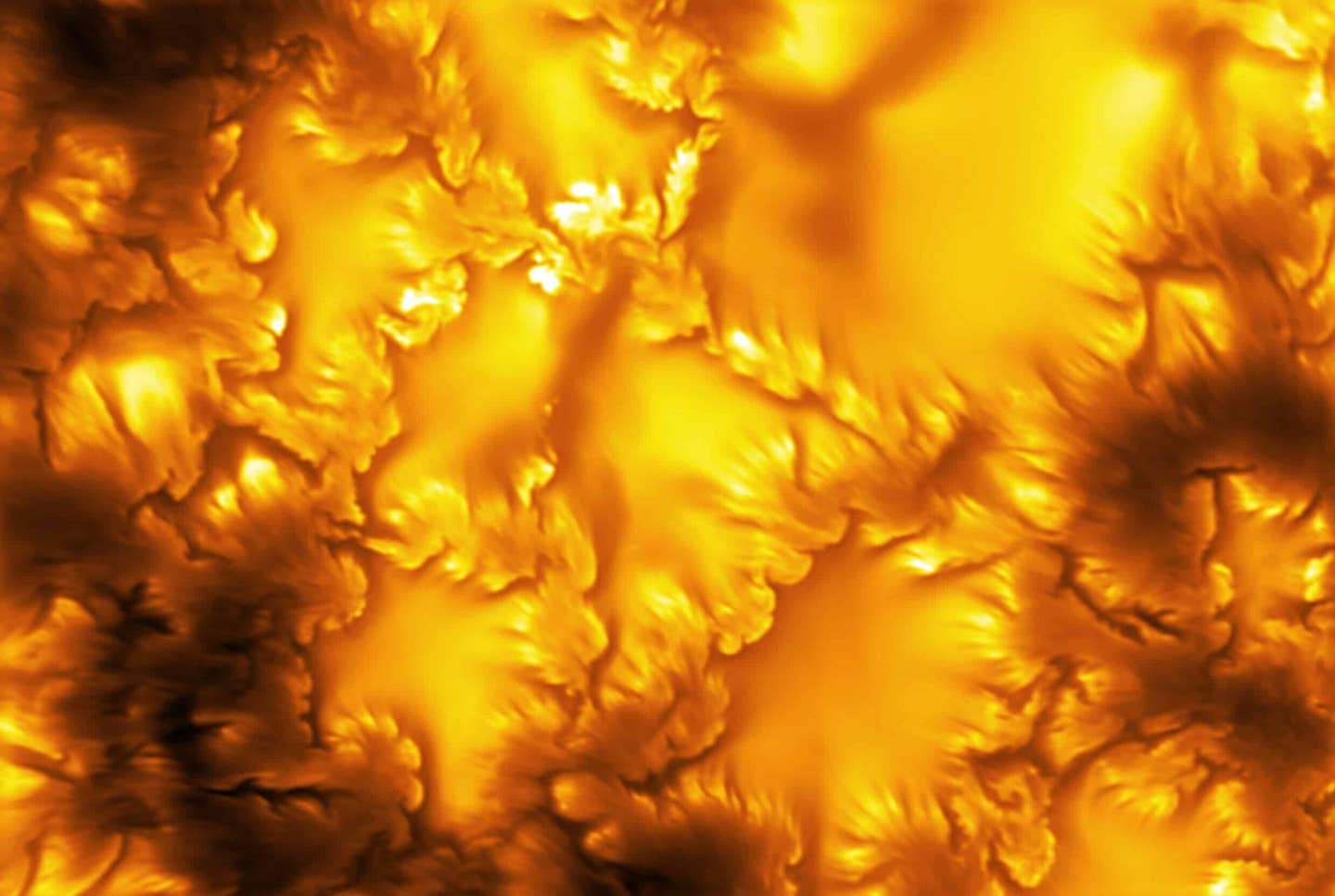
Captured at a wavelength of 416 nanometers by the Inouye Solar Telescope, this is the highest-resolution image ever taken of the Sun’s visible surface. It reveals ultra-fine magnetic structures and distorted boundaries shaped by the Kelvin-Helmholtz instability. (CREDIT: NSF/NSO/AURA/MPS)
- Scientists using the Inouye Solar Telescope discovered tiny whirlpool-like vortices forming along magnetic boundaries on the Sun's visible surface.
- Observations, computer simulations, and theoretical models all identify the same cause: the Kelvin-Helmholtz instability, a phenomenon also seen in ocean waves and cloud formations.
- The newly observed vortices may twist magnetic fields, redistribute magnetic energy, help heat the Sun's atmosphere, and improve forecasts of space weather.
The Sun’s surface is not smooth. It boils with bright cells of rising plasma, yet along the edges of some magnetic regions, that familiar pattern breaks into tiny swirls and dark, fast-moving stripes.
Images from the NSF Daniel K. Inouye Solar Telescope have now exposed those structures at scales near 19 kilometers. The observations offer the first clear view of Kelvin-Helmholtz instability in the solar photosphere, the layer seen as the Sun’s visible surface.
The international team included researchers from the U.S. National Science Foundation National Solar Observatory, the Max Planck Institute for Solar System Research in Germany, and the High Altitude Observatory in the United States.
The telescope observed an active region near a sunspot on April 14, 2025. Its four-meter mirror and high-resolution imaging system captured magnetic boundaries that looked sharply different from those seen through smaller telescopes.
A solar boundary breaks into waves
The photosphere is covered with granules, bright convective cells between 500 and 2,000 kilometers wide. Hot plasma rises inside them, cools near the surface, and sinks again along their edges.
Where granules met concentrated magnetic fields, the telescope revealed rows of small vortices and narrow striations. Some structures measured only about 20 kilometers across, near the telescope’s theoretical diffraction limit at the observed wavelength.
Resolving an object that small on the Sun is comparable to seeing a one-euro coin from 180 kilometers away.
“To detect the vortices, we needed to resolve structures on the solar surface about 20 kilometers in size. That is at the limit of what even the world’s largest solar telescope and state-of-the-art simulations can achieve,” said MPS scientist Michiel van Noort.
The team analyzed 47 vortices in the observed field. The average spacing between them was 65 kilometers, while measured sizes ranged from 25 to 170 kilometers. Their apparent horizontal speeds ranged from 0.67 to 3 kilometers per second.
A familiar instability in an unfamiliar place
Kelvin-Helmholtz instability occurs when neighboring fluids move past one another at different speeds. The velocity difference creates shear, allowing small disturbances along the boundary to grow into waves and spiraling vortices.
The effect appears in windy lakes, ocean waves, cloud formations, planetary atmospheres, and the interaction between solar wind and planetary magnetospheres. Solar physicists had predicted it could occur in the photosphere, but telescopes with apertures below two meters could not resolve the expected scale.
The new images showed the right shapes and motions, but the team also tested the explanation with detailed computer simulations. The researchers used the MURaM code, which models radiation, magnetic fields, and plasma motion in the solar atmosphere.
The simulations produced vortex-like structures along magnetic boundaries that closely matched the observations. In synthetic images, the typical spacing peaked at 49 kilometers. Growth rates and apparent velocities also fell within ranges similar to those measured by the telescope.
“It is very exciting to see that the highest-resolution observations of the solar photosphere revealed a new dynamical regime in the form of KH vortices at the edges of magnetic field concentrations,” said HAO scientist Matthias Rempel.
The models supplied one key detail that the images could not measure directly: horizontal plasma velocity. Plasma flowed parallel to magnetic boundaries, with a sharp change in speed across the interface. That created the shear needed to trigger the instability.
Vortices disturb the magnetic framework
The Sun’s magnetic field can suppress Kelvin-Helmholtz instability when it runs parallel to the shear flow. In the observed region, however, the strong fields stood mainly vertical while the shear moved horizontally.
That geometry offered little stabilizing effect. The vortices could therefore form repeatedly around vertically oriented magnetic concentrations.
The simulations showed that the structures extended downward as vertical rolls. In deeper layers, weaker magnetic stabilization allowed the disturbances to grow more strongly. The instability sometimes split larger magnetic features into smaller strands beneath the visible surface.
The vortices also entered a turbulent stage quickly. Some merged into larger structures, while smaller vortices formed on top of bigger ones. This behavior indicates that Kelvin-Helmholtz instability contributes to turbulence along these boundaries.
The team estimated a turbulent diffusivity of about 0.65 × 10^12 square centimeters per second in regions with strong magnetic fields. That mixing allows magnetized and mostly unmagnetized plasma to exchange material, changing downflows and energy transport below the surface.
The same mixing may help magnetic fields spread through the lower solar atmosphere. That matters because the Sun completes its magnetic cycle in about 11 years, a rapid pace that current models struggle to explain.
A possible engine for magnetic braiding
Solar activity draws energy from stressed magnetic fields. One leading idea, known as magnetic flux braiding, holds that motions at the surface twist and interlace magnetic field lines.
Those tangled fields store free magnetic energy. When the configuration becomes unstable, magnetic reconnection can rearrange the field and release energy through events ranging from nanoflares to larger flares, jets, and coronal mass ejections.
What drives the constant braiding has remained difficult to observe. The newly visible vortices may provide one answer because they appear wherever strong magnetic boundaries meet convective flows.
“We are only at the beginning of recognizing the wide-reaching impact the discovery of Kelvin-Helmholtz instability has on our understanding of the connection between the magnetized plasma motion and the energy transport and release into the upper solar atmosphere,” said NSO scientist Friedrich Wöger.
The structures could also launch magnetohydrodynamic waves and feed turbulence that carries or dissipates energy higher in the atmosphere. That possibility connects the discovery to the long-standing question of why the solar corona reaches temperatures near one million kelvin.
Practical implications of the research
The discovery gives solar physicists a new process to include in models of magnetic transport, atmospheric heating, and solar activity. It also provides the highest-resolution observational test yet of magnetohydrodynamic simulations of the photosphere.
Researchers now plan to use automated methods to identify more vortices in Inouye Telescope data. Larger samples could show how much energy these structures carry upward and how strongly they affect magnetic diffusion.
Better measurements may also clarify how small motions at the solar surface contribute to space weather. Flares and coronal mass ejections can disrupt satellites, GPS navigation, communications, and electrical grids on Earth.
“To understand the dynamic space weather that affects Earth, we have to see the small-scale processes driving it,” said NSF program director Jacqueline Keane.
Dig deeper into solar vortices, magnetic braiding and coronal heating
These recent research resources explore how small-scale plasma motions may transport energy, twist magnetic fields and help heat the Sun’s atmosphere.
- Solar Vortices: Catalysts of Magnetoacoustic Wave Dissipation and Atmospheric Heating
High-resolution 3D simulations show that photospheric vortices can strengthen wave-driven shocks and increase heating in the lower solar atmosphere. The work connects swirling surface motions directly with the movement and dissipation of energy higher above the photosphere. (arXiv, May 2026) - Distribution of Energy Release Events Due to Magnetic Braiding
These simulations examine what happens as solar magnetic field lines become increasingly tangled. The researchers found thinner and more numerous current sheets, greater magnetic complexity and increased energy entering the modeled corona, supporting magnetic braiding as a viable coronal-heating mechanism. (arXiv, June 2026) - Testing Theories of Solar Coronal Heating with Three-Dimensional Models
This work tackles the broader coronal-heating problem by constructing 3D models whose predicted solar emission can be compared with observations from the Solar Dynamics Observatory and Hinode. It provides useful context for how competing explanations for the million-degree corona can be tested observationally. (arXiv, July 2026) - First High-Resolution Observations of Chromospheric Swirls
Observations of 34 solar swirls traced their behavior from the photosphere into the middle chromosphere. The results support a magnetic origin for the structures and suggest that torsional Alfvén waves may help connect motions near the surface with dynamics higher in the atmosphere. (Monthly Notices of the Royal Astronomical Society, 2025) - Chromospheric and Coronal Heating in an Active Region Plage by Dissipation of Currents from Braiding
High-resolution observations combined with advanced simulations found evidence consistent with magnetic-field braiding producing current sheets whose dissipation heats both the chromosphere and corona. It provides important observational support for the magnetic-braiding mechanism discussed in the solar-vortex story. (Nature Astronomy, 2024)
------ Update made on Aug. 11, 2026 ------
A new section, "Dig deeper into solar vortices, magnetic braiding and coronal heating," expands on the science behind these phenomena and provides additional research and resources for readers interested in exploring solar activity in greater depth.
Research findings are available online in the journal Nature.
The original story "Small whirlpool-like structures reveal how the Sun stores and releases energy" is published in The Brighter Side of News.
Related Stories
- Large-scale waves are forming deep inside our Sun
- The Sun contains 55% more silver than astronomers previously thought
- Earth may not be swallowed by our dying sun after all, study finds
Like these kind of feel good stories? Get The Brighter Side of News' newsletter.
Joshua Shavit
Writer and Editor
Joshua Shavit is a NorCal-based science and technology writer with a passion for exploring the breakthroughs shaping the future. As a co-founder of The Brighter Side of News, he focuses on positive and transformative advancements in technology, physics, engineering, robotics, and astronomy. Having published articles on AOL.com, MSN, Yahoo News, and Ground News, Joshua's work highlights the innovators behind the ideas, bringing readers closer to the people driving progress.