Researchers grow potatoes in simulated lunar soil using compost and fertilizer
Oregon State researchers grew potatoes in simulated lunar soil, finding that 30% vermicompost restored growth in one simulant. Fertilizer supported every treatment, and lunar farming remains untested.

 Editor: Joshua Shavit

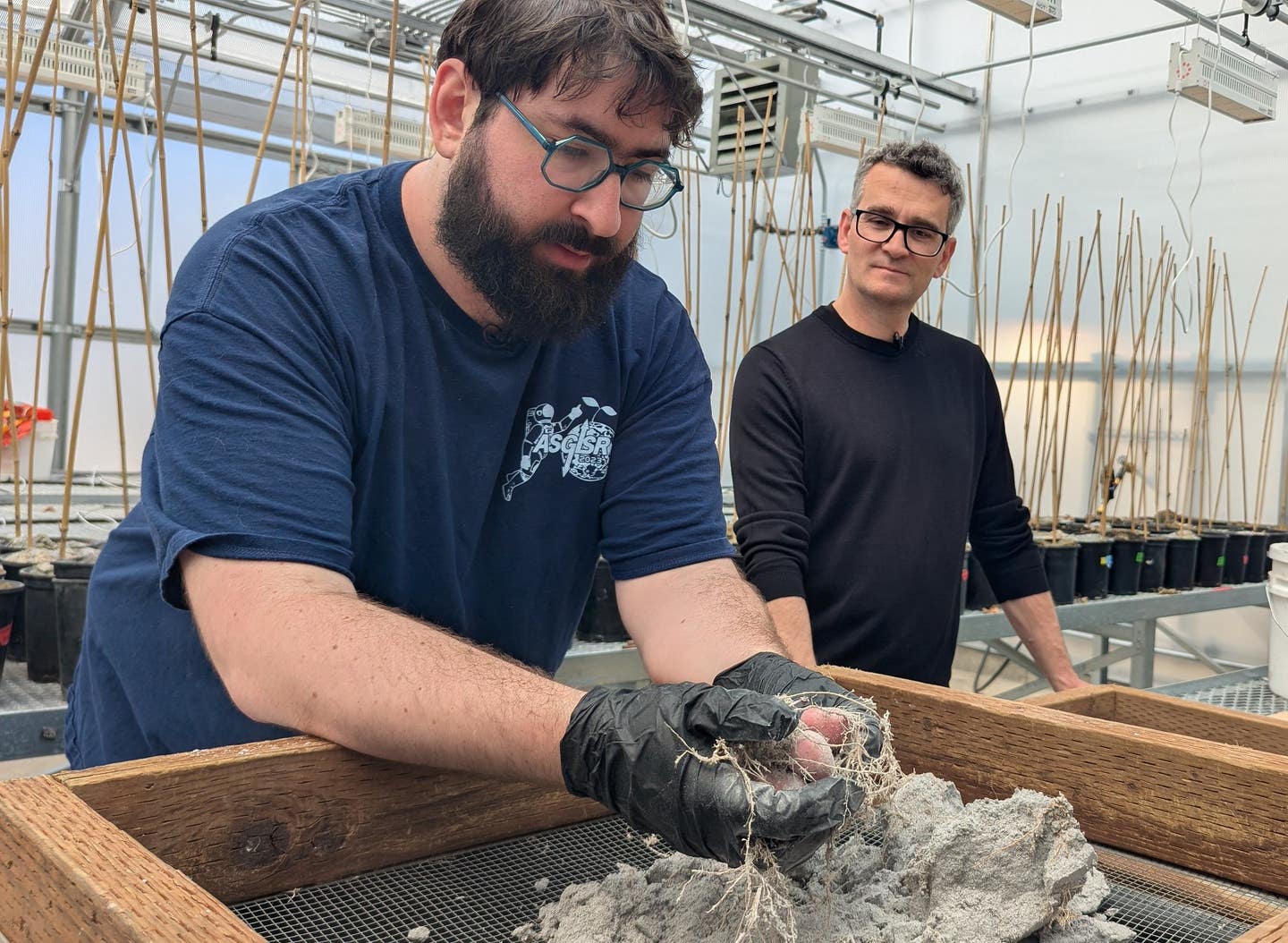
Oregon State University postdoctoral scholar David Handy and associate professor Aymeric Goyer examine potatoes grown in soil designed to simulate conditions on the Moon. (CREDIT: Sean Nealon/Oregon State University)
- Potatoes grown on Earth in one lunar-soil simulant mixed with 30% vermicompost achieved growth and tuber production comparable to a terrestrial-soil control.
- All treatments received fertilizer. A separate test with five simulants and 5% compost produced lower tuber yields than Earth soil.
- Tuber chemistry and toxin measurements were encouraging, but the experiments do not establish food safety or crop performance under actual lunar conditions.
Potatoes can produce harvestable tubers in simulated lunar soil when researchers add organic matter and fertilizer. In one greenhouse experiment, a mixture containing 30% worm-produced compost supported growth comparable to an Earth-soil control. The result advances an important question for lunar exploration: how much local material could future food systems use?
Aymeric Goyer and colleagues at Oregon State University report the findings in npj Microgravity. Their experiments examined plant growth, tuber chemistry and changes in gene activity. The study used manufactured substitutes for lunar regolith, the loose rock and dust covering the Moon’s surface.
The work builds on experiments with plants in regolith, including studies using small samples returned by Apollo missions. Those tests showed that germination alone does not establish a productive crop. Roots, shoots and edible tissues must all develop successfully.
Research on chickpeas has explored another possible lunar staple. Growing potatoes in lunar soil simulants tests a crop with a practical advantage: substantial food energy from a relatively small area. This study followed the Modoc variety, which produces red-skinned tubers with white flesh, through growth and harvest.
Growing potatoes in lunar soil simulations
The first experiment compared a lunar mare simulant, called LMS-1E, with sandy soil collected near Hermiston, Oregon. Mare refers to the Moon’s dark volcanic plains. Researchers mixed each substrate with either zero, 15% or 30% vermicompost by volume, then planted small seed tubers.
Vermicompost is organic material processed by earthworms. Every treatment also received slow-release fertilizer to prevent nutrient deficiencies from obscuring other effects of the substrate. Consequently, the findings describe a managed growing system rather than the performance of compost and simulated regolith alone. The researchers supplied nitrogen and other nutrients so they could investigate stresses associated with the mineral material.
That distinction matters across space agriculture. A mineral growing medium still needs suitable water, nutrients and environmental conditions. Here, plants grew in an Oregon greenhouse under Earth gravity, with daytime temperatures of 22°C and nighttime temperatures of 18°C.
At harvest, 74 days after planting, the 30% compost treatment restored most measured growth traits to levels comparable to the terrestrial control. Tuber mass matched or exceeded that control in some replicates. As with other alternative substrates, that comparison applies to the tested conditions, rather than commercial field yields.
Why compost made a difference
Without compost, plants in LMS-1E showed severe stunting and poorly developed roots. Three of four plants had roots weighing below the measurement threshold of 0.01 grams. The 15% mixture produced intermediate growth, although it did not differ statistically from either comparison group.
The team suspects metal exposure contributed to the damage. Plants in unamended simulant accumulated more copper in their leaves and tubers than the Earth-soil controls. Organic matter may provide binding sites that make copper less available for plants to absorb, but the proposed mechanism needs further testing.
Research on recycled waste similarly investigates ways to improve mineral materials for cultivation. Compost could eventually connect crop production with the reuse of food scraps and plant residues. This experiment used commercially sourced vermicompost rather than a functioning lunar waste-recycling system.
Water movement also matters, as experiments with water-retaining soil illustrate. The potato study measured differences in substrate moisture, acidity and chemistry. Improving one property may not resolve all the stresses that roots encounter, so researchers need to evaluate the complete growing medium.
Five simulants produced different stresses
The second experiment tested five lunar simulants representing mare and highland environments. Each received 5% vermicompost, allowing enough growth for analysis while retaining measurable stress. Researchers included the Earth-soil control and harvested tubers 59 days after planting. This experiment asked how substrate composition affected the crop, rather than whether the higher compost dose could rescue every simulant.
All five simulants produced lower tuber mass than the control. One highland simulant, NUW-LHT-5M, caused particularly severe impairment, including delayed emergence. Only three of its five plants grew large enough for scanner detection and produced harvestable tubers.
Earlier Apollo-soil experiments also found stressful growing conditions. In the potato study, different simulants triggered distinct patterns of gene activity in leaves. The researchers therefore found evidence of several biological responses rather than a single, uniform reaction to simulated Moon material.
Those differences complicate plans for potatoes in lunar soil. Just as photosynthesis research examines how plants manage energy, crop testing must examine the conditions supporting that machinery. The successful 30% treatment involved one simulant, so it does not demonstrate equivalent performance across all five materials.
What the tuber tests show
The researchers examined harvested tubers as well as plant size. Their analyses found relatively modest changes in measured metabolites, the small molecules involved in cellular chemistry. Six of seven targeted compounds showed no statistically significant differences across the analyzed treatments. These included vitamin C and other selected compounds, so the findings concern measured components rather than a comprehensive dietary assessment.
Two targets were solanine and chaconine, naturally occurring potato glycoalkaloids that can be toxic at excessive levels. Neither increased significantly under the tested conditions. That is reassuring evidence about those compounds, although an absence of statistical significance does not prove identical concentrations or complete safety.
Metal measurements add another qualification for astronaut nutrition. Some simulants increased copper or zinc accumulation, while two highland simulants increased aluminum in tubers. The authors described the overall accumulation as modest and called for verification in future experiments.
Planning space menus requires both nutritional value and dependable food safety. The measurements support further development, but do not establish the safety of every possible harvest. Actual regolith, repeated crop cycles and different growing conditions could produce different results.
Practical implications
The study gives researchers a useful recipe to test further: one simulant containing 30% vermicompost, supplied with fertilizer and water. “We found that potatoes can complete their entire life cycle in simulated lunar soil when supplemented with organic matter,” Goyer said. The next challenge is determining how reliably that performance transfers to other substrates and larger production systems.
Long missions could combine crops with other approaches, including microbial food production. Regolith-based cultivation offers one possible way to reduce transported growing materials. Researchers still need to compare its demands on water, energy, fertilizer and crew time with alternative systems. A productive pot is one component of that calculation; a dependable food supply requires repeated harvests and reliable supplies.
Experiments involving yeast in space show the broader effort to build biological production systems beyond Earth. Growing potatoes in lunar soil would also require a protected habitat. These greenhouse tests did not reproduce lunar gravity, radiation or the full chemistry of weathered Moon dust.
The team plans to report separate experiments involving 10 potato varieties. Co-authors include David Handy, Anika Loeffler, Medora Knudson, Sydney Campbell, Pankaj Jaiswal and Jeffrey Anderson. Future work must establish which combinations of crop, substrate and recycled inputs can repeatedly deliver nutritious tubers under conditions closer to a lunar farm.
Dig deeper into crops and lunar growing materials
These resources examine regolith amendments, plant stress and the design of extraterrestrial crop experiments.
Bioremediation of lunar regolith simulant through mycorrhizal fungi and plant symbioses enables chickpea to seed: Experiments investigate how compost and beneficial fungi support chickpea seed production in simulated lunar material. (Scientific Reports, 2026)
Overview and recommendations for research on plants and microbes in regolith-based agriculture: This perspective examines experimental design, simulant selection and microbial research for future regolith-based cultivation. (npj Sustainable Agriculture, 2024)
Green compost amendment improves potato plant performance on Mars regolith simulant as substrate for cultivation in space: Researchers test how compost changes a Martian simulant and the performance of potato plants grown in it. (Plant and Soil, 2023)
Plants grown in Apollo lunar regolith present stress-associated transcriptomes that inform prospects for lunar exploration: A study using genuine Apollo material documents plant growth and gene activity associated with environmental stress. (Communications Biology, 2022)
The Potential for Lunar and Martian Regolith Simulants to Sustain Plant Growth: A Multidisciplinary Overview: This review compares simulant properties and methods for improving their suitability as crop substrates. (Frontiers in Astronomy and Space Sciences, 2022)
Research findings are available online in the journal npj Microgravity.
The original story "Researchers grow potatoes in simulated lunar soil using compost and fertilizer" is published in The Brighter Side of News.
Related Stories
- ISS test finds that moon dust could be effective as a lunar building material
- Scientists create space bricks for moon base using microwaves and lunar soil
- 3D printed moon dust structures could be the future of lunar construction
Like these kind of feel good stories? Get The Brighter Side of News' newsletter.
Joseph Shavit
Writer, Editor-At-Large and Publisher
Joseph Shavit, based in Los Angeles, is a seasoned science journalist, editor and co-founder of The Brighter Side of News, where he transforms complex discoveries into clear, engaging stories for general readers. With vast experience at major media companies like The Los Angeles Times, Times Mirror and Tribune Publishing, he writes with both authority and curiosity. His writing focuses on space science, planetary science, quantum mechanics, geology. Known for linking breakthroughs to real-world markets, he highlights how research transitions into products and industries that shape daily life.