Scientists generate electricity from living prickly pear cacti
Prickly pear stems produce measurable electrical outputs linked to their water-saving photosynthesis. Researchers are studying whether that energy could support farm sensors, while testing how light, drought and nutrients shape the signal.
 UC Santa Cruz Writer: Emily Cerf

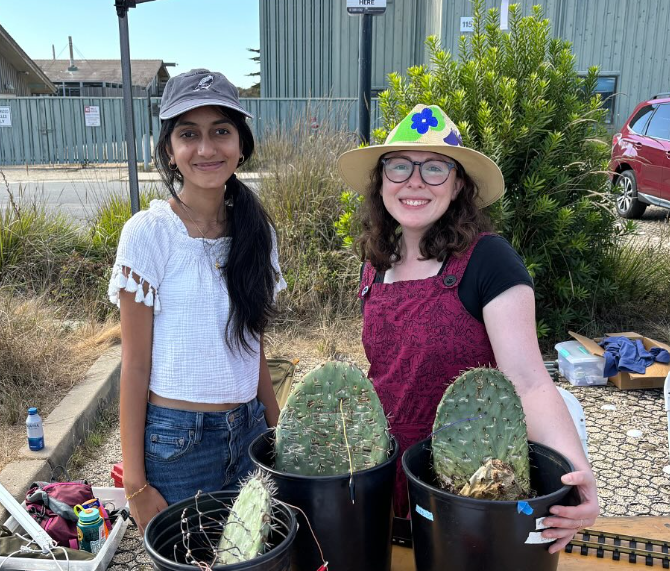
Undergraduate alumna researcher Sahithi Adiraju (left) and graduate alumna Charlie Chesney demonstrating their prickly pear cactus solar panels. (CREDIT: UC Santa Cruz)
Fine wires inserted into a prickly pear cactus can pick up an electrical signal that changes as the plant goes about its day. Researchers are exploring whether that small output could eventually help run farm sensors. The energy source would grow alongside the crops those instruments monitor.
The work at the University of California, Santa Cruz draws on the cactus’s water-saving approach to photosynthesis. Environmental studies researcher Charlie Chesney and professor Michael Loik led the project, reported in Plants, People, Planet. Their experiments examined how differences between opposite sides of a stem produce a measurable voltage.
The idea joins a broader effort to build useful technologies around living plants. Here, the goal is modest electrical harvesting for small devices, with possible clues to plant physiology along the way. The findings also show why measuring voltage is only the beginning of making a practical power source.
A nighttime habit creates a daytime opportunity
Prickly pears conserve water through crassulacean acid metabolism, usually shortened to CAM. Many crops open microscopic pores during daylight to take in carbon dioxide, losing water in the process. CAM plants generally shift that intake to cooler nighttime hours, a strategy associated with drought-resistant plants. When the air is cooler, opening those pores generally costs the plant less water, leaving more available for survival.
They store the captured carbon in malic acid. During the following day, they release carbon dioxide from that reserve for sugar production. Sunlight still powers the light-dependent reactions of photosynthesis; CAM changes the timing of carbon capture and use.
The cactus’s thick, opaque pads create another useful difference. Photosynthetic tissue occupies roughly the outer two millimeters, and each side receives a different amount of light. That uneven exposure affects how the sides process their acid stores during photosynthesis.
An acidity difference can therefore develop across the pad, producing an electrochemical potential. The researchers inserted electrodes into opposing sides to measure it. Their results support a role for concentration gradients, although the paper also identifies other ions and biological processes that may contribute to the measured voltage.
Wiring up a living power source
The team studied Opuntia streptacantha, a prickly pear species, in experiments spanning February 2022 to September 2024. They rooted pads taken from three established campus plants and tested them outdoors, in greenhouses and in laboratories. Sensors recorded electrical measurements and acidity alongside changing environmental conditions.
The university reports that individual stems produced voltages up to about half a volt, while eight linked stems reached 4.5 volts. Those numbers are useful for exploring energy harvesting, but they describe voltage rather than the rate of energy delivery. That rate also depends on current.
A standard AA battery has a nominal voltage of 1.5 volts, but the comparison does not establish equivalent power or stored energy. Unlike conventional solar-powered greenhouses, this system harvests a small output from living tissue. Its proposed role is to supply electronics with very low energy demands.
The project also brought together students from engineering, sciences and social sciences. Seven former undergraduate researchers became study authors, contributing different skills to the shared problem. “It was a fun way to explore climate solutions that put creativity first,” Chesney said. Loik’s roughly 40 years studying cactus physiology helped shape the prediction that their daily acid cycle could generate a harvestable signal.
Sunlight matters, but the response is complicated
Seasonal measurements showed higher maximum voltage and larger daily voltage swings in summer than in winter. In that experiment, average maximum daily voltage reached about 60 millivolts in summer, compared with about 11 millivolts in winter. These values describe that particular comparison, rather than the highest outputs reported across the project.
“Just how closely the voltage aligned with the sunlight conditions was really surprising,” Chesney said. Timing matters in plant monitoring, because a reading taken at one hour may miss a pattern that unfolds across the day. The team followed both light exposure and electrical changes over time.
Controlled-light experiments revealed a more complicated relationship. Voltage, current and power followed a U-shaped response across the tested daily light treatments, with higher values at both the lowest and highest exposures. The findings therefore do not establish a single middle level of light as universally best.
The researchers discuss several interacting processes, including protective responses to strong light, acid availability and differences between stem surfaces. Understanding those relationships will matter if the voltage becomes a tool for assessing crop health. A larger reading cannot automatically be interpreted as a healthier or more productive plant.
Drought resilience comes with a monitoring catch
The drought experiment produced another surprise. Researchers withheld water for 15 months, then compared eight droughted stems with eight watered stems under controlled lighting. The droughted plants became substantially thinner and produced no new pads, while the watered controls each grew a daughter stem.
Despite those visible effects, their electrical outputs generally persisted. Under some light conditions, droughted stems had higher voltage measurements than controls. The result adds an unusual dimension to research on drought response: a plant’s electrical signal can remain strong even when growth and water storage have suffered.
That resilience could be useful for harvesting energy in dry places. It also means voltage alone may be a poor warning of water stress. Other work on plant water access highlights how much can happen beneath outward signs of survival; here, continued electricity production did not mean drought had no consequences.
The authors suggest internal carbon recycling may help maintain the gradient during drought, even when the plant takes in little fresh carbon dioxide. That remains a proposed explanation. It helps frame why an electrical measurement needs physiological context before it becomes an agricultural decision tool.
From experimental pads to useful farm equipment
Nutrients provided a different possible application. In experiments led by undergraduate Erin Langness, added nitrogen prolonged voltage later into the afternoon. The team interprets that persistence as consistent with larger acid reserves supporting daytime activity, potentially offering information about fertilizer needs.
The nitrogen treatment did not significantly increase maximum voltage or its daily range. That distinction matters: the useful signal may lie in its duration, rather than its peak. The researchers envision prickly pears contributing both renewable energy and information within a farm monitoring system. Prickly pears already supply edible pads, known as nopales, and fruits called tunas, giving plant monitoring a direct agricultural use.
Getting there requires better connections. Wound healing developed around inserted electrodes after about three days, potentially restricting current, so researchers replaced or repositioned electrodes during measurements. Future designs could combine improved contacts, multiple pads, energy-management circuits and temporary storage to accumulate small outputs for sensor use. Such a system would need to budget energy for taking measurements, storing readings and sending them to a receiver.
Electrical engineering assistant professor Colleen Josephson and doctoral student John Madden are continuing the project. Other CAM plants, including agave and pineapple, are possible candidates, although their suitability remains untested here. The next challenge is turning a cactus’s measurable daily chemistry into a dependable source of small amounts of electricity.
Dig deeper into plant electricity and farm sensors
These resources explore biological energy harvesting, CAM photosynthesis and electronics that monitor living plants.
- Machine learning-enabled implantable plant biomarker sensor for early detection and classification of acid and salt stress: Develops an implanted sensor and classification system to distinguish plant stress types and levels, illustrating the interpretation needed to turn biological signals into useful information. (Nature Communications, April 2026)
- Sunflower-like self-sustainable plant-wearable sensing probe: Combines solar-energy harvesting, sap-flow sensing and light-based communication in a wearable plant device, offering a comparison for the goal of self-powered monitoring. (Science Advances, December 2024)
- Wearable sensor supports in-situ and continuous monitoring of plant health in precision agriculture era: Reviews plant-wearable sensing technologies, their measurements and the obstacles to reliable monitoring under agricultural conditions. (Plant Biotechnology Journal, January 2024)
- Engineering crassulacean acid metabolism to improve water-use efficiency: Explains the coordinated day-and-night processes behind CAM and the challenges of transferring its water-saving traits into other crops. (Trends in Plant Science, May 2014)
- From Dynamic Measurements of Photosynthesis in a Living Plant to Sunlight Transformation into Electricity: Describes an earlier cactus biofuel-cell approach that harvests products of photosynthesis, providing historical context for a mechanism distinct from measuring opposite-side concentration gradients. (Analytical Chemistry, February 2010)
Research findings are available online in the journal Plants People Planet.
The original story "Scientists generate electricity from living prickly pear cacti" is published in The Brighter Side of News.
Related Stories
- New wallpaper generates electricity from the moisture inside your home
- New coating helps solar panels generate electricity from raindrops and sunlight
- Researchers create prototype device that generates electricity from shadows
Like these kind of feel good stories? Get The Brighter Side of News' newsletter.
Joshua Shavit
Writer and Editor
Joshua Shavit is a NorCal-based science and technology writer with a passion for exploring the breakthroughs shaping the future. As a co-founder of The Brighter Side of News, he focuses on positive and transformative advancements in technology, physics, engineering, robotics, and astronomy. Having published articles on AOL.com, MSN, Yahoo News, and Ground News, Joshua's work highlights the innovators behind the ideas, bringing readers closer to the people driving progress.