Scientists bring photonic quantum emulation closer to the desktop
A classical emulator reproduces selected statistics from photonic quantum experiments with far less memory and computing hardware than an earlier method. The advance strengthens quantum testing while preserving important limits on accuracy, speed and scope.
 University of Edinburgh Writer: Corin Campbell

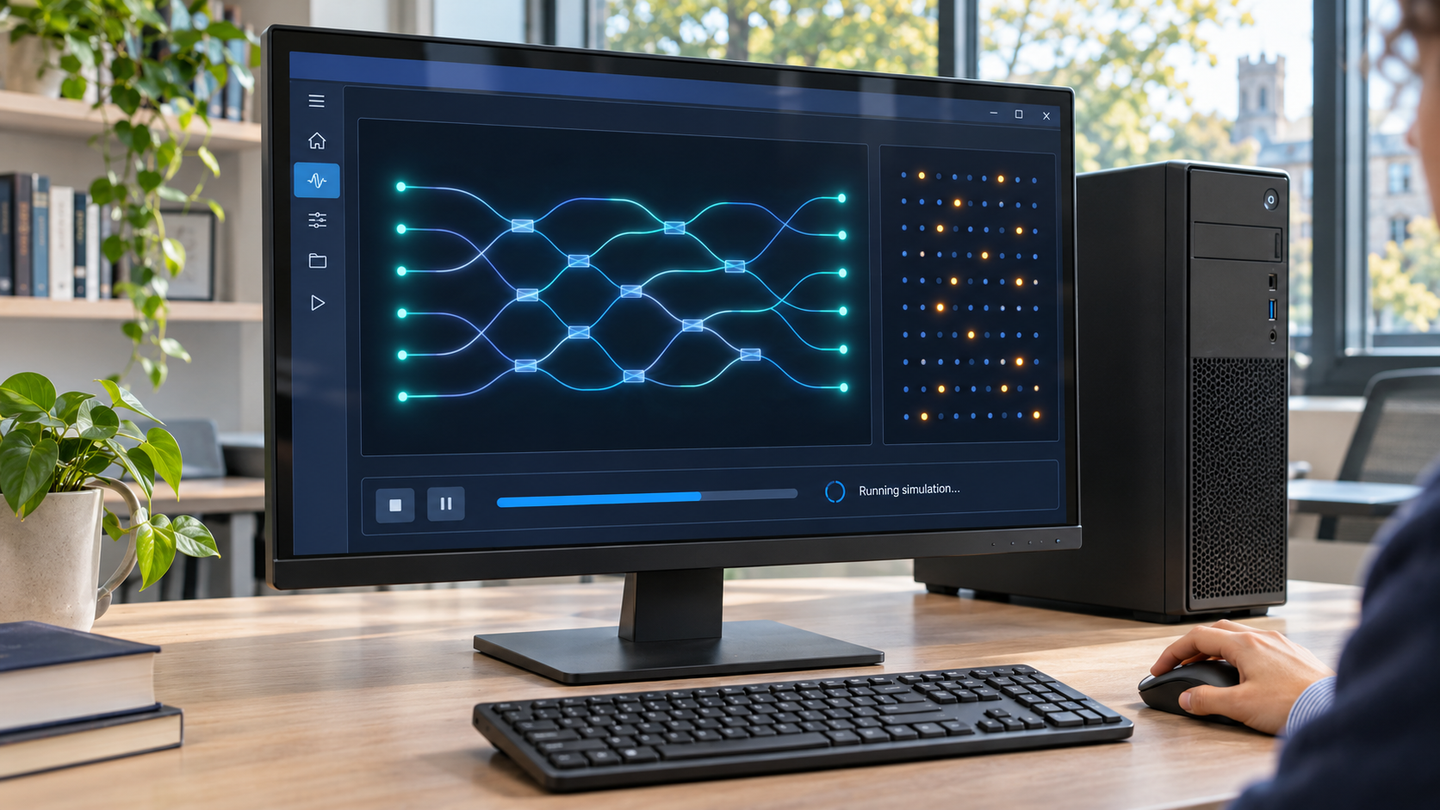
Conceptual visualization of a quantum simulation application running on a desktop computer. A new algorithm makes selected photonic quantum experiments easier to emulate using conventional computing hardware. (CREDIT: The Brighter Side of News)
A quantum computer’s claim to an advantage depends partly on how well ordinary computers can keep up. Improve the classical software, and a once-formidable comparison can change. Researchers have now developed an algorithm that brings simulations of certain light-based quantum devices within reach of much more accessible hardware.
The team, from the University of Edinburgh, its supercomputing center EPCC and Polytechnique Montréal, reports the advance in Science Advances. Its emulator matched or exceeded imperfect photonic experiments on selected statistical tests. That extends a continuing effort to improve classical simulations alongside quantum hardware. The paper’s lead author, Tom Dodd, is a doctoral researcher in Edinburgh’s School of Informatics.
Edinburgh describes the resource requirement as around five percent of that previously needed for the simulations. The paper provides more specific comparisons in memory and hardware use. Together, the findings could make it easier for researchers to investigate where present devices fall short and which improvements would make them harder to simulate.
Following patterns made by light
The work focuses on Gaussian boson sampling, a specialized task used to explore possible quantum computational advantage. In these experiments, carefully prepared light travels through an optical network. Detectors record patterns at the output, with different patterns occurring according to quantum probabilities.
The challenge is to generate samples following those probabilities. Light particles, or photons, interfere as they travel through the network. For sufficiently large ideal systems, researchers expect the resulting sampling problem to be extremely difficult for classical computers.
Actual optical circuits contain losses and other imperfections. Those effects change the patterns that emerge, including relationships between detector outputs. An algorithm aimed at reproducing a real experiment can therefore face a different challenge from one asked to reproduce an ideal, error-free device.
The new study concentrates on detectors that report whether light was detected, rather than exactly how many photons arrived. Each output can be represented as a zero or one. The emulator generates strings of those outcomes using a statistical description of the experimental system. Success is assessed through the patterns of many runs, rather than by checking whether any single outcome looks convincing.
Keeping the correlations that matter
The algorithm’s central idea is to organize relationships between outputs into progressively larger groups. Knowing how often two detectors click together provides information beyond each detector’s individual behavior. Larger groups can reveal additional relationships that pairs alone do not capture.
Researchers describe those additional relationships using quantities called cumulants. In current experiments, quantum errors and losses can weaken the higher-order relationships. That makes it possible to investigate whether a limited collection of smaller-group information can reproduce the statistics that benchmark tests examine.
The team’s implementation retained terms through fifth order in the experimental comparisons. It combined those precomputed quantities with approximations that help choose each successive output bit. Reusing intermediate calculations reduced the cost of generating samples while matching the statistics of relevant quantum correlations on the tests performed.
This is an approximation with conditions, rather than a guarantee that every quantum distribution becomes easy. Its usefulness depends on higher-order correlations being small enough to neglect and the retained information being efficiently calculable. Stronger correlations in future hardware could require a more demanding approximation. At a fixed approximation order, sampling costs grow polynomially with the number of modes, although retaining larger groups raises that cost.
Bringing the calculation onto smaller machines
The researchers report that their method can operate on a single central processing unit or graphics processing unit. An earlier approach needed more than 100 GPUs to deliver essentially equivalent sampling performance in their comparison. That opens the tools to laboratories without routine access to large supercomputing facilities.
Memory savings are substantial too. For a 144-mode configuration, storing the cumulants required about two gigabytes, around three orders of magnitude less than the earlier state encoding. Additional working data required memory as well: about 2.5 gigabytes for auxiliary indices and two megabytes per sampling thread.
For the full experimental comparisons, the team generated ten million samples in 115 minutes using eight GPUs on one cluster node. The workloads can run in parallel, helping these simulation tools benefit from extra processors. The claim of accessible hardware should therefore be read alongside the resources used for that larger sampling run.
“Our work has contributed significant improvements in memory use, running time and energy costs in the simulation of photonic quantum computing devices, making mainstream what was before only accessible to a handful of facilities in the world,” said Raúl García-Patrón. Cheaper testing could help researchers assess proposed optical hardware before committing more resources to experiments.
What matching a quantum experiment means
The emulator was evaluated against configurations of the Jiuzhang 2.0 and 3.0 photonic experiments. The team compared correlations and the distribution of detector clicks with a mathematical description that includes losses. On these measures, its results sometimes aligned with that reference better than the experimental samples did.
Such comparisons help check quantum experiments, but statistical agreement has limits. Calculating the entire output distribution is impractical at the sizes under discussion. The authors therefore used established benchmarks rather than proving that their sampler exactly reproduces every output probability.
One Jiuzhang 3.0 comparison also simplified the detector readout. Although the state before measurement involved 1,152 modes after time multiplexing, the researchers evaluated a coarse-grained version with 144 modes. That qualification matters when judging what the classical checks cover.
Speed is another separate question. The paper illustrates quantum hardware producing ten million samples in about ten seconds, compared with the emulator’s 115-minute run on eight GPUs. Outperforming a device on selected accuracy benchmarks therefore does not mean generating samples faster than that quantum machine.
A moving target for future hardware
The result gives designers a clearer challenge: adding more optical modes alone may not establish a harder sampling task. Devices also need to preserve meaningful higher-order correlations through losses and imperfections. Better classical software helps reveal when those relationships are missing from an experiment’s output.
That makes the emulator potentially useful alongside advances in photonic components and other quantum architectures. The researchers are exploring ways to scale toward thousands of modes. Doing so may require multiple computing nodes and more careful handling of very small probabilities. Generating samples independently allows the work to be distributed, but scaling the preparation stage remains another implementation challenge.
The paper also leaves rigorous bounds on approximation accuracy for future work. Possible extensions beyond this sampling task depend on specific mathematical conditions, so the advance cannot be generalized to every quantum computing system. The research received support from the UK’s Engineering and Physical Sciences Research Council and Canada’s Natural Sciences and Engineering Research Council.
For now, the practical gain is a more affordable way to test particular photonic experiments against a stronger classical competitor. That can sharpen claims of quantum advantage and guide hardware improvements. As the quantum machines improve, the software used to judge them must improve too.
Dig deeper into photonic sampling and classical simulation
These studies explain the sampling task, experimental demonstrations and the classical algorithms that challenge their benchmarks.
- Large-scale quantum reservoir computing using a Gaussian Boson Sampler: Explores a computing application for a large photonic sampler while distinguishing its experimental comparisons from a general advantage over all classical methods. (npj Quantum Information, May 2026)
- Classical algorithm for simulating experimental Gaussian boson sampling: Develops an earlier classical simulation of imperfect photonic experiments, providing an important comparison for the new emulator’s resource savings. (Nature Physics, June 2024)
- Gaussian Boson Sampling with Pseudo-Photon-Number-Resolving Detectors and Quantum Computational Advantage: Reports the Jiuzhang 3.0 experiment and its detector scheme, supplying context for the later coarse-grained emulator tests. (Physical Review Letters, October 2023)
- Quantum computational advantage with a programmable photonic processor: Describes Borealis, a programmable photonic sampling experiment using photon-counting detection, illustrating another branch of the experimental landscape. (Nature, June 2022)
- Gaussian Boson Sampling: Introduces the squeezed-light sampling framework underlying these experiments and the arguments for its classical computational difficulty. (Physical Review Letters, October 2017)
SEO and publishing details
SEO title: New software makes quantum experiments easier to simulate
Focus keyphrase:
Meta description:
Excerpt:
Slug: photonic-quantum-simulation-classical-emulator
Primary category: Innovations
Article topic: Physics
Subtopic: Quantum Computing
Featured image caption: Conceptual scene of a researcher comparing computer simulations with a photonic experiment. A new classical algorithm reproduces selected benchmark statistics from imperfect light-based quantum devices using substantially fewer computing resources. (CREDIT: The Brighter Side of News)
Suggested image alt text: Conceptual scene of a scientist at a workstation beside a photonics bench with optical components and carefully aligned light paths.
Tags
, Science Advances
Research findings are available online in the journal Science Advances.
The original story "Scientists bring photonic quantum emulation closer to the desktop" is published in The Brighter Side of News.
Related Stories
- Scientists take a major step toward quantum computers that correct their own errors
- Quantum computer simulates how stored energy can become new particles
- Future quantum computers may be built like modular data centers
Like these kind of feel good stories? Get The Brighter Side of News' newsletter.
Shy Cohen
Writer