Researchers solve 100-year-old mystery behind rubber
A new study explains why carbon black transforms soft rubber into a material strong enough for tires, seals and aerospace systems.

 Edited By: Joseph Shavit

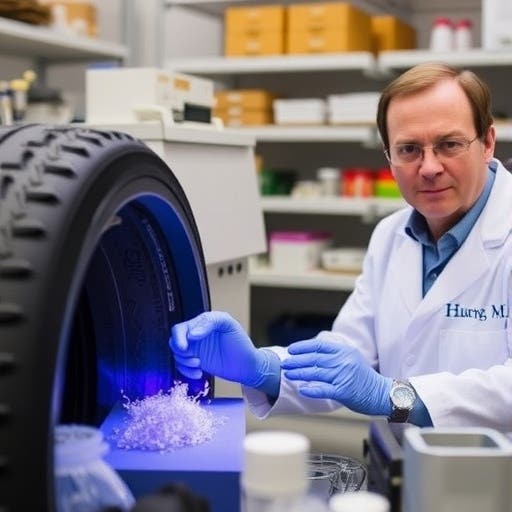
Scientists solved a century-old mystery behind reinforced rubber, explaining why carbon black makes tires and seals so strong. (CREDIT: Wikimedia / CC BY-SA 4.0)
Rubber seems ordinary until it fails.
It holds air in your car tires, seals machinery in power plants, cushions vibration in industrial equipment and keeps garden hoses from dripping. For nearly a century, engineers have relied on reinforced rubber to handle heat, pressure and repeated stress in products that millions of people use without a second thought. Yet one of the most basic questions about it remained unsettled: Why does adding tiny particles to soft rubber make it so much stronger?
A team led by University of South Florida engineering professor David Simmons now says it has the clearest answer yet. After running 1,500 molecular dynamics simulations, the researchers found that the main reason reinforced rubber becomes dramatically stiffer is not any single old theory on its own, but a deeper conflict inside the material itself.
In simple terms, the rubber is forced to resist a change in volume that it does not want to make.
"How is it that we've been using this for 80, 90, 100 years and haven't really known how it works?" Simmons said. "It's been through enormous trial and error. The tire companies can purchase many different grades of carbon black, basically fancy soot, and they just have to use trial and error to figure out what’s worth paying more for and what isn’t."
That question matters far beyond the lab. Reinforced rubber sits at the heart of the global tire business and many safety-critical systems. Tires, industrial seals, vibration dampers, actuators and medical devices all depend on it.
A century-old argument inside black rubber
The recipe itself is familiar. Add microscopic particles, usually carbon black, into rubber, and the result becomes tougher, more durable and able to survive years of wear. That is why most tires are black and why they can absorb repeated stretching and heating without falling apart quickly.
The puzzle was what those particles were actually doing.
For decades, scientists argued over competing explanations. One idea held that the particles linked into networks inside the rubber. Another suggested that sticky interactions around the particles stiffened nearby material, almost like a glue effect. A third argued that the particles simply occupied space and forced the rubber to deform differently.
Each explanation caught part of the behavior, but not enough of it.
Simmons, USF postdoctoral scholar Pierre Kawak and doctoral student Harshad Bhapkar approached the problem through simulation rather than direct observation. At the nanoscale, many of the key processes are too small and too tangled to watch clearly in an experiment. So the team built virtual models that captured how hundreds of thousands of atoms behave inside reinforced rubber.
Their computing effort was enormous.
"It's not that we literally had a simulation running for 15 years," Simmons said. "What it means is if you ran a calculation using your laptop for one hour and it used up the whole laptop with six cores, it would be six computing hours. We used USF's large computing cluster with many, many cores for many months."
When rubber cannot shrink the way it wants to
The breakthrough centers on something called Poisson's ratio, which describes how a material changes shape when you stretch it.
Rubber normally gets longer and thinner at the same time. That thinning matters because rubber strongly resists changing its overall volume. Stretch a rubber band, and it narrows as it lengthens, keeping its volume nearly the same.
Carbon black disrupts that response.
The particles act like tiny supports inside the material. When the rubber is pulled, those supports keep it from thinning as much as it normally would. That leaves the rubber with a problem. If it keeps getting longer but cannot get thin enough, then its volume has to increase. Rubber resists that increase, and that resistance sharply raises the material's stiffness.
Simmons compares the effect to pulling back the plunger of a sealed syringe full of water. Since water does not compress easily, the harder you pull, the more resistance you feel.
The same basic conflict plays out in reinforced rubber. The researchers found that the dominant strengthening effect comes from this mismatch in how the rubber and the particle network want to deform.
In other words, the material ends up fighting against itself.
That finding also helped settle the long-running debate. The older explanations were not entirely wrong. Instead, the team found that particle networks, sticky interactions and space-filling effects all contribute. They just feed into a larger picture in which the main reinforcement comes from this volume-related struggle.
More than one kind of stiffness
The simulations also uncovered another layer of behavior at very low strain.
When polymer-particle interactions were especially strong, the material developed what the researchers describe as glassy shells around the nanoparticles. In that regime, nearby polymer segments slowed down so much that they behaved almost like glass. Those glassy regions could overlap between particles, creating bridges inside the material.
That did not overturn the main explanation. The researchers found that beyond very small strains, those glassy bridge effects were not the primary driver of stiffness. Instead, they strengthened the particle network in a way that amplified the larger Poisson's ratio mismatch effect.
Still, the glassy bridges left a distinct fingerprint. They produced an ultra-low-strain response, below about 2% strain, followed by a sharp softening. According to the team, that feature could serve as a diagnostic clue for identifying when glassy bridge effects are present.
The work also suggests that engineers may be able to tune different parts of rubber behavior separately. Changing particle structure tended to boost the rubbery modulus without necessarily causing the same low-strain softening linked to glassy polymer layers. Increasing filler loading and particle attraction, by contrast, raised stiffness but also made low-strain softening more pronounced.
That matters because real products rarely need just one trait.
Why the findings matter outside the lab
For tire designers, the challenge is sometimes described as the "Magic Triangle." The goal is to improve fuel efficiency, traction and durability at the same time, even though gains in one area often hurt another.
"The struggle always is to get more than two of the three to be good, and this is where trial and error only gets you so far," Simmons said. "With these findings, we're laying a new foundation for rationally designing tires."
A better map of how reinforced rubber works could help engineers move beyond guesswork. Instead of relying mostly on repeated testing of different grades of carbon black or silica, they may eventually be able to choose particle structure, loading and interactions more precisely to hit a target combination of performance traits.
The implications stretch beyond tires. Reinforced rubber is used in infrastructure, aerospace and energy systems, where failure can be much more serious than a worn-out household gasket.
"If you remember, the reason the Challenger failed was a rubber gasket that got too cold," Simmons said. "A lot of energy systems, power plants have rubber parts. Everybody's had a garden hose that started leaking because a rubber gasket failed. Now imagine that happening in a power plant or a chemical plant."
The study does have limits. It focused on low-strain reinforcement and relied on simulations rather than direct observation at full industrial scale. The researchers also note that some secondary effects, including possible changes in effective crosslink density, still need more direct validation in future work.
Practical implications of the research
This work gives engineers a clearer framework for designing reinforced rubber with fewer costly rounds of guesswork.
It points to ways of adjusting particle loading, particle structure and polymer-particle attraction to shape stiffness and low-strain behavior for specific uses.
That could support better tire performance, more reliable seals, improved vibration control and safer rubber components in demanding systems where failure carries high consequences.
Research findings are available online in the journal PNAS.
The original story "Researchers solve 100-year-old mystery behind rubber" is published in The Brighter Side of News.
Related Stories
- Arizona start-up reinvents the wheel for a cleaner environment
- Sunsmart streets using recycled rubber last twice as long
- Tires turned into graphene that makes stronger concrete
Like these kind of feel good stories? Get The Brighter Side of News' newsletter.
Rebecca Shavit
Writer
Based in Los Angeles, Rebecca Shavit is a dedicated science and technology journalist who writes for The Brighter Side of News, an online publication committed to highlighting positive and transformative stories from around the world. Having published articles on MSN, AOL News, and Yahoo News, Rebecca's reporting spans a wide range of topics, from cutting-edge medical breakthroughs to historical discoveries and innovations. With a keen ability to translate complex concepts into engaging and accessible stories, she makes science and innovation relatable to a broad audience.