Schrödinger’s anthill: Quantum entanglement detected inside a centimeter-sized strange metal
A bulk strange metal showed deep quantum entanglement, giving physicists a new way to probe its bizarre behavior.

 Edited By: Joseph Shavit


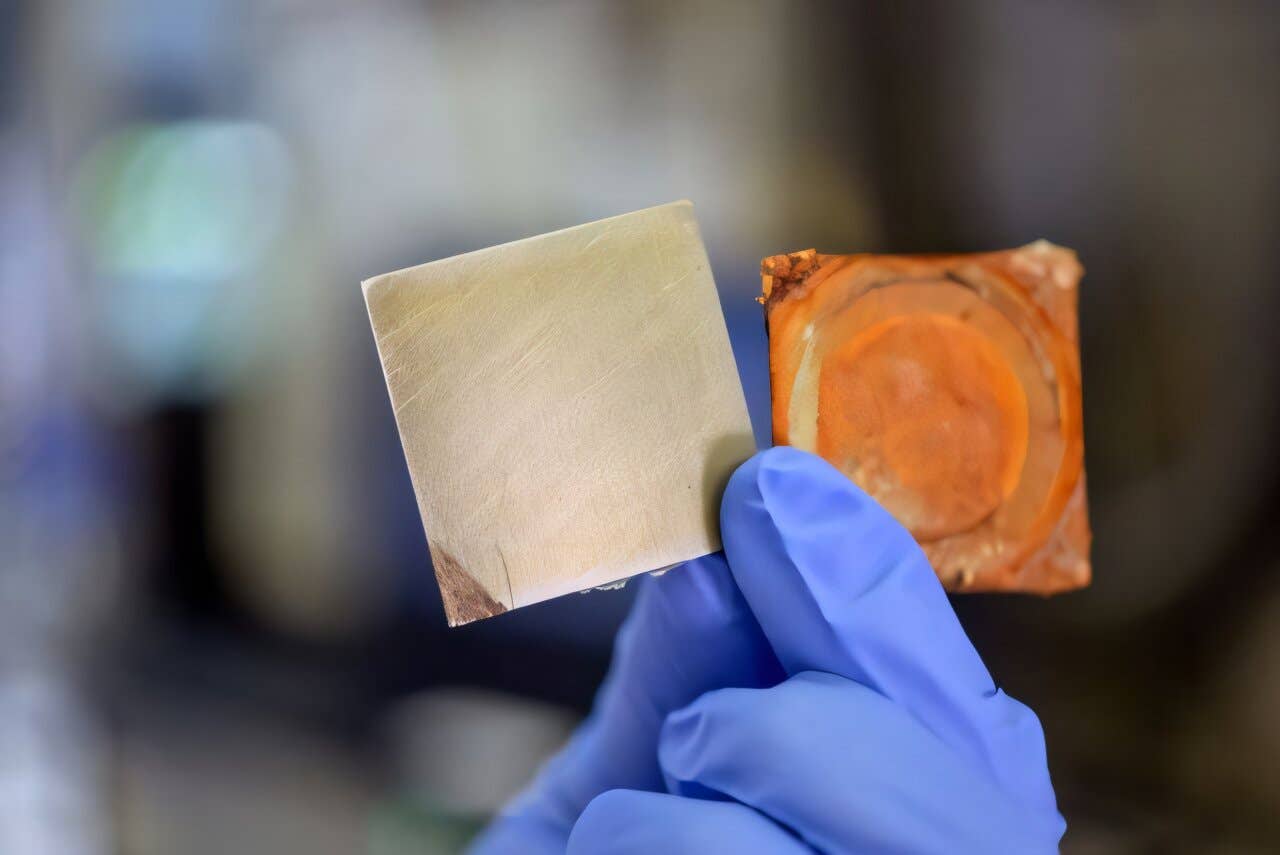
A strange metal crystal showed at least nine-partite quantum entanglement, offering a new clue to its unusual behavior. (CREDIT: TU Wien / Harald Ritsch)
A strange metal can fit in your hand, yet still behave in ways that seem to belong to a far smaller world. In a new experiment, physicists found direct evidence that a centimeter-sized crystal hosts extensive quantum entanglement. This is the kind of collective linkage more often discussed for isolated atoms or photons than for bulk matter.
That matters because strange metals have become one of condensed matter physics’ most stubborn mysteries. Their electrical resistance changes linearly with temperature at low temperatures, rather than following the standard pattern expected for ordinary metals. They also show other unusual traits. These include behavior linked to missing quasiparticles, jumps in Fermi volume, and, in earlier work on related systems, remarkably quiet electrical current.
The new measurements suggest that this odd behavior is not just another quirk of one difficult material. It may reflect a deeper organizing principle, one in which many quantum entities act together in a highly entangled state.
At the center of the work is a heavy-fermion compound, Ce3Pd20Si6, made of cerium, palladium, and silicon. Researchers at TU Wien and collaborators studied the crystal at the Institut Laue-Langevin in Grenoble. They used inelastic neutron scattering to probe how it responded under extremely low temperatures and a carefully tuned magnetic field.
A bulk crystal with a many-body quantum signal
The team’s approach did not try to place the whole crystal into an exotic superposition, the kind of thought experiment made famous by Schrödinger’s cat. Instead, they asked whether the crystal’s constituents respond collectively in a way that reveals entanglement across the material.
“Our approach is different,” says Prof. Silke Bühler-Paschen from the Institute of Solid State Physics at TU Wien. “We do not try to bring the crystal as a whole into a superposition of two states. Instead, we ask whether its constituents are – collectively – in such a state entanglement.”
She compares that behavior less to a cat and more to an anthill. When disturbed, it is not one ant reacting alone, but a whole colony responding together.
To capture that kind of collective quantum response, the researchers used a quantity from quantum information theory called quantum Fisher information, or QFI. In simple terms, QFI tracks how strongly a quantum system responds to a disturbance. If particles behave independently, the response is limited. But if they are entangled, the system can react more strongly than the sum of its parts.
“The quantum Fisher information quantifies how sensitively a quantum system responds to a change,” explains Bühler-Paschen. “For a collection of independent particles, the response is limited because each particle contributes on its own. However, if the the particles are entangled, the entire system can respond more strongly than the sum of its individual parts. This enhanced sensitivity is precisely what makes entanglement such a valuable resource for quantum metrology, where one aims to detect extremely small signals with the highest possible precision. By measuring how strongly a system responds to a perturbation, one can therefore infer the degree of entanglement present in the material”
Neutrons, low temperatures, and an unusual response
The experiment focused on a quantum critical point in Ce3Pd20Si6 near a magnetic field of 1.73 tesla. At that point, the material sits at the edge of a transition tied to the breakdown of Kondo screening, a process that normally binds local electronic degrees of freedom to conduction electrons. Near this boundary, the material enters the strange-metal regime.
Using a cold-neutron triple-axis spectrometer with high energy resolution, the team measured the crystal’s dynamical spin response down to 60 millikelvin. The data showed strong dynamical scaling with an exponent of 0.88 ± 0.02. This supports the view that the fluctuations were not ordinary order-parameter fluctuations tied to a simple phase transition.
From those neutron data, the researchers calculated the QFI density. It rose sharply as the system cooled, increasing by nearly a factor of 40 between 10 kelvin and 60 millikelvin. At the lowest measured temperature, the QFI density reached 8.2 ± 0.9.
That number matters because it can be translated into a lower bound on entanglement depth. In this case, the result indicates at least 9-partite entanglement. This means at least nine quantum entities are acting in a correlated way that cannot be explained as a set of independent particles.
“In a normal material, one would expect a neutron to transfer its energy to an individual particle,” says Federico Mazza, the PhD student who carried out the neutron measurements. “But by analyzing the data using the quantum Fisher information, we found a response that cannot be explained in terms of independent particles. Instead, it indicates that groups of at least nine quantum-entangled entities act collectively.”
A clue to the strange-metal problem
The study’s larger aim was to understand strange metallicity itself. Heavy-fermion compounds have long served as one of the main testing grounds for that question, and Ce3Pd20Si6 is already known to host a field-induced strange-metal quantum critical point. Earlier work had shown linear-in-temperature resistivity at the critical fields and a jump in the Hall response in the zero-temperature limit.
The new result adds entanglement to that picture.
“What we see here is not a detail of one particular material, but a general physical principle,” says Fakher Assaad from the University of Würzburg, lead theorist of the work. “Strong entanglement appears to be directly linked to the unusual behaviour of strange metals.”
To test whether the experimental signature reflected something broader than a single compound, the researchers also carried out auxiliary-field quantum Monte Carlo simulations of a Kondo destruction transition in a different model system. Despite clear differences between the model and the material, the simulations showed the same qualitative feature at criticality. Specifically, they observed a scale-free rise in QFI as temperature dropped.
That agreement does not solve the strange-metal problem, and the paper is careful not to claim that. Competing theoretical pictures still exist, and the authors note that a unified understanding remains out of reach. But the results strengthen the case that enhanced multipartite entanglement is part of the strange-metal state near this kind of quantum critical point.
The work also highlights why these measurements are so demanding. Because the relevant fluctuations grow strongest at very low energies and temperatures, the experiments required exceptional energy resolution, millikelvin conditions, and painstaking background subtraction. The authors argue that neutron scattering remains especially powerful here. This is true even as other techniques have been proposed for probing QFI.
Practical implications of the research
The immediate impact is conceptual: the study offers a direct way to quantify entanglement in a macroscopic quantum material, using a measurable response rather than an abstract theoretical label. That gives researchers a new tool for testing ideas about strange metals and Kondo destruction in real materials.
Longer term, the result could matter for quantum technology. Multipartite entanglement is a useful resource in quantum metrology, where stronger collective sensitivity can help detect extremely small signals.
The authors say strange metals may eventually be explored as candidates for high-precision measurement platforms, though that remains a future goal rather than a present application.
Research findings are available online in the journal Nature Physics.
The original story "Schrödinger’s anthill: Quantum entanglement detected inside a centimeter-sized strange metal" is published in The Brighter Side of News.
Related Stories
- Oxford physicists create a new kind of Schrödinger’s cat
- New theory proposes the universe collapsed itself into reality, solving Schrödinger’s cat paradox
- Schrödinger's cat theory may prove that parallel universes actually exist
Like these kind of feel good stories? Get The Brighter Side of News' newsletter.
Shy Cohen
Writer