Scientists demonstrate sustained operation of the world’s first self-regulating nuclear clock
Thorium nuclei now guide a working clock’s laser through automatic feedback, though the prototype still trails leading atomic clocks.
 Edited By: Shy Cohen

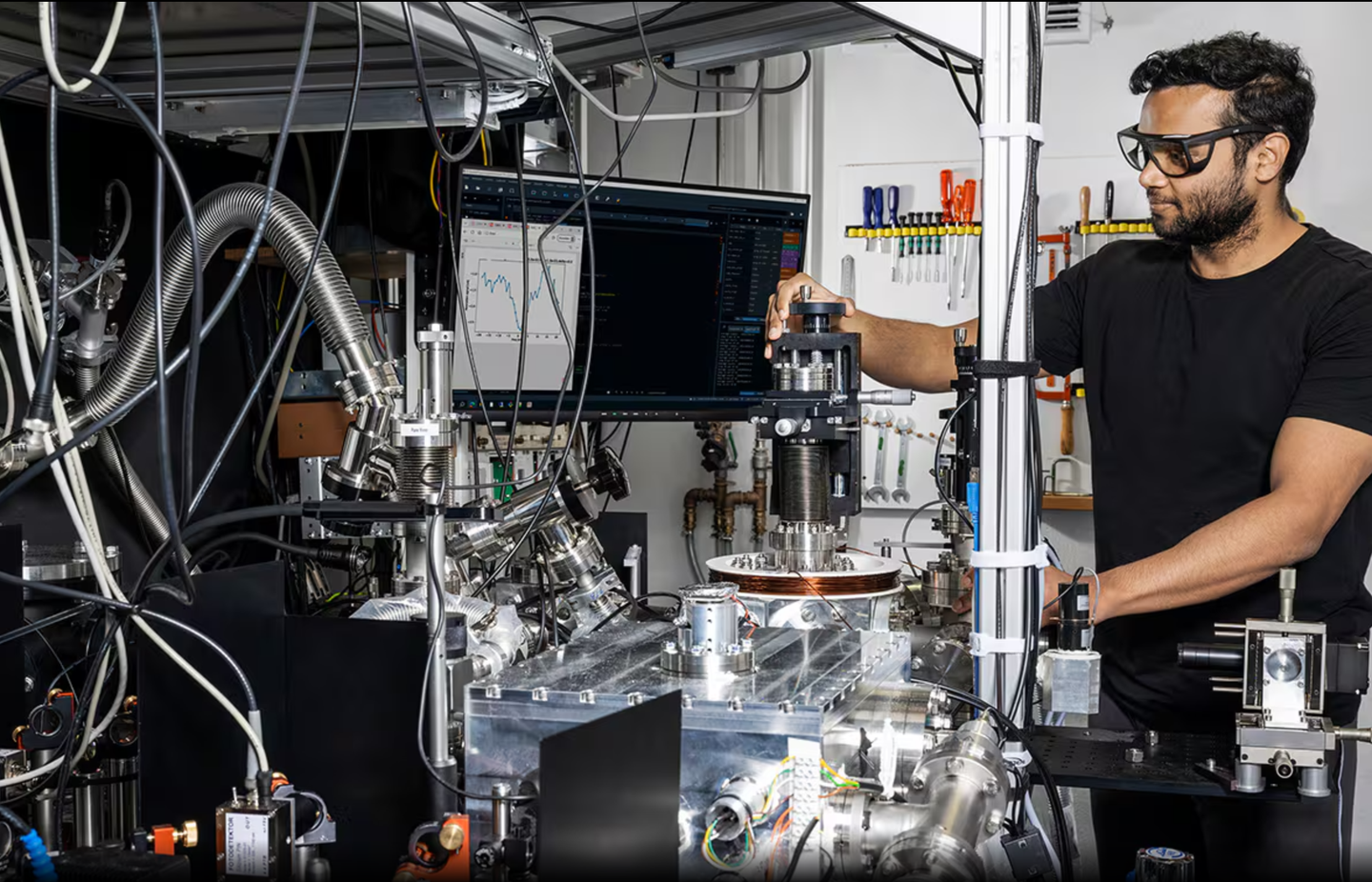
PTB researcher Vishal Lal with the PTB’s nuclear clock experiment. (CREDIT: Physikalisch-Technische Bundesanstalt)
- A thorium-229 nuclear clock in Vienna ran for more than 24 hours without intervention, automatically correcting its laser frequency.
- The crystal-based prototype establishes a working feedback system for a new approach to precision timekeeping and fundamental physics.
- It has not surpassed the best optical atomic clocks, and a preliminary dark-matter search found no significant signal.
A crystal containing thorium nuclei kept a laser on frequency for more than 24 hours without anyone adjusting it. The Vienna experiment marks a transition from measuring a nuclear resonance to using that resonance to control a working clock.
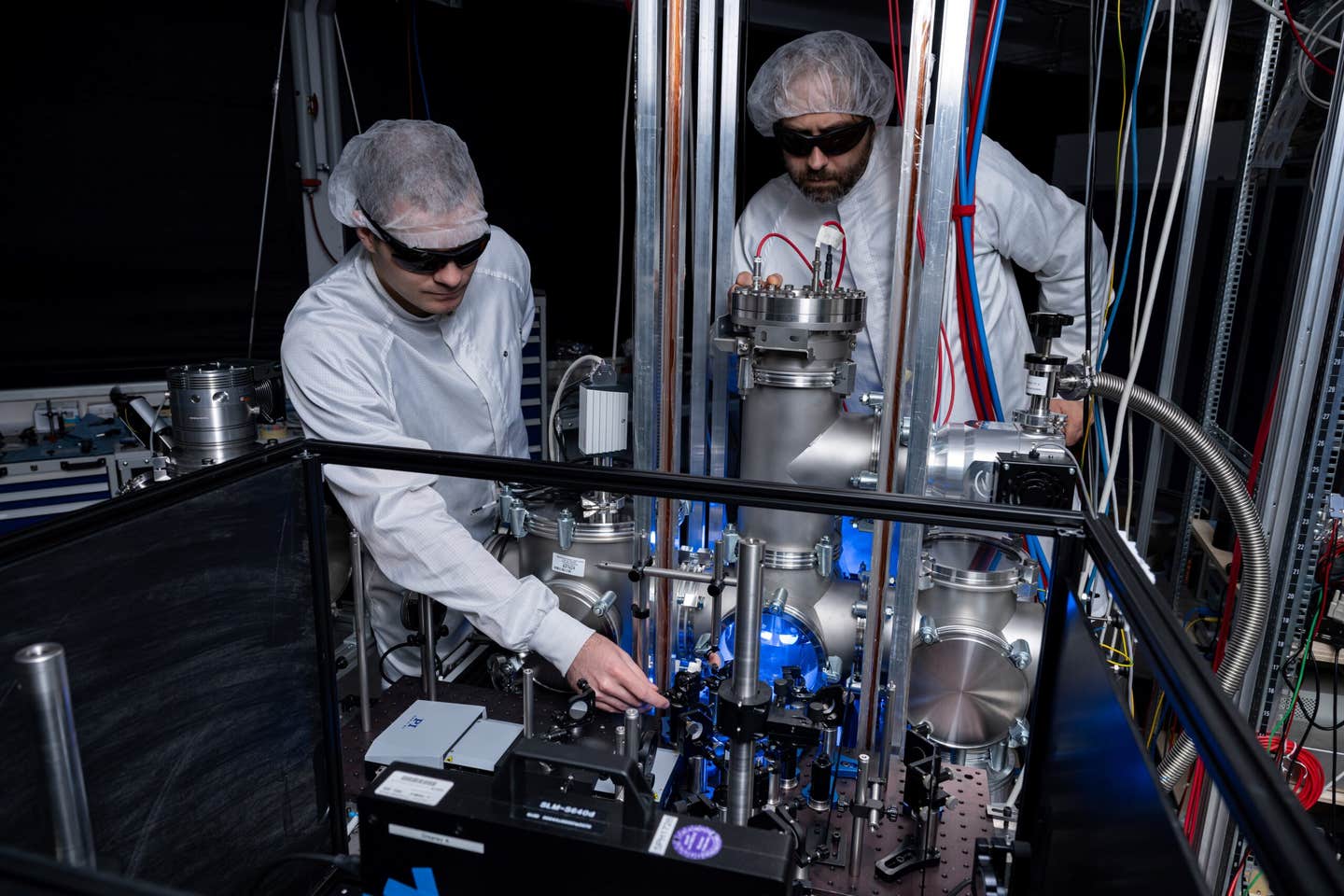
Scientists at TU Wien and Germany’s Physikalisch-Technische Bundesanstalt, or PTB, report the prototype in Nature. Led by Thorsten Schumm and Ekkehard Peik, the collaboration built a feedback loop that automatically corrects the laser. An earlier companion paper established the absorption measurements that made those corrections possible.
Conventional atomic clocks use transitions between electronic energy states as their reference. This device instead relies on a transition within the nucleus of thorium-229. Its designers hope nuclear timekeeping will eventually offer greater precision and new ways to test fundamental physics.
“What you really want is a self-stabilizing nuclear clock,” Schumm said. “The basic idea is simple: you have a laser and you have thorium. The laser changes the energy state of the thorium nuclei, and the thorium nuclei are used to stabilize the frequency of the laser.”
The prototype has not beaten the best optical atomic clocks. Its significance lies in demonstrating sustained operation with nuclear feedback, while identifying the technical problems that still limit performance.
Why thorium made the experiment possible
Most nuclear energy transitions require far more energy than ordinary optical lasers can provide. Thorium-229 is unusual because its ground state and a long-lived excited state lie exceptionally close together. The gap is approximately 8.4 electron volts, accessible with vacuum-ultraviolet light near a wavelength of 148 nanometers.
Peik and Christian Tamm proposed a thorium nuclear clock in 2003. Finding the exact laser frequency remained a major obstacle for roughly two decades. The laser needed to match a narrow transition whose energy was initially known only approximately.
TU Wien supplied calcium fluoride crystals containing large numbers of thorium nuclei. That arrangement allowed researchers to illuminate many nuclei simultaneously, improving their chances of detecting excitation. In April 2024, the Vienna and PTB teams demonstrated laser excitation of the thorium-229 nucleus.
Later that year, experiments connected the nuclear transition with a conventional optical atomic clock. Those measurements established a precise relationship between nuclear and electronic frequencies. They did not yet provide the feedback needed for a stand-alone nuclear clock.
The crystal approach also differs from clocks built around isolated atoms or ions held in vacuum. Here, the timekeeping nuclei sit inside a solid at room temperature. That arrangement offers a large population of reference nuclei, while introducing material effects that researchers must understand and control.
Measuring absorption instead of waiting for light
The original excitation apparatus used a pulsed laser system spread across optical tables. Detecting the nuclear response required illuminating the crystal, blocking the beam and watching excited nuclei emit fluorescence. The roughly 10-minute fluorescence timescale made rapid frequency corrections difficult.
PTB worked with the Max Born Institute in Berlin to develop a compact, continuously emitting laser source. Presented in December 2025, it supplied narrow-band radiation at the required ultraviolet wavelength. More stable frequency and power made a different detection method possible.
Instead of waiting for emitted light, the researchers measured how much laser light the nuclei absorbed. Absorption changes as the laser moves across the nuclear resonance. The signal arrives without waiting for the excited nuclei to decay.
In the clock, measurements at frequencies on either side of the resonance provide a correction signal. An optical cavity supplies short-term laser stability, while the nuclear measurements correct longer-term drift. The two control systems work together to maintain the clock’s frequency.
The team tested feedback intervals of 20 seconds and 30 minutes. Faster corrections allow quicker comparisons with another clock, but introduce more measurement noise. Longer intervals preserve more of the cavity’s short-term stability while correcting drift less frequently.
Stability within a run, variation between days
The researchers compared the nuclear clock with a ytterbium-ion optical clock at Austria’s Federal Office of Metrology and Surveying, or BEV. A stabilized optical fiber connection linked the laboratories. That comparison measured the prototype’s behavior rather than supplying its nuclear feedback reference.
During continuous operation, the paper reports fractional frequency instability in the low 10⁻¹⁴ range. This metric describes fluctuations in the clock’s output, rather than a complete evaluation of its absolute accuracy. Sustained stability and agreement with an ideal reference are related but different requirements.
Separate runs revealed a larger problem: frequency reproducibility was limited to approximately 5 × 10⁻¹³. Before each run, the laser system needed realignment. That could move the beam through slightly different regions of the crystal.
Measurements at different crystal positions found resonance-center differences of up to 1.7 kilohertz. Repeating measurements at the same position reproduced the frequency. The researchers suspect local strain associated with structural irregularities, although that explanation remains a hypothesis.
Stronger ultraviolet lasers could reduce measurement noise, while longer light paths through the crystal could improve the signal. More uniform crystals and a reproducible beam path could address differences between runs. Alternative host materials may also offer narrower resonances, but projected improvements remain future goals.
A first test of dark-matter interactions
The clock already provides measurements useful beyond timekeeping. The companion spectroscopy study examined different thorium environments within calcium fluoride. Their distinct responses reveal microscopic crystal structure and may guide the selection of better clock materials.
The clock experiment also searched for effects predicted by some models of ultralight dark matter. Such hypothetical particles could cause periodic changes in fundamental constants, altering the nuclear transition frequency. Comparing nuclear and electronic clocks provides a way to look for those changes.
Researchers analyzed approximately 23 hours of data taken with 20-second feedback. No oscillation exceeded their statistical detection threshold. They therefore placed upper limits on possible signals and used them to constrain proposed dark-matter interactions.
The strength of those constraints depends on the assumed nuclear sensitivity, which is not precisely known. The measurements do not demonstrate that dark matter changed the clock or establish which particles constitute it. They show how nuclear timekeeping can test hypotheses that remain unresolved.
The clock study establishes an operating system and a route to improvement. Better lasers and crystals must now turn sustained nuclear feedback into more reproducible measurements. The prototype’s achievement is a clock that can correct itself, with its ultimate precision still to be demonstrated.
Dig deeper into nuclear clocks and precision timekeeping
These resources trace nuclear-clock development and explain the measurements needed to evaluate their performance.
The thorium-229 low-energy isomer and the nuclear clock: Reviews the unusual nuclear state and its potential uses in precision measurements and fundamental physics. (Nature Reviews Physics, 2021)
Laser Excitation of the Th-229 Nucleus: Reports the laser excitation milestone that opened the way to controlling the nuclear transition directly. (Physical Review Letters, 2024)
Frequency ratio of the ²²⁹ᵐTh nuclear isomeric transition and the ⁸⁷Sr atomic clock: Establishes a frequency connection between the thorium nuclear transition and a strontium optical atomic clock. (Nature, 2024)
Frequency reproducibility of solid-state thorium-229 nuclear clocks: Examines how crystal composition, temperature and time affect the repeatability of nuclear-clock frequencies. (Nature, 2026)
Optical atomic clocks: defining the future of time and frequency metrology: Reviews optical clock performance and the challenges of incorporating these systems into precision timekeeping infrastructure. (Optica, 2026)
Research findings are available online in the journal Nature.
The original story "Scientists demonstrate sustained operation of the world's first self-regulating nuclear clock" is published in The Brighter Side of News.
Related Stories
- Physicists use thorium-229 to power the world's first working nuclear clock
- The world's first nuclear clock can detect changes in nature’s fundamental constants
- Reading a quantum clock takes more energy than operating it
Like these kind of feel good stories? Get The Brighter Side of News' newsletter.
Joseph Shavit
Writer, Editor-At-Large and Publisher
Joseph Shavit, based in Los Angeles, is a seasoned science journalist, editor and co-founder of The Brighter Side of News, where he transforms complex discoveries into clear, engaging stories for general readers. With vast experience at major media companies like The Los Angeles Times, Times Mirror and Tribune Publishing, he writes with both authority and curiosity. His writing focuses on space science, planetary science, quantum mechanics, geology. Known for linking breakthroughs to real-world markets, he highlights how research transitions into products and industries that shape daily life.