Scientists find a way to run error-protected quantum operations 1,000 times faster
Quantum lattice gates could replace thousands of control cycles with one, reducing the time fragile quantum information stays exposed to errors.
 Chalmers Writer: Henrik Dahlberg

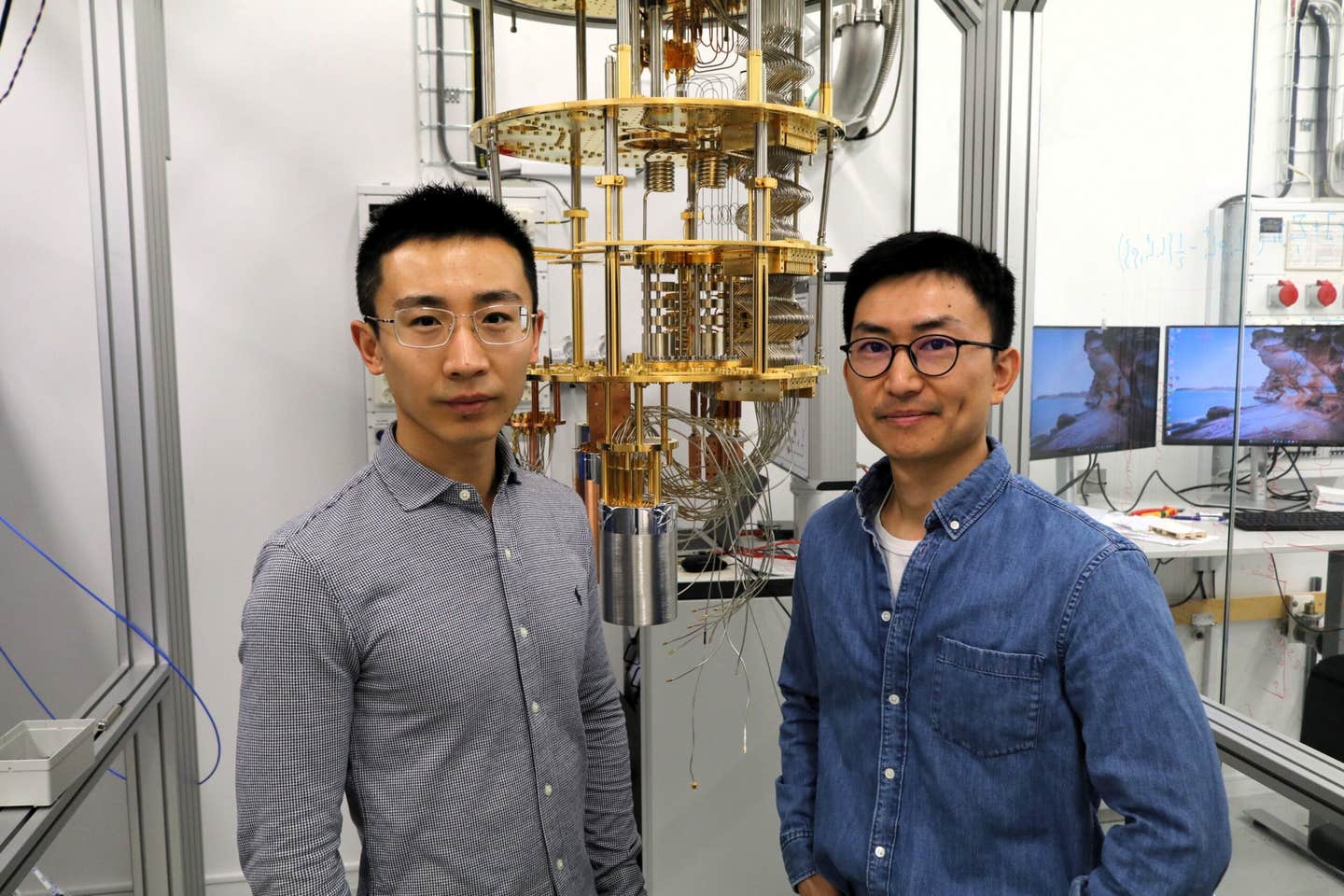
Lei Du and Tangyou Huang, Chalmers University of Technology. (CREDIT: Chalmers University of Technology_Lovisa Håkansson)
- A new theoretical method from Chalmers University of Technology could perform complex operations on bosonic quantum states within a single driving cycle instead of the thousands of cycles required by earlier Floquet-based approaches.
- The researchers numerically demonstrated the approach on binomial, cat and Gottesman-Kitaev-Preskill quantum error-correcting codes, with some operations completing in only a few microseconds and more than 1,000 times faster than earlier adiabatic protocols.
- The method is designed for superconducting quantum hardware already in use, but it remains a theoretical and numerical result that still needs to be demonstrated experimentally on a working quantum processor.
Quantum computers face a race against time every time they perform a calculation. Their quantum states are so fragile that even tiny disturbances from electrical noise, heating, radiation or imperfect hardware can push a computation away from its intended result.
A new theoretical approach from Chalmers University of Technology in Sweden could dramatically shorten the amount of time those states remain vulnerable. The method is designed to prepare and manipulate sophisticated error-protected quantum states within a single periodic driving cycle instead of the thousands of cycles required by earlier versions of the technique.
The work, published in Physical Review Letters, focuses on bosonic quantum codes and a recently introduced tool called quantum lattice gates. Numerical simulations suggest that certain operations could be completed in only a few microseconds, offering improvements of more than three orders of magnitude compared with slower adiabatic approaches.
“Our method shows that a diverse range of quantum operations on bosonic states can be completed within a single driving cycle, rather than the several thousand cycles that have been required previously,” said lead author Lei Du, a researcher in Applied Quantum Physics at Chalmers.
Quantum computers lose information easily
Quantum computers store information in qubits, but qubits are notoriously sensitive to their surroundings. Small disturbances can alter a quantum state and introduce errors that accumulate as a computation continues.
Conventional computers also experience errors, but established error-correction methods can detect and repair them efficiently. Quantum systems are harder to protect because directly measuring an unknown quantum state can disturb the information researchers are trying to preserve.
One promising solution involves bosonic quantum codes. Rather than storing quantum information only in individual two-level qubits, these codes encode information in the many possible states of an oscillator, such as a microwave field inside a superconducting cavity.
“Rather than storing quantum information in individual qubits, bosonic codes encode information in the microwave fields found within superconducting circuits,” said Tangyou Huang, a researcher in Quantum Technology at Chalmers and co-author of the study. “This approach has been shown to provide stronger protection against certain types of errors.”
A powerful technique had a major speed problem
Bosonic codes can provide built-in protection, but creating and controlling them is difficult. Previous approaches using periodically driven quantum systems often relied on a process known as adiabatic ramping.
In an adiabatic protocol, control parameters are changed gradually so the quantum system follows the desired path without being pushed into unwanted states. The approach can work well, but it may require thousands of repeated Floquet periods, leaving the quantum state exposed to noise for much longer.
That creates an uncomfortable trade-off. The control process must be gentle enough to avoid introducing errors, yet the longer it takes, the more time outside disturbances have to corrupt the information.
Du and Huang designed a way around that bottleneck. Their method constructs the desired quantum transformation mathematically and then realizes it using a sequence of quantum lattice gates compressed into a single Floquet period.
“You can think of it like building a large Lego castle,” Huang said. “Instead of assembling it brick by brick and risking mistakes along the way, quantum lattice gates act like pre-built Lego modules that can be connected quickly and efficiently.”
Quantum lattice gates provide the shortcut
Quantum lattice gates are a recently proposed set of operations for controlling bosonic quantum systems. In superconducting circuits, they can take advantage of the nonlinear behavior of Josephson junctions, components already widely used in quantum hardware.
The new approach uses a technique called noncommutative Floquet engineering to construct a target operation inside the oscillator’s quantum state space. The researchers then break that transformation into a sequence of quantum lattice gates that can be carried out within one periodic driving cycle.
The team also developed an optimal pulse engineering method. It fine-tunes the strength and timing of the control signals while accounting for limits imposed by real hardware and errors introduced by mathematical approximations.
The researchers first tested whether the framework could generate arbitrary quantum states. Their simulated outputs reproduced the expected statistical behavior of Haar-random states, a standard benchmark used to test whether a quantum-control method can reach a broad range of possible states.
The computational resources required by the method also increased linearly with the size of the modeled Hilbert space. In the comparisons performed in the study, the approach required fewer resources than a competing method based on selective number-dependent arbitrary phase, or SNAP, gates.
Three major error-correcting codes were tested
The researchers next applied the method to three widely studied bosonic error-correcting schemes: binomial codes, cat codes and Gottesman-Kitaev-Preskill, or GKP, codes. Each stores logical quantum information in a different pattern within an oscillator.
Their simulations showed that the method could prepare all three types directly from the oscillator’s vacuum state with high fidelity. The team also used quantum lattice gates to perform logical single-qubit operations within the protected code spaces.
Those operations included the Hadamard, phase and T gates, which form important building blocks for universal quantum computation. With optimal pulse engineering, the simulations produced high-fidelity operations on timescales of only a few microseconds.
The researchers report improvements of as much as three orders of magnitude in timescale, fidelity and robustness against noise when compared with the adiabatic protocol used as a benchmark. The faster operations matter because every reduction in gate time also shortens the period during which decoherence can damage the encoded information.
Existing superconducting systems could use the method
One advantage of the proposal is that it does not require an entirely new kind of quantum computer. The researchers designed the method with superconducting circuits and Josephson junctions in mind, making it potentially compatible with platforms already under active development.
“A key advantage of our approach is that it can be implemented using existing superconducting quantum circuit platforms,” Huang said. Chalmers is currently developing a 100-qubit superconducting quantum computer, and the researchers are discussing possible experimental implementations with colleagues.
That hardware test will be essential. The current results come from theory and numerical simulation, not from an experimental demonstration on a working quantum processor.
Real systems introduce additional complications, including calibration errors, finite coherence times, hardware imperfections and control noise. The present work also focuses mainly on single-mode state preparation and logical single-qubit operations, while large-scale quantum computation will require robust two-qubit logical gates as well.
The researchers say the framework can be extended to two-mode systems, potentially allowing those more complex operations in the future. For now, the work addresses one of the field’s most persistent problems: quantum error protection is useful only if creating and manipulating protected states does not take so long that errors accumulate first.
By compressing thousands of driving cycles into one, the new method could give fragile quantum information something especially valuable: far less time to go wrong.
Dig deeper into bosonic quantum computing
These resources explore quantum lattice gates, bosonic error correction and experimental approaches for protecting logical information in superconducting quantum systems.
Engineering Fault-tolerant Bosonic Codes with Quantum Lattice Gates: Introduces the quantum lattice gate framework and explains how Floquet engineering can be used to prepare and manipulate bosonic code states. (arXiv, 2024)
Hardware-efficient quantum error correction via concatenated bosonic qubits: Demonstrates a superconducting logical memory that combines bosonic cat qubits with an outer repetition code to improve protection while limiting hardware overhead. (Nature, 2025)
Fault-Tolerant Operation of Bosonic Qubits with Discrete-Variable Ancillae: Develops a framework for fault-tolerant operations on bosonic qubits using ancilla-assisted control and protected logical operations. (Physical Review X, 2024)
Research findings are available online in the journal Physical Review Letters.
The original story "Scientists find a way to run error-protected quantum operations 1,000 times faster" is published in The Brighter Side of News.
Related Stories
- World’s first superconducting quantum heat engine looks to transform quantum computing
- Quantum cat strategy reduces errors and speeds up quantum computing
- Scientists unlock scalable entanglement for next-generation quantum computing
Like these kind of feel good stories? Get The Brighter Side of News' newsletter.
Joshua Shavit
Writer and Editor
Joshua Shavit is a NorCal-based science and technology writer with a passion for exploring the breakthroughs shaping the future. As a co-founder of The Brighter Side of News, he focuses on positive and transformative advancements in technology, physics, engineering, robotics, and astronomy. Having published articles on AOL.com, MSN, Yahoo News, and Ground News, Joshua's work highlights the innovators behind the ideas, bringing readers closer to the people driving progress.