Before MeerKAT, South Africa’s Karoo telescope had its own ways of reading the stars
Around the SKA telescope, old star stories survive through practical knowledge, new meanings and changing community traditions.
 Sissa Medialab Writer: Federica Sgorbissa

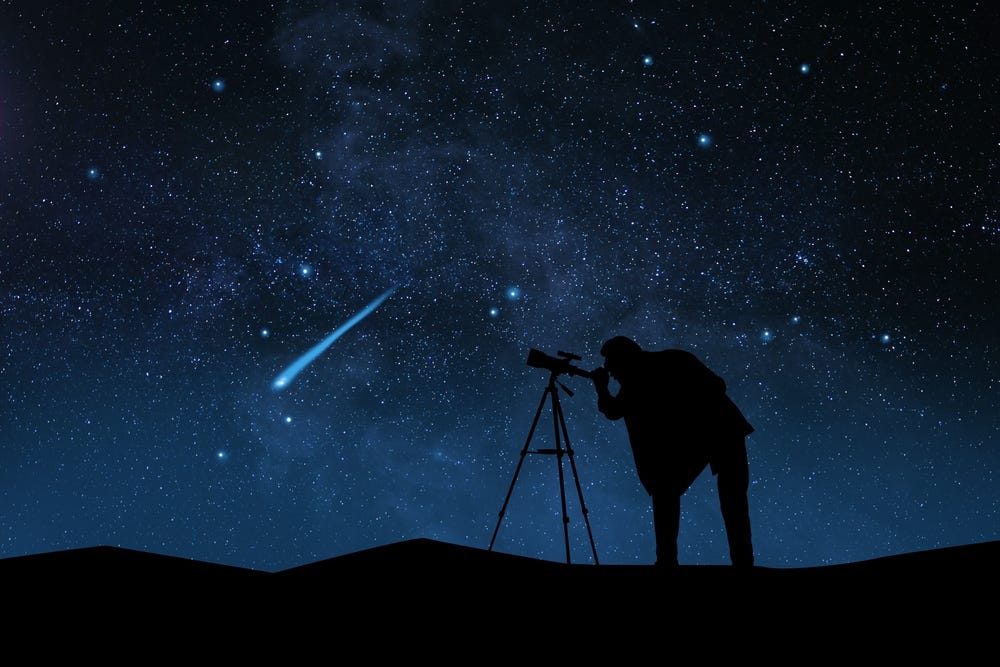
Around the SKA telescope, old star stories survive through practical knowledge, new meanings and changing community traditions. (CREDIT: Shutterstock)
- Workshops with about 52 elders and knowledge holders found that San-descended astronomical traditions in South Africa’s Karoo survive through selective memory, adaptation and continued everyday use.
- Practical knowledge involving Venus, the Moon, rainfall and daily routines remained especially strong, while many older cosmological narratives had become fragmented or transformed.
- The work produced a Dialogical Knowledge Renewal Model that treats historical archives, living community knowledge and contemporary astronomy as sources for continuing dialogue rather than a fixed tradition to be recovered.
Long before enormous radio dishes began rising from South Africa’s Karoo, people there were already watching the sky. They used celestial objects to organize daily activities, interpret environmental changes and tell stories about the world around them.
The arrival of MeerKAT and the developing SKA-Mid telescope has now brought those traditions into conversation with modern radio astronomy. A practice insight published examines about a decade of engagement with communities descended from the San around the telescope site.
Anton Binneman worked with roughly 52 elders and recognized knowledge holders in seven communities. He found neither an untouched body of ancient astronomy nor a tradition that had simply vanished. Instead, astronomical knowledge persisted selectively, changing with language, religion, social conditions and contemporary experiences.
“Stories are not frozen in time,” Binneman said. “Language evolves, the way people relate to the sky changes, and our knowledge of the universe changes too.”
An old archive becomes the start of a conversation
The work grew from environmental and social assessments connected with the Square Kilometre Array, or SKA. The South African Radio Astronomy Observatory had already constructed MeerKAT in the Central Karoo, and that telescope is becoming part of SKA-Mid.
Understanding local Indigenous Knowledge Systems became part of the engagement around the project. One major historical resource was the Bleek and Lloyd archive, which contains oral narratives recorded from |Xam speakers between 1870 and 1884.
But Binneman did not treat those records as a definitive description of what communities know today. The archive itself reflects the circumstances and perspectives of the people who assembled it during the 19th century.
Instead, workshops presented historical stories alongside images of objects in the night sky. Participants were asked what they saw, what names they knew and what stories or observations they remembered.
Evening stargazing allowed those conversations to occur beneath the actual sky. When older knowledge holders could not attend because of age or mobility problems, researchers conducted home visits and informal interviews.
Some pieces survived because people still used them
The workshops revealed a strikingly selective pattern of continuity.
Complicated cosmological narratives were often poorly remembered, particularly among younger generations. Knowledge connected to practical activities was more likely to remain active.
Venus offered one of the clearest examples. Participants remembered the Morning and Evening Star as a marker for beginning or ending daily work. It was commonly called boer se horlosie, Afrikaans for “the farmer’s clock.”
Zodiacal light was also connected with starting the day through the term Invaltyd, meaning “time to get started.” Observations of the Moon remained linked with rainfall and seasonal conditions.
The Milky Way showed how an older narrative could survive in fragments. Participants still used Hemelstraat, meaning “the heavenly road” or “road in the sky,” but few connected the name with an older |Xam story about a girl throwing ashes into the heavens to create light.
“She threw ashes into the sky and commanded them to become the ‘Milky Way’. She wanted a little light to be made,” the historical narrative says.
Changing stories do not necessarily mean lost knowledge
Christianity, Afrikaans language traditions and changing ways of life had become intertwined with many accounts.
Participants sometimes described older narratives as previous beliefs or interpreted them through biblical ideas. Yet Christianity did not simply erase the earlier traditions. New and older explanations could exist beside each other.
The Waterslang, or Water Snake, appeared in every workshop location, although its details varied. Some versions connected the being with water, glowing light and warnings about behavior. In Brandvlei, participants described another being called the Ogvoet, associated with a glowing stone and caves.
Rather than judging whether contemporary versions were historically correct, Binneman examined how narratives had changed and what those changes meant.
That distinction led to a broader argument: describing altered traditions only as cultural loss misses how knowledge survives. Communities reinterpret stories as languages, religions, economies and everyday experiences change.
Older astronomical traditions therefore remain living knowledge precisely because they are capable of changing.
From knowledge recovery to knowledge renewal
That thinking eventually produced what Binneman calls the Dialogical Knowledge Renewal Model.
The seven-part framework does not aim to reconstruct one supposedly authentic version of Indigenous astronomy. Instead, it places historical records, community knowledge and contemporary science into continuing conversation.
Archives should be treated critically. Community-recognized knowledge holders should shape engagement. Astronomy should remain connected to local landscapes and social conditions, while findings and resources should return to participating communities.
The distinction between “recovery” and “renewal” is central. Recovery suggests that knowledge existed in one correct historical form and merely needs to be retrieved. Renewal recognizes that living traditions can retain older elements while acquiring new meanings.
The approach has already contributed to astro-tourism projects, training for local astronomy guides, educational materials, heritage publications and Indigenous Knowledge initiatives around the Karoo.
A major telescope becomes part of an older story
The work also has limits. The engagement occurred within an institutional program governed by environmental requirements, funding structures and predefined project goals. Binneman himself participated as a science communication practitioner, giving him an insider role that affected both access and interpretation.
Still, the experience suggests that large science projects can do more than explain themselves to nearby communities. They can create spaces where scientific research, cultural memory and community knowledge interact without treating one as merely a historical curiosity.
That changes the story of the SKA’s arrival in the Karoo.
Modern radio astronomy may use instruments unimaginable to earlier sky watchers, but the act of observing and interpreting the heavens did not begin when the first telescope was constructed there.
“The first astronomers were not those who built MeerKAT or the SKA,” Binneman said.
In that sense, SKA-Mid is not bringing astronomy into an empty landscape. It is adding another way of looking at the sky to a place where people have been doing exactly that for generations.
Dig deeper into Indigenous astronomy, the Karoo and science engagement
These resources explore San cultural memory, Indigenous astronomy and the wider relationship between major astronomy projects and the communities around them.
Star stories: using indigenous knowledge for stakeholder engagement: This earlier study examines how San astronomical narratives were used to create dialogue between communities and the Square Kilometre Array project in the Central Karoo. (Communitas, 2020)
Elusive Identities: Karoo |Xam Descendants and the Square Kilometre Array: This analysis examines the historical relationship between |Xam descendants, the Karoo landscape and the territory designated for radio astronomy, including questions of identity and community benefit. (Journal of Southern African Studies, 2019)
Shared Sky: This SKA Observatory initiative brings together South African and Aboriginal Australian artistic traditions connected with Indigenous understandings of the sky, placing modern astronomy alongside longstanding cultural knowledge. (SKA Observatory, 2024)
Research findings are available online in the journal Journal of Science Communication.
The original story "Before MeerKAT, South Africa's Karoo telescope had its own ways of reading the stars" is published in The Brighter Side of News.
Related Stories
- NASA’s Roman Space Telescope launches to map billions of galaxies and hunt distant worlds
- NASA’s giant space ‘starshade’ could help ground telescopes photograph another Earth
- NASA’s Webb telescope may have solved the mystery of the universe’s 'little red dots'
Like these kind of feel good stories? Get The Brighter Side of News' newsletter.
Joseph Shavit
Writer, Editor-At-Large and Publisher
Joseph Shavit, based in Los Angeles, is a seasoned science journalist, editor and co-founder of The Brighter Side of News, where he transforms complex discoveries into clear, engaging stories for general readers. With vast experience at major media companies like The Los Angeles Times, Times Mirror and Tribune Publishing, he writes with both authority and curiosity. His writing focuses on space science, planetary science, quantum mechanics, geology. Known for linking breakthroughs to real-world markets, he highlights how research transitions into products and industries that shape daily life.