Scientists just built a computer that doesn’t require electricity
Researchers built a mechanical computer from springs and bars that can count and store simple memories without electricity.

 Edited By: Joseph Shavit

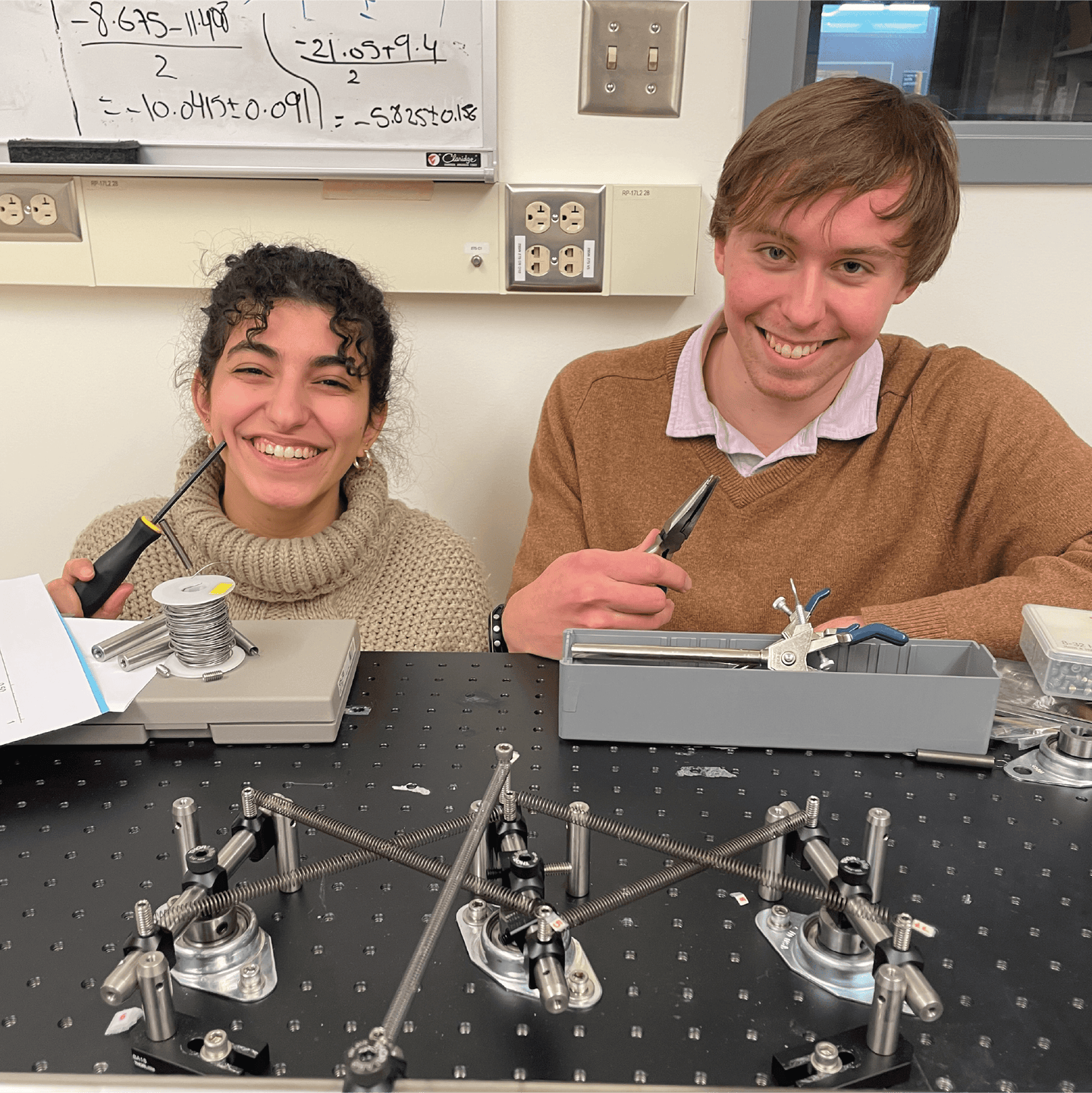
Led by Professor Paulsen (center), the St. Olaf undergraduate research team was composed of Faten Abu Al Ardat ’27, Harry Maakestad ’26, Alex Walk ’28, and Jack Feider ’26, working on building the mechanical computer. (CREDIT: St. Olaf College)
A steel bar pivots. A spring stretches. Then, with a small shove, the whole setup flips into a new state and stays there until the next push.
That simple motion sits at the heart of a mechanical computer built by researchers from St. Olaf College and Syracuse University, who designed a system that can perform basic computations without electricity, batteries, or a computer chip. Published in Nature Communications, the work turns an abstract idea from physics into a working platform made from rigid bars, steel rods, and ordinary springs.
“We typically think of memory as something in a computer hard drive, or within our brains,” said Joey Paulsen, an associate professor of physics at St. Olaf College. “However, many everyday materials retain some kind of memory of their past, for example, rubber can ‘remember’ how far it has been squeezed or stretched in the past.”
The team wanted to push that idea further. Could a material not only remember motion, but also use that history to process information?
Where the memory sits
The answer, in this case, comes from parts called hysterons. Each one is a bistable mechanical unit, a rigid bar mounted on a central pivot and confined between two stops. A spring connects the bar to a rod that slides horizontally, providing the global mechanical input. As that rod moves, the bar can snap from one stable position to another.
A single unit already behaves like memory. It holds one state until the applied motion crosses a threshold, then flips. Move the input back past another threshold, and it flips again. That gap between switching points gives the system hysteresis, meaning its current state depends on its past.
The researchers then linked these units together with more springs. Some spring arrangements encouraged neighboring bars to settle into the same state. Others favored opposite states. By changing where those coupling springs attached, the team could tune how strongly one unit influenced another.
That mattered because the goal was not just to build a clever moving object. It was to create a physical system whose switching thresholds and interactions could be designed in advance, making it possible to carry out simple forms of computation through motion alone.
“We now have a rational way of building these machines that can perform simple computations without a computer chip or a power source,” Paulsen said.
Three kinds of computation
To show that the platform could do more than switch back and forth, the researchers built three different mechanical computers.
One counted how many times it had been driven through a cycle. In that design, a chain of coupled hysterons acted like a moving boundary between two patterns of states. Each half-cycle of motion pushed that boundary one step down the chain. The position of the boundary then stored the count. According to the paper, a chain with 2n hysterons can record the number of cycles up to n.
A second machine counted modulo 2, which means it could tell whether it had been pushed an odd or even number of times. This version used four hysterons arranged so that a repeated driving cycle forced the system into a two-cycle rhythm. After one cycle it ended in one state; after the next, it ended in another. That repeating pattern let the machine sort odd from even.
The third behavior was more unusual. The system could latch, meaning it could remain in a changed state after one level of input, but reset after a larger one. In the experiment, driving the setup up to 10 centimeters and back to zero left it in one stored state. Driving it to 32 centimeters and back released that state and reset the system through a sequence of intermediate flips.
The paper also points to another function within the broader framework: a 2-bit analog-to-digital converter appears in the supplementary material, showing that the platform can be configured for more than the three highlighted examples.
A platform, not a one-off trick
Much of the study focuses on why the system works, not just that it does. The researchers developed a kinematic model linking the geometry and spring properties of the setup to the switching thresholds observed in the lab. In experiments on pairs of coupled hysterons, the theory matched the measured thresholds closely and predicted where the system’s behavior would qualitatively change.
That control is one of the main claims of the paper. Previous mechanical metamaterials, including origami bellows, corrugated sheets, buckled beams, and biholar sheets, have been developed to store mechanical memory or carry out specific tasks. But the authors argue that no earlier system had realized the full generality of the abstract interacting hysteron model they set out to build.
Their design also produced both cooperative and frustrated interactions, along with non-reciprocal behavior, where one unit affects another more strongly than it is affected in return. Those features helped enable behaviors such as latching and cycle counting.
The machine does not need electricity because it draws energy directly from physical force. Push or pull the driving rod, and the structure harvests that input mechanically.
That makes the idea appealing for settings where ordinary electronics struggle. The researchers describe these devices as a possible alternative in harsh environments, including extreme temperatures or corrosive chemical exposure, when only simple computations are required.
Limits still in view
The paper does not present this as a finished replacement for conventional computing.
Paulsen said future work should focus on the limitations of mechanical computers and on how far the designs can scale. The discussion section of the paper makes that caution even clearer. Some theoretical questions remain unresolved, including what interaction patterns are possible in real mechanical systems. Designing larger collections of hysterons also remains difficult.
In the four-hysteron modulo-2 device, the team did not derive the final working arrangement in one clean step. Instead, they iteratively adjusted spring mounting positions, post angles, and other geometric parameters to capture more of the desired cycle. The authors compare that process to supervised learning and suggest that future algorithms might help navigate the many possible system configurations.
They also note open questions about the full constraints on switching thresholds and interaction strengths in realizable structures and metamaterials.
So the study offers a proof of design, not a finished technology roadmap.
“Our results are one step toward designing materials that can sense their environment, make a decision, and then respond,” Paulsen said.
Practical implications of the research
The practical value here lies in small decisions made by matter itself.
A mechanical computer like this could, in principle, operate in places where electronics are unreliable or unnecessary. It could also become part of a material rather than a separate device bolted onto one. The researchers say that idea could help in the development of smart materials, including more responsive artificial limbs or tactile rooms.
Paulsen’s group is already probing what happens when one rotor interacts with a second and possibly a third. That work is continuing through St. Olaf’s Collaborative Undergraduate Research and Inquiry program.
For now, the machine is simple. It counts, distinguishes odd from even, and remembers whether a medium or large force was applied. But it does those things with bars, springs, and geometry alone. That is what makes the study stand out. It suggests computation does not always need silicon, only a system built to remember where it has been.
Research findings are available online in the journal Nature Communications.
The original story "Scientists just built a computer that doesn’t require electricity" is published in The Brighter Side of News.
Related Stories
- Revolutionary supercomputer uses adaptive chips to boost speed and cut power
- Researchers build magnetic computer that thinks like a brain
- Breakthrough DNA-based supercomputer runs 100 billion tasks at once
Like these kind of feel good stories? Get The Brighter Side of News' newsletter.
Rebecca Shavit
Writer
Based in Los Angeles, Rebecca Shavit is a dedicated science and technology journalist who writes for The Brighter Side of News, an online publication committed to highlighting positive and transformative stories from around the world. Having published articles on MSN, AOL News, and Yahoo News, Rebecca's reporting spans a wide range of topics, from cutting-edge medical breakthroughs to historical discoveries and innovations. With a keen ability to translate complex concepts into engaging and accessible stories, she makes science and innovation relatable to a broad audience.