The world’s largest fungus is hiding in Oregon’s Blue Mountains — and its really big
Oregon researchers found one vast fungus beneath the Blue Mountains, stretching for miles and surviving for thousands of years.

 Edited By: Joseph Shavit

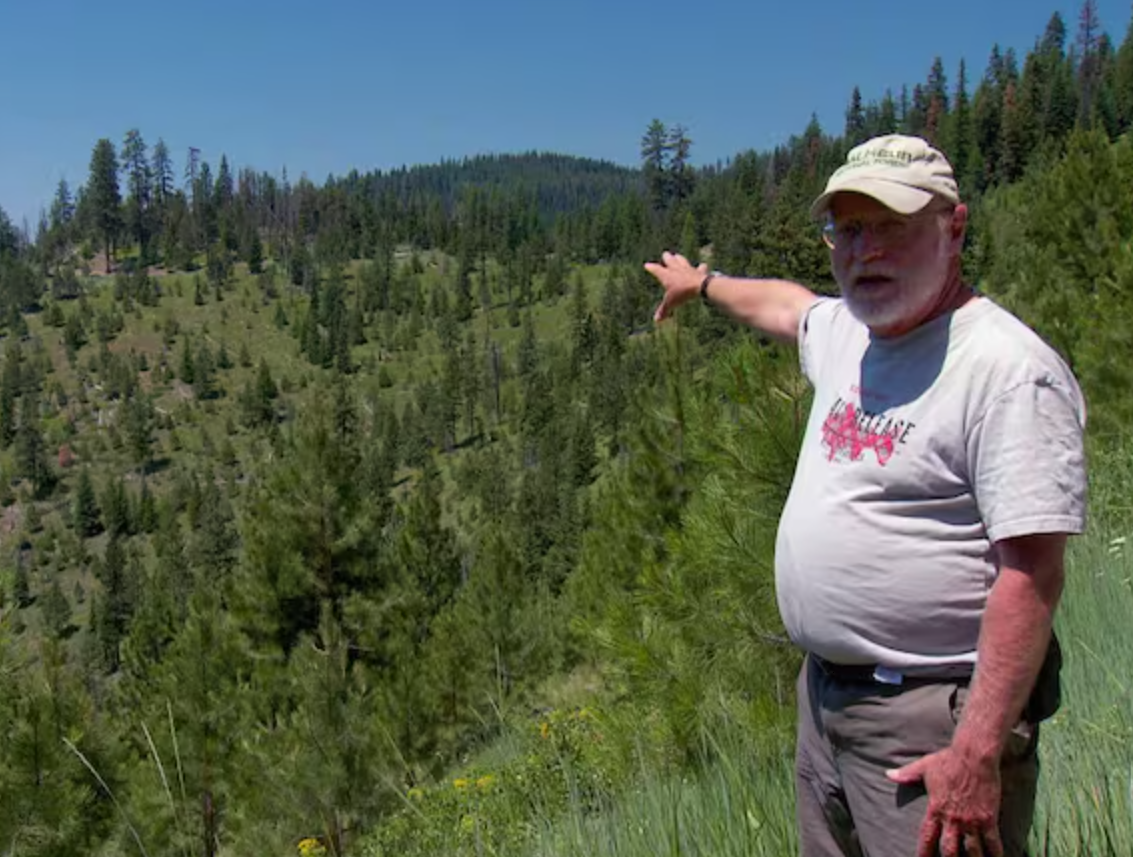
Forest ranger Greg Whipple first spotted the fungus in 1988, estimating it spread across 400 acres. (CREDIT: Todd Sonflieth / OPB)
In Oregon’s Blue Mountains, patches of dying trees once looked like separate outbreaks, scattered across ridges and drainages as if disease had struck at random. Instead, scientists found something far stranger beneath the soil: many of those distant pockets belonged to the same fungus.
That fungus, Armillaria ostoyae, covered about 9.65 square kilometers, making it the largest known individual fungus on Earth at the time of the study. It had likely been growing there for at least 1,900 years, and possibly as long as 8,650.
For researchers, the discovery did more than set a record. It challenged a basic biological idea: what counts as an individual.
“It’s one organism that began as a microscopic spore and then grew vegetatively, like a plant,” said Dr. Catherine Parks, a research plant pathologist with the U.S. Department of Agriculture Forest Service and coordinator of the team. “From a broad scientific view, it challenges what we think of as an individual organism.”
The fungus is no harmless oddity. Armillaria ostoyae is a major tree pathogen, responsible for one form of Armillaria root disease, which kills conifers across western North America and southern Canada. In British Columbia alone, the disease has been estimated to cause annual growth loss and mortality equal to 3.8 million cubic meters of timber.
A hidden organism spread across the mountains
The study area lay in the Malheur National Forest in northeastern Oregon, in a mixed-conifer landscape shaped by fire, logging, insects, and disease. From the air, researchers had seen ring-shaped openings in the canopy, a classic sign of Armillaria root disease. Many people assumed those tree-kill patches marked separate fungal individuals.
What the team found was very different.
By sampling fungal material from infected trees across the landscape and growing the isolates together in Petri dishes, the researchers tested whether the samples behaved as self or non-self. The method depended on the fungus’s own ability to recognize another individual. When the samples fused, they belonged to the same genet, or genetic individual. When they formed a boundary, they did not.
“The technique is actually very simple, and makes use of this fungus’ own ability to distinguish one individual from another,” Parks said.
Using those pairings, along with molecular identification, the researchers mapped six fungal genets in the study area. Five were Armillaria ostoyae. One of them, called genet D, dwarfed the rest. It stretched 3,810 meters at its widest point and occupied roughly 965 hectares.
That equals about 9.65 square kilometers, or roughly 1,600 football fields.
“If you could take away the soil and look at it, it’s just one big heap of fungus with all of these filaments that go out under the surface,” Parks said.
Why size matters in a dry forest
The team’s results suggested that dry forests may allow fewer fungal individuals to become established, but those that do survive can spread for enormous distances over long periods. Earlier studies had found that Armillaria genets in wetter forests were usually much smaller. In the Blue Mountains, by contrast, the population density was very low, but the fungal territory was immense.
The study area itself was chosen because it already showed extensive disease symptoms, so the researchers were careful not to claim that every similar forest would contain such giant genets. Still, the finding revealed that a landscape can hold ancient, continuous fungal individuals far larger than most observers would guess from surface damage alone.
That matters because disease symptoms do not necessarily map neatly onto the fungus itself. A single genet can produce several distinct mortality centers, with apparently healthy forest between them. In other words, visible damage may only show part of the organism’s reach.
“The fact that an organism like this has been growing in the forest for thousands of years really expands our view of the forest ecosystem and how it functions,” Parks said.
Fire suppression did not create the fungus
One of the paper’s most important conclusions pushed back against a common management assumption.
Forest managers had often believed that modern fire suppression helped Armillaria root disease spread by disrupting a natural cycle that once kept it in check. But the Oregon fungus turned out to be far older than modern fire policy, and even older than human influence on regional fire systems.
“But because this fungus is thousands of years old, and grew long before fire systems were influenced by man, we know this isn’t the case,” Parks said. “It also means that fire does not naturally control this disease.”
That does not mean fire is irrelevant. The paper argues that fire history likely shaped how the disease appeared on the landscape, influencing forest structure, host species, and where mortality became obvious. But the existence of such ancient, extensive genets suggests the fungus itself expanded under natural fire regimes over many forest generations.
The researchers made a subtle but important distinction. Human actions may have increased disease expression, meaning more visible mortality inside fungal territory, without creating the fungal territory in the first place.
Over the last century or so, selective harvesting, fire suppression, and grazing helped shift many eastern Oregon forests away from western larch and pine and toward Douglas-fir and grand fir, species more vulnerable to damage. That likely gave the fungus more chances to kill trees inside its long-established boundaries.
A natural force, not just a forest problem
The paper argues that Armillaria ostoyae should be understood not only as a timber pathogen, but also as a long-standing participant in forest ecology. Its effects reach beyond tree death. Large genets may influence forest succession, shape stand structure, create coarse woody debris, and even provide refuges for bark beetle populations.
That broader view also helps explain why the fungus can persist in places with little obvious damage. Infected forests may contain trees with latent or quiescent root infections, waiting until harvesting, fire, insects, or stress create an opportunity for the fungus to expand through root systems.
That is why some routine forestry practices can backfire. After an infected tree is cut, its root system can become heavily colonized, raising the disease risk nearby.
“After you cut an infected tree, the entire root system can be colonized by the fungus, which then increases the disease potential around that area,” Parks said.
The authors argued that managers should think less in terms of erasing the fungus and more in terms of reducing its impact, especially inside known genet boundaries.
Top 5 largest fungus in the world
The largest fungi on Earth are not towering mushrooms or giant caps rising from the forest floor. They are mostly hidden underground, spreading through soil, roots, and decaying wood as vast networks of mycelium.
1. Malheur National Forest, Oregon, United States:
- The largest known fungus on Earth is the famous “Humongous Fungus” in Oregon’s Malheur National Forest. This individual honey fungus, usually identified as Armillaria ostoyae or Armillaria solidipes, spreads beneath the soil through the Reynolds Creek and Clear Creek areas.
- It covers about 9.65 square kilometers, making it one of the largest known living organisms by area and biomass. Most of it is hidden underground as mycelium, while the visible mushrooms are only its seasonal fruiting bodies.
2. Glenwood, Washington, United States:
- The second-largest known fungus is another Armillaria individual discovered in eastern Washington, near Glenwood. Before the Oregon giant took the title, this Washington fungus was widely cited as the world’s largest living thing.
- It covers more than 6.07 square kilometers, a staggering footprint for an organism that most people would never notice while walking through the forest. Like the Oregon specimen, its size comes from a vast underground network that invades tree roots and spreads slowly over time.
3. Genet A, Malheur National Forest, Oregon, United States:
- The third-largest is known as Genet A, another genetically distinct Armillaria ostoyae individual in Oregon’s Malheur National Forest.
- It covers about 2.60 square kilometers, which would already make it enormous by almost any biological standard. Its presence in the same forest as the record-holder shows that Malheur is not just home to one strange giant, but to a landscape where multiple fungal individuals have grown to extraordinary scale beneath the trees.
4. Genet E, Malheur National Forest, Oregon, United States:
- The fourth-largest is Genet E, also located in the Malheur National Forest. This individual Armillaria ostoyae spans about 1.95 square kilometers.
- It belongs to the same group of large, genetically unique fungal networks that researchers mapped in the forest. Though smaller than the record-setting Oregon fungus, Genet E is still massive enough to reshape how we think about what a single organism can be.
5. Genet B, Malheur National Forest, Oregon, United States:
- The fifth-largest is Genet B, another Malheur Armillaria ostoyae individual, covering about 0.95 square kilometers.
- Its size may seem modest compared with the 9.65-square-kilometer giant nearby, but it is still far larger than most familiar organisms.
Together, these five fungi show that the world’s biggest organisms are not always whales, trees, or towering forest giants. Some of Earth’s largest life-forms live mostly out of sight, spreading silently through soil, roots, and decaying wood.
Practical implications of the research
The findings suggest that forest managers should treat Armillaria root disease as a deep-rooted ecological force, not a recent disturbance that can simply be reversed. In areas occupied by large fungal genets, selective cutting may increase inoculum and worsen future disease pressure rather than reduce it.
The study points toward a more cautious strategy: favor tree species that are less susceptible to damage, such as western larch, western white pine, and ponderosa pine, while reducing reliance on more vulnerable hosts like grand fir and Douglas-fir in affected areas. It also suggests that apparently healthy stands inside fungal territory may still carry hidden risk.
For science, the Oregon fungus did something equally important. It showed that what looks like a patchwork of separate problems at the surface can belong to one ancient living system underground. As Cindy Prescott, co-editor of the Canadian Journal of Forest Research, put it, the study offered “new insights into how forests work, and causing us to rethink fundamental ideas like, what is an individual, and what is a species?”
Research findings are available online in the journal Canadian Journal of Forest Research.
The original story "The world’s largest fungus is hiding in Oregon's Blue Mountains — and its really big" is published in The Brighter Side of News.
Related Stories
- NASA cleanroom fungus could survive a trip to Mars, raising contamination concerns
- A friendly fungus protects crops using airborne chemicals
- New international study traces plant viruses back to the last Ice Age
Like these kind of feel good stories? Get The Brighter Side of News' newsletter.
Rebecca Shavit
Writer
Based in Los Angeles, Rebecca Shavit is a dedicated science and technology journalist who writes for The Brighter Side of News, an online publication committed to highlighting positive and transformative stories from around the world. Having published articles on MSN, AOL News, and Yahoo News, Rebecca's reporting spans a wide range of topics, from cutting-edge medical breakthroughs to historical discoveries and innovations. With a keen ability to translate complex concepts into engaging and accessible stories, she makes science and innovation relatable to a broad audience.