Scientists reproduce a long-predicted flow state from deep inside planets
Scientists reproduced a long-predicted turbulent flow state that may govern heat and motion deep inside rapidly rotating planets and stars.
 HZDR Writer: Simon Schmitt

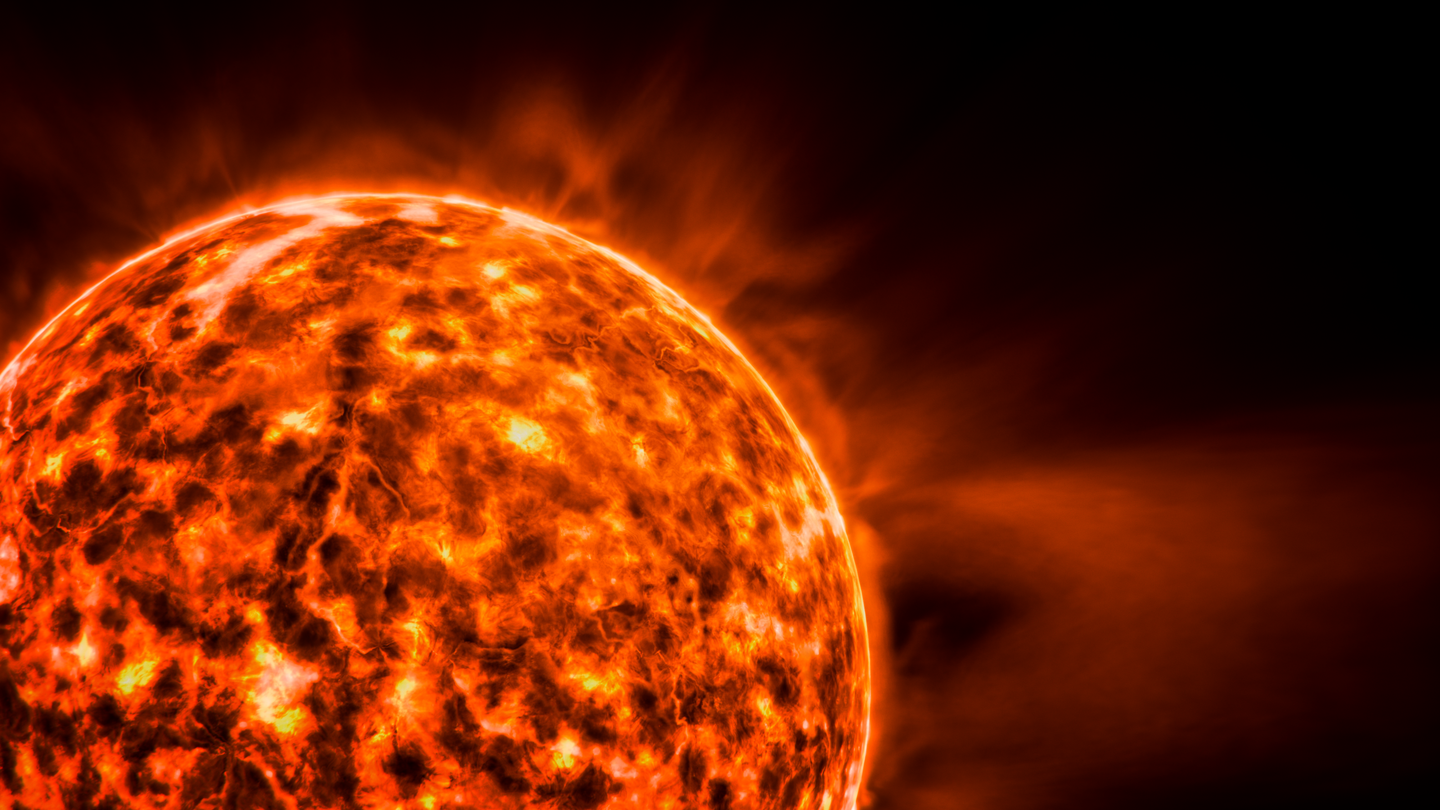
Complex flow patterns develop in the interiors of rapidly rotating stars. An international research team has now experimentally demonstrated for the first time a flow state characteristic of such celestial bodies. The artistic visualization shows a star characterized by turbulent structures. (CREDIT: B. Schröder/HZDR)
- A liquid-gallium experiment has reproduced a turbulent convection regime long predicted to occur inside rapidly rotating planets and stars.
- Heat transport, flow velocity and temperature fluctuations all matched theoretical predictions, giving researchers three independent tests of the same physical model.
- The results strengthen the case that small laboratory experiments can help scientists model inaccessible processes deep inside planets and stars.
The interiors of stars and planets remain largely beyond direct observation. Instead, scientists build experiments that reproduce pieces of the physics expected to operate under conditions that cannot be reached or observed directly.
A rotating tank filled with liquid gallium has now provided an important test of one such idea. An international team led by the University of California, Los Angeles has experimentally reproduced a turbulent flow state predicted to occur in the interiors of rapidly rotating celestial bodies.
The state, known as rotating diffusivity-free turbulent convection, had been predicted theoretically for decades but had resisted clear confirmation in a conventional laboratory experiment. The results, published in Physical Review Letters, showed quantitative agreement among laboratory measurements, theoretical predictions and numerical simulations.
“This gives us far greater confidence to apply these models to the interiors of planets and stars,” said Tobias Vogt of the Helmholtz-Zentrum Dresden-Rossendorf, who participated in the experiments during two research stays at UCLA.
Why convection matters inside planets and stars
Convection occurs when hotter material rises while cooler material sinks. Inside planets and stars, this movement transports heat and can create large-scale turbulent flows. In planetary interiors, those motions are also associated with the dynamo action that sustains global magnetic fields.
Rotation complicates that picture. Theory predicts that sufficiently strong turbulence inside rapidly rotating systems can enter an extreme state where large-scale heat and momentum transport become largely independent of microscopic properties such as viscosity and thermal diffusivity.
Scientists call this the diffusivity-free regime. In that state, buoyancy, rotation and inertia govern the larger flows, while the direct effects of viscosity and thermal diffusion become negligible.
The distinction matters because models of objects such as planetary fluid cores and stellar convection zones must reach conditions far beyond those available in conventional experiments or even many numerical simulations. If researchers can verify the predicted scaling laws in the laboratory, they gain more confidence when applying those relationships to natural systems.
Until now, however, laboratory walls kept getting in the way.
A decades-old experimental obstacle
A standard way to study convection is Rayleigh-Bénard convection. A fluid sits between boundaries, with heat supplied from below and removed from above. If the apparatus rotates around a vertical axis, researchers can study how rotation changes the resulting flows.
Those solid boundaries create thermal boundary layers. In conventional rotating experiments, these layers strongly influence how heat moves through the system. Additional flows can develop along the sidewalls, further complicating measurements.
As a result, researchers could not clearly determine whether the bulk fluid itself had reached the theoretically predicted diffusivity-free regime. The very equipment needed to conduct the experiment could mask the behavior scientists wanted to observe.
The UCLA-led team found a way around that problem by exploiting a different type of convection found in rapidly rotating fluids with very low Prandtl numbers, including liquid metals.
Instead of relying on the usual steady convection, the researchers focused on an oscillating thermal-inertial mode. This instability is driven by the temperature field inside the fluid rather than being controlled by the thermal boundary layers.
“Our experiment demonstrated this theoretically predicted state in the lab for the first time, which greatly strengthens our confidence in the models we use to describe processes inside stars and planets,” said Jewel Abbate of UCLA, who conducted the research as part of her doctoral studies.
A desktop experiment filled with liquid gallium
The experiments used UCLA’s rotating RoMag device. Its cylindrical test chamber contained liquid gallium between copper blocks. A heating pad supplied heat at the bottom, while a heat exchanger connected to a recirculating chiller removed heat from the top.
The entire cell rotated around its vertical axis. Researchers varied both thermal forcing and rotation across a broad range of conditions, allowing them to study how the liquid responded as convection became increasingly turbulent.
Thermistors embedded in the apparatus measured temperatures at the upper and lower boundaries. Five additional thermistors inside the gallium tracked temperature fluctuations within the fluid.
The researchers measured motion using ultrasonic Doppler velocimetry. Natural impurities suspended in the gallium acted as particles that could reflect the acoustic signal, allowing the team to calculate vertical flow velocities through the liquid.
Those measurements gave the researchers three separate ways to test the theoretical prediction: global heat transport, internal flow velocity and temperature fluctuations.
Three measurements point to the same answer
All three measurements agreed quantitatively with predictions for diffusivity-free convection.
The temperature fluctuations and vertical velocities followed the expected thermal-inertial scaling across the experimental geometries. Heat transport also approached the theoretical behavior most closely in wider tanks, which reduced the influence of flows attached to the sidewalls.
Direct numerical simulations supported the laboratory results and remained consistent with the experimental measurements within the observed scatter.
“What makes our work particularly compelling is the fact that theory, experiment, and numerical simulations now agree quantitatively, allowing us to confirm experimentally that the underlying physical models describe the observed heat transport very accurately,” Vogt said.
The distinction between the oscillatory and steady convection modes was also clear. Once steady convection appeared, measurements moved away from the diffusivity-free scaling. The oscillating thermal-inertial regime was the key to reaching the predicted state.
A laboratory window into unreachable interiors
The results show that diffusivity-free convection can emerge even inside a relatively small, closed laboratory container. That addresses a long-running question about whether boundary effects would always prevent conventional experiments from reaching conditions relevant to natural rotating systems.
The experiment does not reproduce an entire planet or star. Instead, it tests the scaling relationships used to describe one fundamental part of their internal dynamics. The researchers found that the same relationships predicted by theoretical models appeared simultaneously in heat transport, fluid velocity and temperature fluctuations.
There are still limits. Narrower containers showed stronger sidewall effects on heat transport, although measurements inside the fluid remained consistent with the predicted behavior. The researchers suggest that suppressing these wall modes could extend future experiments to different container shapes.
Other low-Prandtl-number fluids, including liquid sodium, could also provide access to broader experimental conditions.
For now, liquid gallium has provided something scientists had sought for decades: a laboratory demonstration that a theoretically predicted form of rapidly rotating turbulence can exist in a closed experimental system.
That connection between theory, simulation and experiment offers a firmer foundation for using the same physics to investigate places no instrument can enter, from the fluid cores of planets to the convection zones of distant stars.
Dig deeper into rotating convection, turbulence and planetary interiors
These resources explore the turbulent convection, heat transport and rotating-fluid physics that underpin models of planetary cores and stellar interiors.
Geostrophic to magnetically-damped turbulence in liquid metal rotating magnetoconvection: Experiments with liquid metal examine how magnetic fields alter rapidly rotating convection and find that some flow regimes follow diffusivity-free scaling before stronger magnetic effects suppress velocities. The work connects laboratory rotating convection more directly with conditions relevant to planetary dynamos. (Physics of the Earth and Planetary Interiors, 2026)
Beyond Nusselt number: assessing Reynolds and length scalings in rotating convection under stress-free boundary conditions: This study tests multiple scaling relationships in rapidly rotating convection rather than relying only on heat transport. It helps show how velocity and characteristic flow scales can be used to judge whether models are approaching regimes relevant to geophysical and astrophysical systems. (Journal of Fluid Mechanics, 2025)
Ultimate Rayleigh-Bénard turbulence: This comprehensive review examines the theoretical, experimental and numerical evidence for extreme turbulent Rayleigh-Bénard convection, including how boundary layers affect heat transport and the difficulty of reaching asymptotic regimes experimentally. (Reviews of Modern Physics, 2024)
Shadowgraph Measurements of Rotating Convective Planetary Core-Style Flows: Liquid-metal experiments visualize rapidly rotating convection under conditions designed to resemble aspects of planetary core flows. The work compares laboratory behavior with diffusivity-free theoretical predictions and illustrates how boundary effects can limit heat-transfer scaling. (Journal of Geophysical Research: Planets, 2024)
Diffusion-Free Scaling in Rotating Spherical Rayleigh-Bénard Convection: Numerical simulations show that spherical geometry can produce regions where rapidly rotating convection follows diffusion-free scaling. The study is particularly relevant to planets because it examines how geometry changes the flow behavior compared with simpler planar models. (Geophysical Research Letters, 2021)
Research findings are available online in the journal Physical Review Letters.
The original story "Scientists reproduce a long-predicted flow state from deep inside planets" is published in The Brighter Side of News.
Related Stories
- Is interstellar object 3I/ATLAS an alien probe? Harvard physicist sparks debate
- Scientists link dark energy to alien life in the multiverse
- Scientists propose simple new way to spot alien life in the universe
Like these kind of feel good stories? Get The Brighter Side of News' newsletter.
Joshua Shavit
Writer and Editor
Joshua Shavit is a NorCal-based science and technology writer with a passion for exploring the breakthroughs shaping the future. As a co-founder of The Brighter Side of News, he focuses on positive and transformative advancements in technology, physics, engineering, robotics, and astronomy. Having published articles on AOL.com, MSN, Yahoo News, and Ground News, Joshua's work highlights the innovators behind the ideas, bringing readers closer to the people driving progress.