Powerful magnetic fields could be trapping giant stellar eruptions before they escape
Powerful magnetic fields may tear apart and trap giant stellar eruptions before the plasma can escape into space.
 Technion-Israel Writer: Doron Shaham

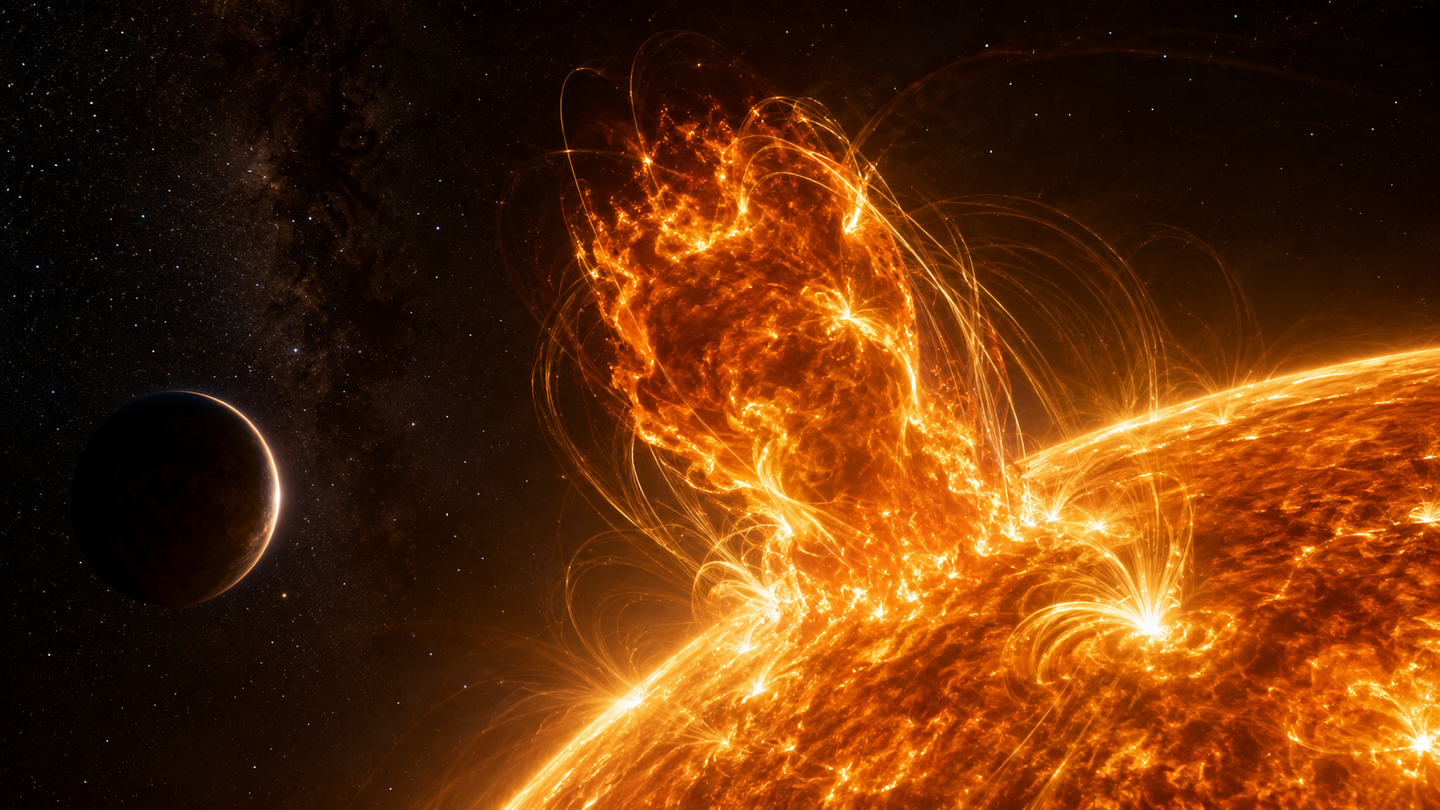
Experiments show strong stellar magnetic fields can stop coronal mass ejections, helping explain why astronomers rarely detect them. (CREDIT: Shutterstock)
- Powerful magnetic fields around active stars may trap huge coronal mass ejections before they can escape into space.
- Laboratory plasma experiments found that stronger magnetic fields caused CME-like flows to fragment, bend and eventually stop.
- The results could help explain why astronomers rarely detect stellar CMEs despite seeing powerful flares on stars far more active than the Sun.
Some of the most active stars in the galaxy appear capable of producing enormous eruptions, yet astronomers rarely see those blasts escaping into space.
Experiments recreating part of that process in a laboratory now offer a possible explanation. Strong stellar magnetic fields may act as a cage, destabilizing massive flows of plasma until they break apart and stop.
An international team of astrophysicists and plasma physicists from the Leibniz Institute for Astrophysics Potsdam (AIP), Germany, École Polytechnique and the Technion-Israel Institute of Technology, combined stellar simulations, high-energy laser experiments and three-dimensional magnetohydrodynamic modeling to investigate why coronal mass ejections are so difficult to find beyond the Sun. The results provide experimental evidence that sufficiently strong magnetic fields can prevent CME-like eruptions from escaping a star.
The effect becomes important at magnetic field strengths around 100 gauss in the modeled stellar conditions. Active stars can possess surface magnetic fields ranging from about 10 to 1,000 gauss, making magnetic confinement a plausible explanation for at least some of the missing eruptions.
A mystery beyond the Sun
Coronal mass ejections, or CMEs, are enormous expulsions of magnetized plasma from a star's atmosphere. They occur routinely on the Sun and contribute to the loss of mass and angular momentum over time. They can also shape conditions around planets caught in their path.
Astronomers have therefore expected active stars to produce plenty of their own CMEs. Many of these stars generate powerful flares, and scaling relationships based on the Sun suggest energetic flares should often accompany energetic mass ejections.
Observations have not produced the expected population. Searches using hydrogen-alpha spectroscopy, X-ray coronal dimming and Type II radio bursts have identified only a limited number of candidates. In many cases, their estimated kinetic energies fall below expectations based on relationships between solar flares and CMEs.
One proposed explanation focuses on magnetic fields. More magnetically active stars can have fields far stronger than the Sun's. Previous theoretical work suggested those fields could slow eruptions or confine them entirely, but directly testing the idea under scalable laboratory conditions remained difficult.
Recreating a stellar eruption in the laboratory
The team approached the problem from three directions. First, astrophysical simulations tested whether a CME-like disturbance could escape from a stellar corona surrounded by a 100-gauss dipole magnetic field.
The researchers used a spherical plasma disturbance to represent the core of an eruption. Their simulations showed stronger confinement when magnetic pressure became more important relative to the pressure within the plasma. Under the more confined conditions, the eruption could not freely escape through the surrounding field.
The next step brought the problem into the laboratory at the ELFIE laser facility at École Polytechnique in France. A laser pulse carrying up to 50 joules of energy struck a Teflon target, producing a hot plasma stream that expanded into a vacuum.
A large magnetic field was positioned across the direction of the moving plasma. The laboratory setup did not reproduce the initial magnetic reconnection that launches an actual CME from a stellar surface. Instead, it modeled the later stage when an eruption has detached and begins traveling through the star's surrounding magnetic environment.
Scaling relationships allowed the team to compare the small, fast laboratory experiment with a vastly larger stellar event. Roughly 10 nanoseconds of laboratory evolution corresponded to about 60 minutes in the modeled astrophysical system.
The plasma suddenly stops
At lower laboratory magnetic fields, the plasma moved rapidly across the experiment. With fields of 100,000 and 200,000 gauss, its speed remained around 600 kilometers per second and it continued beyond the available field of view.
The behavior changed dramatically when the field reached 300,000 gauss, corresponding through the scaling model to stellar conditions near 100 gauss.
After about 20 nanoseconds, the plasma flow stagnated. Images showed the stream fragmenting into several branches, bending strongly and failing to travel as far as it had under weaker fields. Different experimental shots produced variations in the details, but the strongest field consistently produced heavily disrupted propagation.
The transition mirrored the astrophysical simulations. Increasing the magnetic influence made it progressively harder for the plasma disturbance to escape.
A kink tears the flow apart
The researchers then used three-dimensional resistive magnetohydrodynamic simulations to examine what caused the sudden disruption.
At a laboratory field of 100,000 gauss, the simulated plasma remained broadly stable while developing smaller flute-like structures along its sides. After 45 nanoseconds, it had traveled about 23 millimeters at roughly 510 kilometers per second, closely resembling the experimental results.
Tripling the field produced a different outcome. The plasma stream bent upward and downward, became unstable and stopped after traveling about 15 millimeters.
The simulations pointed to a kink instability as the likely mechanism. Rather than simply slowing the plasma uniformly, the strong magnetic environment destabilized its overall structure. The flow twisted and bent until its outward motion collapsed.
That behavior provides a physical mechanism for magnetic confinement. A CME trying to cross a sufficiently powerful stellar magnetic field may not simply push through more slowly. Its structure can become unstable enough to prevent the eruption from escaping at all.
Why missing CMEs matter
The results add experimental support to earlier numerical work suggesting that strong magnetic fields can suppress eruptions from active stars. They could also help explain why enormous stellar flares have not produced the number of detectable CMEs expected from simple extensions of solar behavior.
Important limits remain. The laboratory experiment reproduced selected plasma conditions rather than the complete magnetic structure of a stellar eruption. Its plasma also came from a Teflon target rather than the hydrogen-rich material found in stellar environments. The researchers used established scaling criteria to connect the two systems and found both operated within conditions where ideal magnetohydrodynamics could be applied.
The findings could affect how astronomers think about stellar evolution and planets orbiting active stars. Escaping CMEs can carry away stellar mass and angular momentum, while repeated eruptions can create intense space weather around nearby planets.
If strong stellar fields trap a substantial fraction of those eruptions, highly active stars may be launching fewer successful CMEs than their flare activity alone would suggest. Some of the eruptions astronomers have spent decades trying to detect may not be difficult to see because they are faint. They may never escape the star in the first place.
Dig deeper into stellar eruptions, magnetic fields and exoplanet space weather
These resources explore how astronomers detect stellar CMEs, how magnetic fields can influence their escape and what powerful stellar eruptions could mean for planets orbiting active stars.
Radio burst from a stellar coronal mass ejection: Researchers reported a radio burst from the M dwarf StKM 1-1262 with properties analogous to a solar Type II burst, providing unusually strong observational evidence for a CME beyond the Sun and showing how radio observations can probe stellar space weather. (Nature, 2025)
Discovery of multi-temperature coronal mass ejection signatures from a young solar analogue: This work identified multi-temperature signatures associated with an eruption from a young Sun-like star, helping connect stellar CME observations with the complex plasma structures seen in solar eruptions. (Nature Astronomy, 2025)
Coronal dimmings and what they tell us about solar and stellar coronal mass ejections: This review examines coronal dimming as a diagnostic of mass loss and magnetic restructuring during CMEs, including recent efforts to use the same signatures to identify eruptions on other stars. (Living Reviews in Solar Physics, 2025)
Radio signatures of star–planet interactions, exoplanets and space weather: The review explains how low-frequency radio observations can reveal stellar magnetic activity, CME-associated shocks and conditions around exoplanets, making radio astronomy one of the strongest tools for finding otherwise elusive stellar eruptions. (Nature Astronomy, 2024)
Suppression of Coronal Mass Ejections in Active Stars by an Overlying Large-scale Magnetic Field: A Numerical Study: Earlier three-dimensional simulations showed that a 75-gauss large-scale dipole field could fully confine modeled stellar eruptions, establishing the theoretical prediction that the new laboratory experiments directly test. (The Astrophysical Journal, 2018)
Research findings are available online in the journal Physical Review Letters.
The original story "Powerful magnetic fields could be trapping giant stellar eruptions before they escape" is published in The Brighter Side of News.
Related Stories
- Astronomers watch a supermassive black hole X-ray flare ignite an ultra-fast galactic wind
- Massive stellar explosion reshapes what we know about planetary safety and stability
- Solar Orbiter traces space-weather particles back to solar flares and CMEs
Like these kind of feel good stories? Get The Brighter Side of News' newsletter.
Joseph Shavit
Writer, Editor-At-Large and Publisher
Joseph Shavit, based in Los Angeles, is a seasoned science journalist, editor and co-founder of The Brighter Side of News, where he transforms complex discoveries into clear, engaging stories for general readers. With vast experience at major media companies like The Los Angeles Times, Times Mirror and Tribune Publishing, he writes with both authority and curiosity. His writing focuses on space science, planetary science, quantum mechanics, geology. Known for linking breakthroughs to real-world markets, he highlights how research transitions into products and industries that shape daily life.