NASA’s Roman Space Telescope launches to map billions of galaxies and hunt distant worlds
Roman is heading toward L2 after a successful launch, carrying instruments built to map galaxies and uncover thousands of distant worlds.

 Edited By: Joshua Shavit

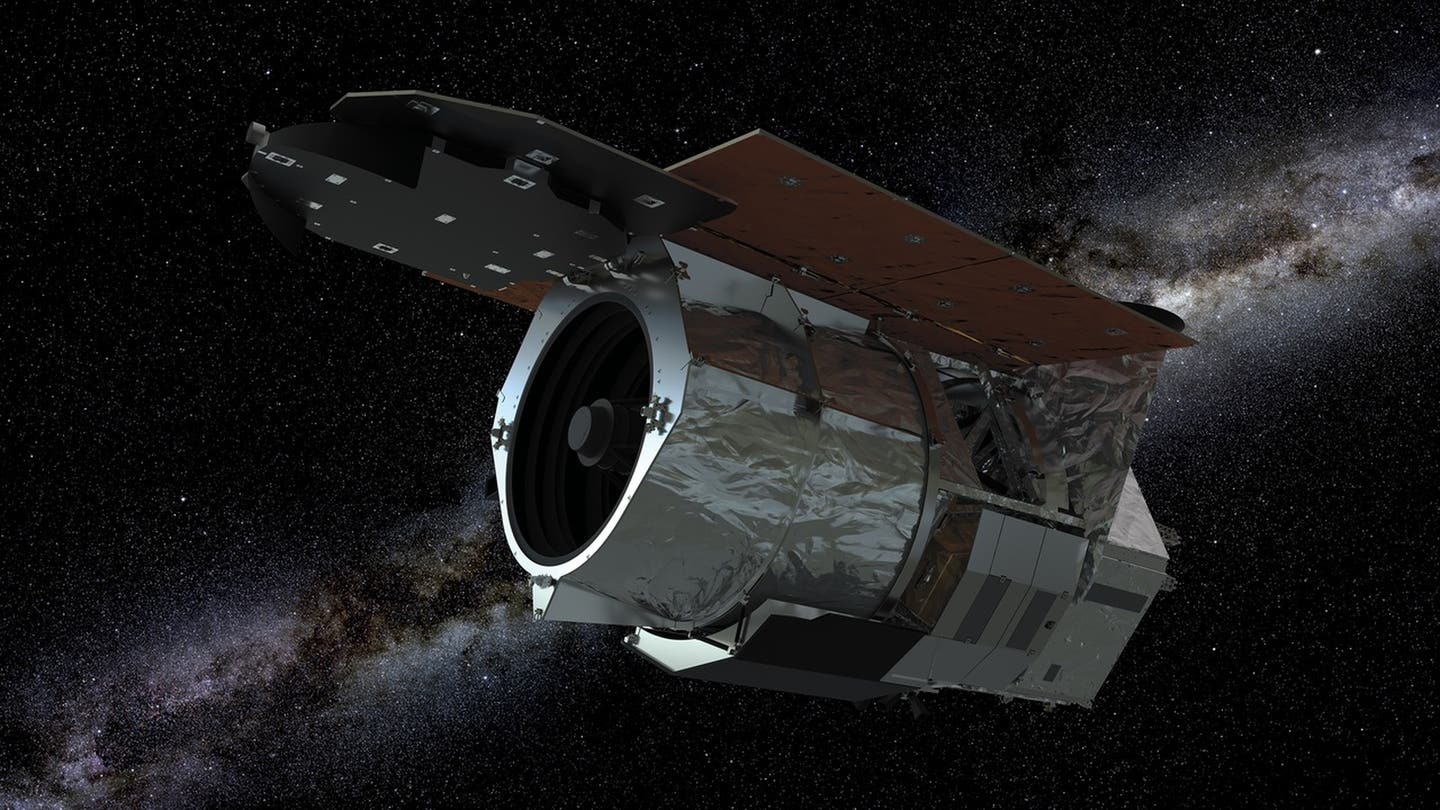
- NASA’s Nancy Grace Roman Space Telescope successfully launched aboard a SpaceX Falcon Heavy and is now beginning its journey toward a position about one million miles from Earth.
- Roman combines Hubble-like sharpness with a field of view at least 100 times larger, allowing it to survey enormous numbers of galaxies, stars and planets.
- The mission will investigate dark energy and dark matter, search for thousands of exoplanets and build huge public datasets that could reveal objects astronomers have never seen before.
A space telescope built to see the universe on an enormous scale has left Earth.
NASA’s Nancy Grace Roman Space Telescope lifted off at 7:26 a.m. EDT Sunday, Aug. 30, aboard a SpaceX Falcon Heavy rocket from Launch Complex 39A at Kennedy Space Center in Florida. Roman separated from the rocket’s second stage at 7:57 a.m. and began flying independently toward the second Sun-Earth Lagrange point, or L2, about one million miles from Earth.
Mission controllers received telemetry from Roman shortly after launch, and NASA later confirmed that its solar panels and lower instrument sun shade had successfully deployed. The observatory now faces a roughly three-month journey and commissioning period involving deployments, instrument activation, calibration and testing before science operations begin.
Roman combines sharp infrared vision with a field of view at least 100 times larger than Hubble’s. That combination could change how astronomers study everything from dark energy to distant planets.
“This enormous field of view will allow us to map astronomical objects in a way that we previously couldn’t,” said David Weinberg, a Distinguished University Professor of astronomy at The Ohio State University. “These better measurements may end up teaching us something extremely revolutionary about all kinds of matter in the cosmos.”
A telescope built to see the bigger picture
Roman carries a 2.4-meter primary mirror, the same diameter as Hubble’s, but its Wide Field Instrument can capture a much larger piece of sky in a single observation. NASA says Roman can survey the universe about 1,000 times faster than Hubble while producing similarly sharp infrared views.
“For just one single point, displaying an image from this telescope would be like looking at a wall full of 4K televisions,” Weinberg said. “These will have an extraordinary image quality as it scans the sky for objects more than 100 million times too faint to see with the human eye.”
More than two dozen Ohio State faculty members, students and postdoctoral scholars helped design Roman’s surveys. Anthony Harbo Torres, a senior graduate student in physics, helped calibrate the observatory’s image detectors.
“With Roman, we'll be seeing some things for the first time, as well as revisiting places we've seen before but with an increased level of resolution,” Harbo Torres said.
Mapping the universe’s dark side
Roman’s science program focuses heavily on dark energy, dark matter and the evolution of cosmic structure. One major wide-area survey will look away from the dusty plane of the Milky Way and combine imaging with spectroscopy across a large part of the sky.
Astronomers will examine hundreds of millions of galaxies, studying how they cluster and how intervening matter subtly distorts their shapes through weak gravitational lensing. Those measurements can reveal where matter lies and show how large-scale structures changed as the universe evolved.
They will also help researchers investigate dark energy, the name given to whatever appears to be driving the accelerating expansion of the universe. By comparing galaxy distributions, gravitational lensing and cosmic expansion across different eras, scientists hope to test how that acceleration has changed.
“Mapping clusters of dark matter will help us figure out why gravity on the scale of the universe is so radically different from gravity on the scale of a solar system or galaxy,” Weinberg said.
Billions of galaxies and stars
Much of Roman’s power will come from sheer scale. Over its surveys, the observatory is expected to examine about a billion galaxies and enormous numbers of stars. One planned Galactic Plane Survey could map roughly 20 billion stars across the Milky Way.
Such enormous catalogs should give astronomers more opportunities to find objects and events that appear too rarely to turn up often in smaller surveys.
“Roman is going to allow us to find extremely rare things and things that don’t happen very often,” said Scott Gaudi, an Ohio State astronomy professor and principal investigator of the Roman Galactic Exoplanet Survey Project Infrastructure Team.
“It’s going to be those things that are likely going to surprise us and lead to new avenues of research.”
Roman is now heading toward L2, where it can conduct long, stable observations beyond the blurring effects of Earth’s atmosphere. NASA expects its commissioning period to last about three months before the observatory begins its scientific work.
A massive search for distant worlds
Roman will also dramatically expand the search for planets beyond the solar system. One major survey will repeatedly monitor the crowded center of the Milky Way using gravitational microlensing.
Microlensing occurs when a foreground object passes close to the line of sight to a more distant star. Its gravity bends and magnifies the background star’s light. A planet around the foreground star can create an additional signal that reveals its presence.
Roman is expected to find more than 1,000 planets through microlensing. Because it will continuously watch enormous numbers of stars, researchers also expect its observations to identify around 100,000 planets through transits.
The two methods reveal different types of planetary systems. Transits favor planets that orbit relatively close to their stars, while microlensing can uncover planets farther out and even worlds drifting through the galaxy without a host star.
Roman could therefore provide one of the broadest statistical pictures yet of how planets are distributed across the Milky Way.
Blocking stars to reveal planets
Roman’s Coronagraph Instrument takes a different approach. The technology demonstration is designed to suppress the overwhelming glare of a nearby star so astronomers can observe far fainter objects beside it.
The instrument will test methods that could eventually support future missions designed to directly study smaller worlds. NASA plans to power on the coronagraph during Roman’s early journey, while the Wide Field Instrument will activate several weeks after launch.
Roman’s greatest discoveries, however, may come from questions nobody has thought to ask yet. Its primary mission is planned for five years, and processed science data will be publicly available for researchers around the world.
“The value of producing really big, vital datasets is that you then enable anyone in the world to go and make discoveries with it,” Weinberg said. “That’s a really powerful way of doing science, and I think bringing that to space-based astronomy is very inspiring.”
NASA anticipates releasing Roman’s first images in early 2027. By then, the observatory should be producing views that combine Hubble-like sharpness with a scale space astronomers have never had before.
“Roman’s technology will have a huge influence on the future of space science,” said Ohio State physics professor Christopher Hirata. “From launch onward, it’s going to be spectacular.”
The original story "NASA’s Roman Space Telescope launches to map billions of galaxies and hunt distant worlds" is published in The Brighter Side of News.
Related Stories
- James Webb Space Telescope finds strange beads and patterns in Saturn’s sky
- Euclid space telescope discovers Einstein Ring in a nearby galaxy
- Rectangular space telescopes could reveal dozens of Earth-like planets nearby
Like these kind of feel good stories? Get The Brighter Side of News' newsletter.
Joseph Shavit
Writer, Editor-At-Large and Publisher
Joseph Shavit, based in Los Angeles, is a seasoned science journalist, editor and co-founder of The Brighter Side of News, where he transforms complex discoveries into clear, engaging stories for general readers. With vast experience at major media companies like The Los Angeles Times, Times Mirror and Tribune Publishing, he writes with both authority and curiosity. His writing focuses on space science, planetary science, quantum mechanics, geology. Known for linking breakthroughs to real-world markets, he highlights how research transitions into products and industries that shape daily life.