Scientists use sound waves to create protective crystal coatings on crops
Researchers developed a sound-wave coating system that safely sprays protective crystal films onto living plant leaves.

 Edited By: Joseph Shavit

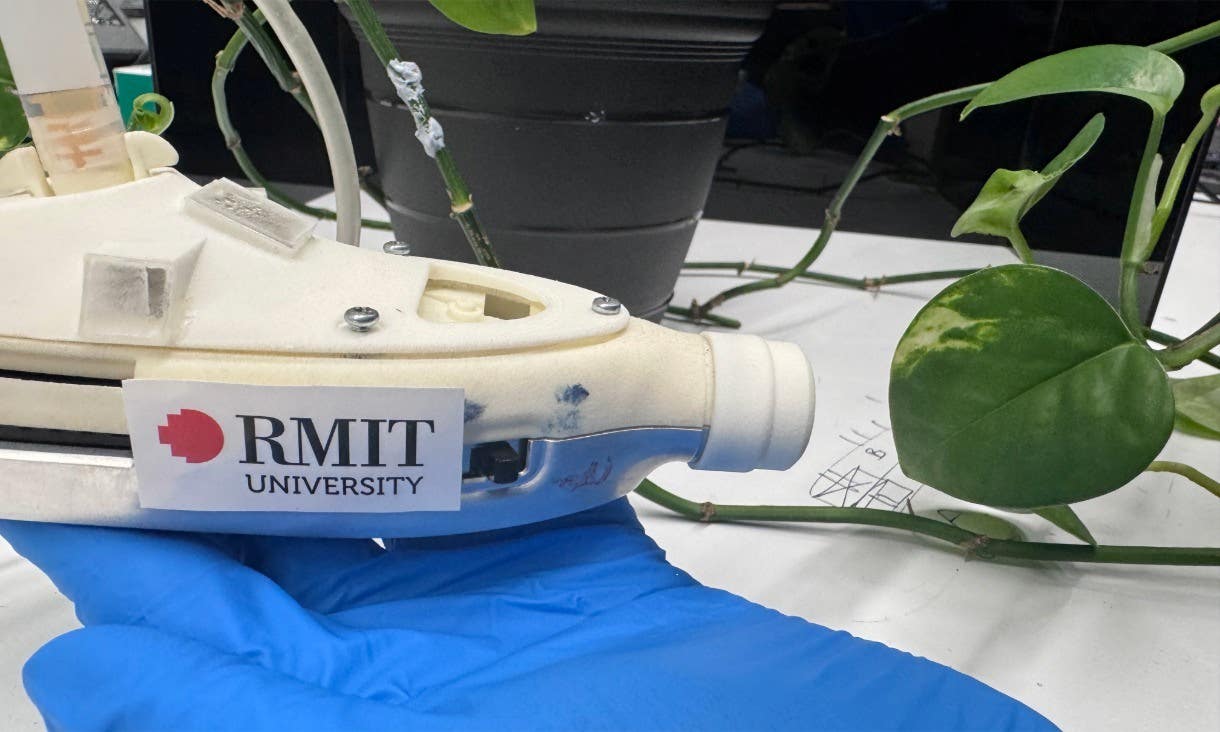
RMIT researchers used high-frequency sound waves to create crystal coatings on living plant leaves without heat or damage. (CREDIT: Will Wright, RMIT University)
A team of researchers at RMIT University has developed a new coating method that sounds almost futuristic. Using high-frequency sound waves, the scientists created a fine mist that forms protective crystal layers on delicate surfaces, including living plant leaves.
The breakthrough could solve a long-standing problem in materials science. Many advanced coatings require intense heat, chemical baths or harsh manufacturing steps that damage fragile materials. Living tissue, soft plastics and sensitive electronics often cannot survive those conditions.
The new process works differently. Instead of baking or chemically treating a surface, the system uses vibrations to transform liquid droplets into microscopic crystals while they travel through the air. Those crystals then settle gently onto the target surface, forming a thin, even coating within minutes.
Researchers say the method could eventually support applications ranging from crop protection to advanced electronics and medical materials.
A Gentle Coating For Living Plants
To test how safe the method really was, the team applied the coating directly onto living plant leaves. They coated only one section of each leaf so they could compare treated and untreated areas side by side.
Lead author Javad Khosravi Farsani said the coating worked like a sunscreen for plants.
“The coating absorbs harmful UV light while allowing visible light through,” he said.
“That means the plant can continue photosynthesis while being protected from damage.”
The coated leaves later faced intense ultraviolet light exposure. The uncoated sections showed major damage, while the protected areas remained healthy. After researchers removed the coating, the plants continued growing normally for months.
That finding mattered deeply because it showed the process itself did not harm the plant tissue. The experiment served as proof that the technology can work on extremely delicate surfaces without causing lasting stress or injury.
Why These Crystal Materials Matter
The coating material belongs to a class of compounds called covalent organic frameworks, or COFs. These materials contain highly ordered networks of organic molecules linked together into repeating porous structures.
Scientists have spent years studying COFs because of their unusual abilities. Their tiny pores and highly organized structures allow them to absorb light, separate molecules, store gases and interact with chemicals in precise ways.
Researchers have explored them for use in energy systems, sensors, electronics, catalysis and environmental protection. But despite their promise, they have remained difficult to apply outside laboratory settings.
Most COFs are produced as powders using high-temperature methods. Turning those powders into useful coatings usually requires additional processing steps that can damage fragile surfaces.
Distinguished Professor Leslie Yeo said this limitation has slowed wider adoption.
“These materials have extraordinary properties, but you’ve typically had to choose between preserving their structure and protecting the surface you’re applying them to,” Yeo said.
“What this work shows is a way to avoid that trade-off by forming and coating the material under very gentle conditions.”
Turning Sound Into A Manufacturing Tool
The heart of the system is an acoustomicrofluidic device that generates high-frequency sound vibrations. The vibrations spread liquid into an ultrafine mist made of microscopic droplets.
As the droplets move through the air, the liquid rapidly evaporates. During that short journey, the COF molecules organize themselves into highly ordered crystals. Those crystals then settle onto nearby surfaces as a thin coating.
Rather than making the coating first and applying it later, the system performs both steps at once.
Associate Professor Joseph Richardson explained why that matters.
“Our method effectively combines manufacturing and coating into a single step,” Richardson said.
“That simplicity is what makes it adaptable across different surfaces and applications.”
The process also works entirely at room temperature and in open air. Conventional methods often require ovens, aggressive solvents or sealed chambers.
Associate Professor Amgad Rezk said avoiding heat and harsh chemicals dramatically expands what researchers can coat safely.
“By using sound waves, we’re able to form and deposit the coating within minutes without heating or damaging the surface,” he said.
“That’s a major shift from conventional coating methods and it allows us to work with fragile materials, including living plant tissue.”
Tiny Droplets Create Highly Ordered Crystals
The researchers demonstrated the method using several different COFs. One especially important example was a material called DMTP-TAPB, which is highly stable in water and acidic environments.
The system produced crystalline coatings in as little as 30 seconds. Advanced imaging techniques showed strong long-range order inside the material, meaning the crystals formed properly despite the rapid process.
The droplets created by sound vibrations were much smaller than those produced in traditional spray systems. Their tiny size allowed solvents to evaporate rapidly, which triggered fast crystal formation.
Researchers found that evaporation speed played a crucial role. If droplets became too large or evaporation slowed too much, the resulting coatings lost their ordered structure.
The team also demonstrated precise control over coating thickness. By adjusting spray time, they produced films ranging from about 20 nanometers to more than 1.5 micrometers thick.
Thicker coatings generally showed greater crystallinity and porosity, though roughness sometimes increased as well.
Coating Almost Any Surface
One of the most striking aspects of the work was the variety of surfaces that could be coated successfully.
Researchers applied the coatings onto glass, plastic, fabric, tissue paper, cylindrical tubes and living leaves. In every case, the material formed evenly while maintaining strong crystalline structure.
The coatings also altered surface behavior. On glass, for example, the coating made the surface more water-repellent.
Mechanical testing suggested the films were durable and chemically stable. They remained intact after exposure to water and acidic conditions for several days.
Because the process is so gentle, researchers believe it may help industries working with materials that cannot tolerate conventional manufacturing.
Many emerging electronic devices, sensors and membranes are extremely sensitive to heat and chemicals. Yet they still need protective surface layers to function outside controlled laboratory settings.
“That opens up opportunities for industries working with sensitive materials that simply couldn’t be processed this way before,” Rezk said.
Future Possibilities Beyond The Laboratory
The researchers believe the technology could eventually support large-scale manufacturing. Because the coating device is compact and relies on chip-based fabrication methods, it may be relatively inexpensive to produce.
The team even suggested that future systems could be mounted onto drones or automated vehicles for targeted coating applications in agriculture or environmental protection.
For agriculture, the plant sunscreen demonstration hints at possible future uses in protecting crops from ultraviolet damage. As climate pressures increase and weather conditions become more extreme, protecting sensitive plant tissues may become increasingly important.
The work also opens new possibilities for medical materials and flexible electronics that cannot withstand traditional coating methods.
Practical Implications Of The Research
This research could help scientists and industries create protective coatings for materials previously considered too fragile to process. Living tissues, soft electronics and delicate membranes may all benefit from coatings that form without heat or harsh chemicals.
In agriculture, the work suggests crops could someday receive protective ultraviolet shields that still allow normal photosynthesis. That could help reduce damage caused by intense sunlight and changing environmental conditions.
For manufacturing, the method may simplify production by combining crystal synthesis and coating into one rapid step. This could reduce energy use, lower processing costs and improve scalability for advanced materials.
The findings may also accelerate research into covalent organic frameworks themselves. By making these materials easier to apply, scientists could explore new uses in electronics, environmental cleanup, sensing technologies and biomedical systems.
Research findings are available online in the journal Science Advances.
The original story "Scientists use sound waves to create protective crystal coatings on living plants" is published in The Brighter Side of News.
Related Stories
- New research finds that cells detect and react to sound waves
- Sound waves unlock hidden secrets inside stars
- Scientists use sound waves to unlock the secrets of quantum physics
Like these kind of feel good stories? Get The Brighter Side of News' newsletter.
Rebecca Shavit
Writer
Based in Los Angeles, Rebecca Shavit is a dedicated science and technology journalist who writes for The Brighter Side of News, an online publication committed to highlighting positive and transformative stories from around the world. Having published articles on MSN, AOL News, and Yahoo News, Rebecca's reporting spans a wide range of topics, from cutting-edge medical breakthroughs to historical discoveries and innovations. With a keen ability to translate complex concepts into engaging and accessible stories, she makes science and innovation relatable to a broad audience.