Six-satellite ‘StormWall’ could stop dangerous solar storms before they hit Earth
A modeled six-spacecraft system could cut the force of major solar storms before they damage technology on Earth and in orbit.
 Edited By: Joshua Shavit

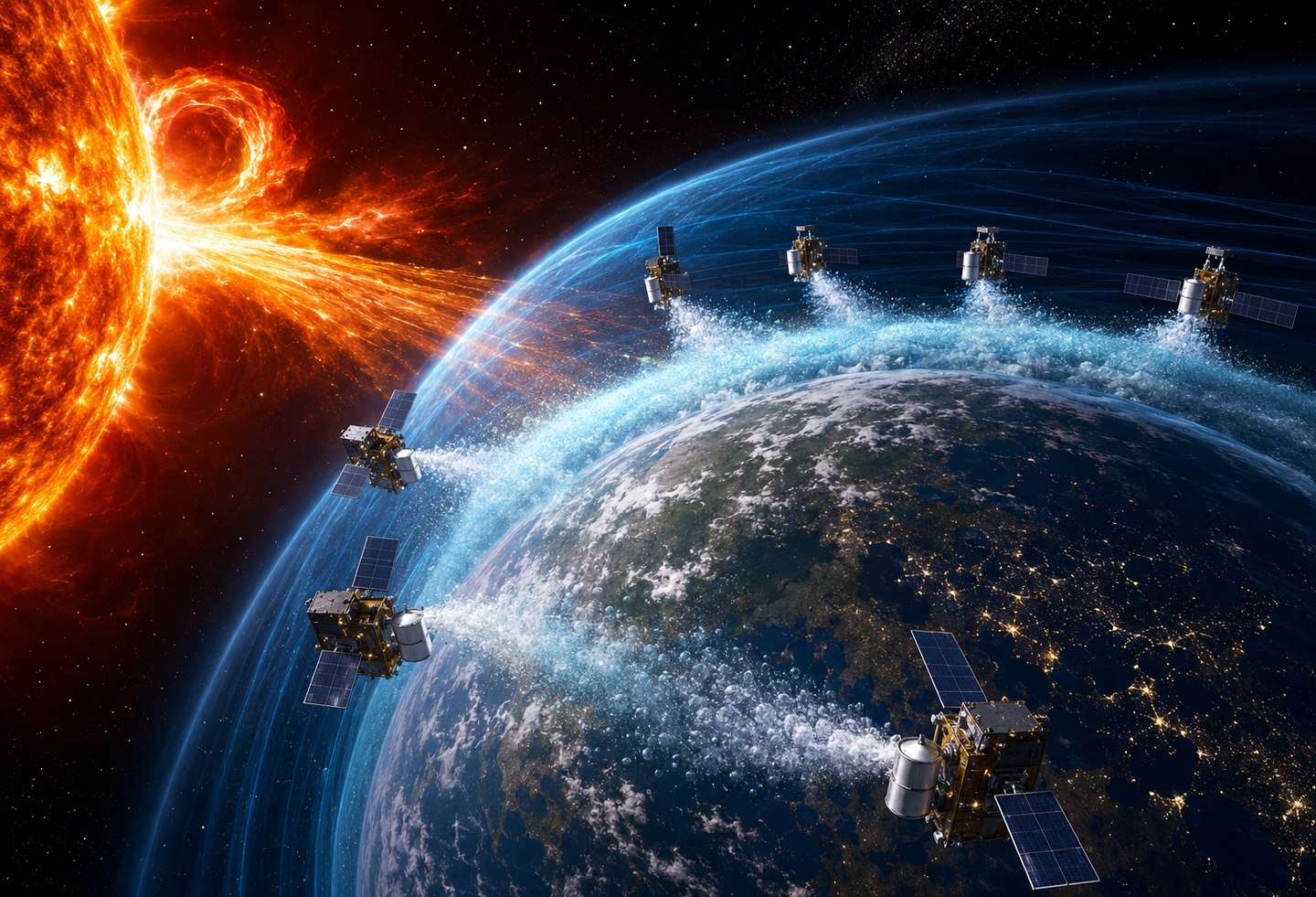
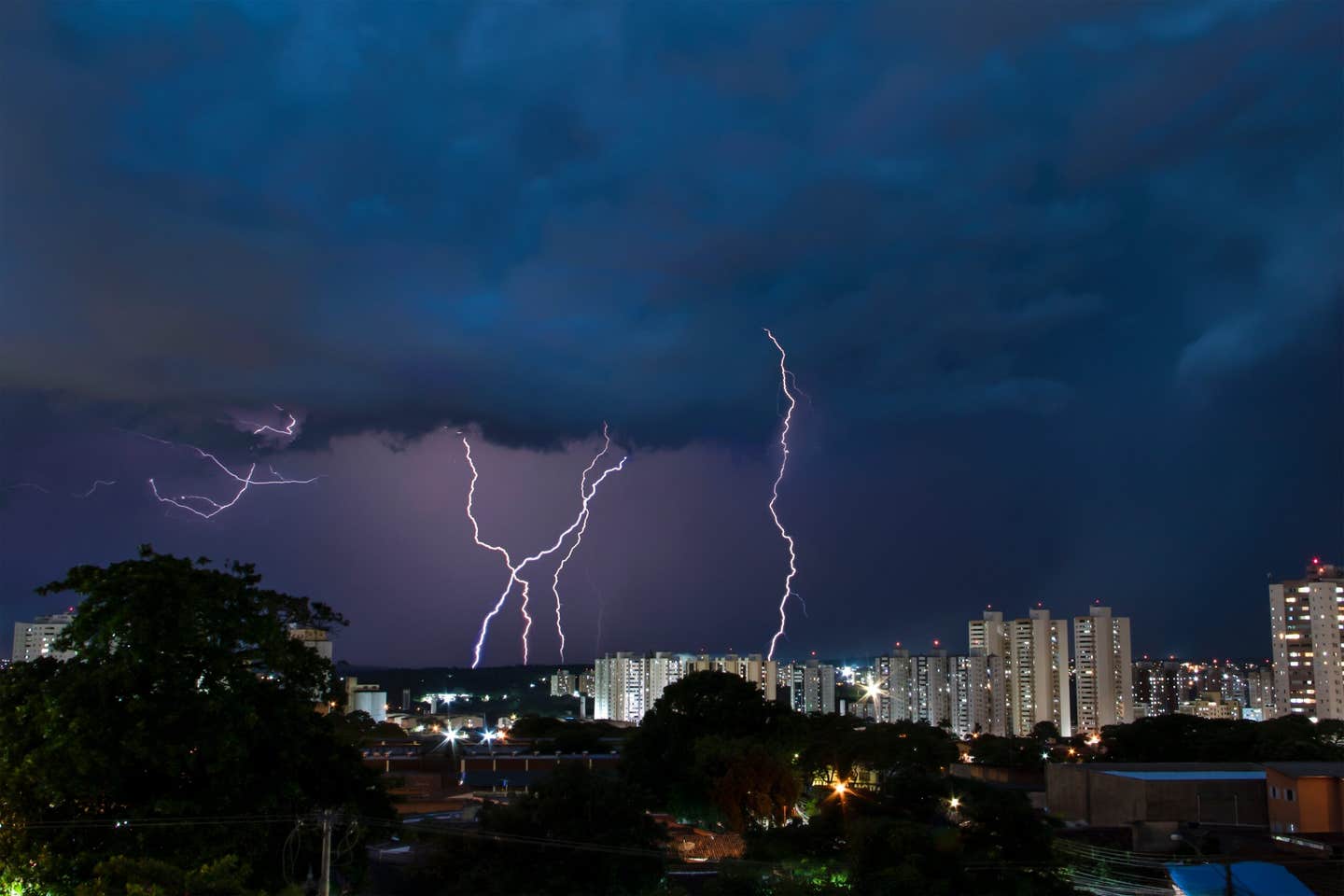
Simulations suggest a fleet of six spacecraft could weaken geomagnetic storms before they disrupt satellites, GPS, and power grids on Earth. (CREDIT: AI-generated image / The Brighter Side of News)
The most dangerous weather around Earth does not come with clouds.
It comes from the sun, which can hurl bursts of energy and charged particles into space hard enough to disrupt radio signals, damage satellites, distort GPS, and drive electrical currents into power grids on the ground. In May 2024, a major solar storm also knocked precision-guided farm equipment off course, slowing planting and harvesting and costing U.S. farmers an estimated $500 million.
For decades, the main response has been prediction. Space weather forecasters watch the sun, estimate what is coming, and give satellite operators and utilities time to brace. Brian Walsh, a Boston University engineer, is asking whether Earth could do more than brace.
His team has modeled a way to temporarily reinforce the planet’s magnetic defenses during a major storm, using a group of spacecraft that would release material into near-Earth space. In simulations, the concept cut the intensity of a powerful geomagnetic storm sharply, suggesting that a severe space weather event might one day be softened before it fully hits.
“Since humans have been in space, we’ve been trying to predict what’s going to happen in the space environment,” says Walsh, a Boston University College of Engineering associate professor of mechanical engineering. “But we came up with a model that could flip the paradigm. It’s like people in a village who see a river flooding, maybe they can predict when that will happen, but probably what’s even better is if they could build a storm wall. That’s what we’re proposing here.”
A wall built from plasma
The idea, described in the journal Space Weather, starts with a known feature of near-Earth space. Material can escape from Earth’s upper atmosphere and drift outward toward the magnetosphere, the magnetic bubble that helps shield the planet from the solar wind. Walsh wondered whether that natural process could be intensified on purpose.
The proposal, called StormWall, would use six spacecraft placed in geosynchronous orbit, high enough to circle Earth at the same rate the planet rotates. Each spacecraft would carry a chemical payload, likely an alkaline or alkaline-earth material such as barium or lithium. Once released, that material would rapidly photoionize in sunlight, turning into plasma.
The goal is not to block the storm head-on like a physical barrier. It is to alter the conditions at the edge of the magnetosphere, where energy from the solar wind enters through a process called magnetic reconnection. If enough extra mass is added there, reconnection becomes less efficient. More solar wind energy gets diverted around Earth instead of being deposited into the magnetosphere.
That matters because geomagnetic storms grow stronger when large amounts of solar wind energy pour through that boundary. Reduce the energy transfer, and the storm weakens.
Walsh says the idea sounds more speculative than it is. “When you apply some really serious physics to it, it does work. And the amount of mass we need, the launch capacities, it’s all within our capabilities,” he says. “People have always thought, ‘space is huge, the sun is massive, we just have to sit here and take whatever it gives us.’ But what we found is that we can impact it.”
Testing the idea on a real storm
To see whether the concept could work, Walsh and a University of Michigan collaborator ran physics-based simulations of the geomagnetic storm of May 10 to 11, 2024, known as the Gannon storm or Mother’s Day storm. It was chosen because it was one of the largest recent storms with upstream solar wind measurements available to drive the model.
The team compared two runs. One simulated the storm under ordinary conditions. The other added six virtual geosynchronous spacecraft that released mass-loading material for 14 hours, from 14:00 UTC on May 10 to 4:00 UTC on May 11.
In that second run, each spacecraft released material at 1.27 kilograms per second. Altogether, the model used 384,048 kilograms of mass-loading material during the simulated storm.
The system did not stop the storm entirely. But by several key measures, it significantly reduced the storm’s force.
Near the peak of the event, the simulated auroral electrojet index, one measure of geomagnetic activity, dropped from 1,600 nanotesla in the reference case to less than 250 nanotesla with mass loading, a reduction of more than 84 percent. The cross-polar cap potential, another measure tied to energy transfer from the solar wind, fell from 370 kilovolts to 145 kilovolts, a 61 percent reduction.
The simulations also showed sharply lower ground magnetic disturbances, the kind associated with geomagnetically induced currents that can damage high-voltage power systems. Once the artificial mass loading stopped, the two model runs began to converge again within a few hours, suggesting the added material would not linger for long in the system.
Expensive, temporary, and still hypothetical
StormWall is far from a finished engineering plan.
The paper presents it as a feasibility study, not a ready-to-build project. The researchers estimate that the full payload in orbit, including spacecraft, tanks, and the mass-loading material itself, would total about 436,253 kilograms. That is a large undertaking, though the authors argue it is within near-future launch capability.
Walsh acknowledges cost as one of the biggest barriers. The system would also be expendable in its current form. Once the stored material is released and photoionized, that protection is gone until new spacecraft or replacement payloads are launched.
The team is now studying ways to reduce the amount of material needed, possibly by half, and exploring pulsed releases that could stretch the system’s useful life. They also want to examine other orbital setups and refine the chemistry to find the best materials for storage and deployment.
There are scientific questions too. Dumping a large cloud of ionized material into near-Earth space could trigger instabilities and electromagnetic waves. Some of those effects have been studied in smaller chemical release experiments, but the authors say more work is needed to understand the possible side effects at larger scale.
Walsh argues the material would not become long-term space junk. “The material drifts out on these natural highways, it leaves the system, the magnetosphere flushes the material out within six or so hours.”
A new kind of planetary defense
The proposal stands out because it moves beyond forecasting and shielding individual assets. Most current efforts aim to make satellites tougher or give operators warning before a storm arrives. StormWall treats the space environment itself as something humans might actively shape.
Walsh says that makes the project unusual even within space physics. “This is quite different than what anyone is doing right now, I don’t know of anyone proposing to geoengineer space.”
The idea may sound grand, but the incentive is not hard to see. The last once-in-a-century geomagnetic storm, the Carrington Event, struck in 1859, before modern electronics and space infrastructure existed. The paper cites estimates that a comparable storm today could inflict $2.4 trillion to $3.4 trillion in damage to power grids alone.
Against that backdrop, a costly orbital defense system begins to look less like science fiction and more like an insurance policy, albeit one still on the drawing board.
Practical implications of the research
If the concept holds up, it could change how governments and industries think about space weather risk. Instead of relying only on forecasting, operators might one day have a way to reduce the force of an incoming geomagnetic storm before it causes widespread damage.
That could matter for power transmission, satellite operations, navigation, communications, finance, and agriculture, all of which now depend heavily on vulnerable electronic systems.
The work also opens a broader policy question: whether the space around Earth should remain something humanity only monitors, or become something it deliberately manages in moments of danger.
Research findings are available online in the journal Space Weather.
The original story "Six-satellite 'StormWall' could stop dangerous solar storms before they hit Earth" is published in The Brighter Side of News.
Related Stories
- Space weather near stars may be hiding alien signals from Earth
- 'Space waves' offer new clues to understanding space weather
- Solar Orbiter traces space-weather particles back to solar flares and CMEs
Like these kind of feel good stories? Get The Brighter Side of News' newsletter.
Joseph Shavit
Writer, Editor-At-Large and Publisher
Joseph Shavit, based in Los Angeles, is a seasoned science journalist, editor and co-founder of The Brighter Side of News, where he transforms complex discoveries into clear, engaging stories for general readers. With vast experience at major media companies like The Los Angeles Times, Times Mirror and Tribune Publishing, he writes with both authority and curiosity. His writing focuses on space science, planetary science, quantum mechanics, geology. Known for linking breakthroughs to real-world markets, he highlights how research transitions into products and industries that shape daily life.