Soft robotic suit helps older adults stand up and walk with less effort
Artificial tendons and thigh sensors helped older adults rise from chairs more easily while preserving a strong sense of movement control.
 TUM Writer: Andreas Schmitz

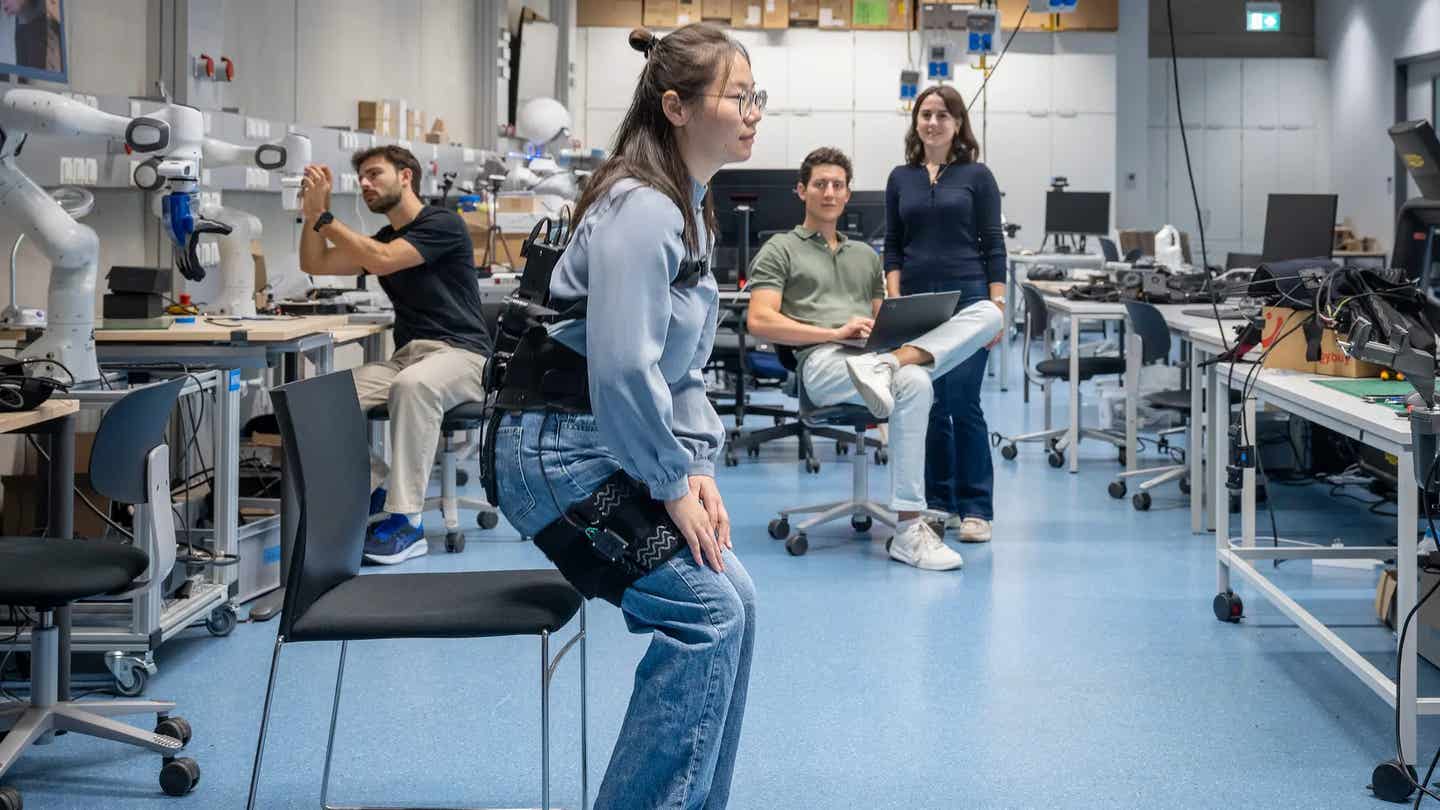
Dr Xiaohui Zhang from the Chair of Intelligent Bio-Robotic Systems at TUM demonstrates her exoskeleton, which helps older people with hip problems to stand up. (CREDIT: Andreas Heddergott / TUM)
- A soft robotic hip exosuit helped older adults stand up from a chair more quickly and complete more sit-to-stand repetitions while preserving largely natural movement patterns.
- During six-minute walking tests, the suit reduced the average metabolic cost of transport by 13.6%, although individual responses varied widely and two participants used more energy with assistance.
- The 2.86-kilogram device uses thigh sensors, machine-learning-based movement recognition and artificial tendons to deliver hip assistance, but larger and longer real-world studies are still needed.
Rising from a chair can become surprisingly demanding with age. The movement requires enough strength, coordination and balance to shift the body forward and upward in only a few seconds.
Researchers at the Technical University of Munich have now tested a soft robotic suit designed to make that movement easier without taking control away from the wearer. In a small feasibility study, older adults wearing the suit completed more sit-to-stand movements in one minute and used less energy while walking.
The system weighs 2.86 kilograms and uses artificial tendons connected to motors near the waist and back. Sensors on the thighs track leg movement, while a control system recognizes whether the wearer is standing up or walking and adjusts assistance accordingly.
The study, published in Nature Communications, included 10 adults ages 69 to 85 who had reduced lower-limb functional performance. The researchers emphasize that the results are preliminary, but they suggest that soft wearable robots could eventually support people who remain independently mobile but need help with everyday movement.
Artificial tendons assist the hips
Traditional powered exoskeletons often use rigid frames aligned with the joints. They can generate substantial forces, but their weight, stiffness and bulk can make them less practical for people who can still walk independently.
The TUM system takes a softer approach. Textile components wrap around the waist and thighs, while tendons transmit pulling forces from motors to assist hip extension.
When someone starts to rise from a chair, the hips must generate substantial extension power. The same joint also contributes to walking, making it an attractive target for a device intended to assist more than one activity.
Two inertial sensors mounted on the thighs monitor leg motion. Their signals feed a controller that identifies the user’s locomotion mode and estimates the movement phase so that assistance arrives at the appropriate time.
“We use machine learning to provide the user with the necessary assistance at exactly the right moment,” researcher Xiaohui Zhang said.
The researchers first trained the recognition system with movement data from young healthy adults. Future versions could become more personalized as data accumulate from older users with different movement patterns.
Older adults stood up more often
Participants performed a one-minute sit-to-stand test, repeating the movement as many times as they safely could.
Nine participants completed the full comparison. Without active assistance, they averaged 16.8 repetitions in one minute. With the exosuit switched on, that increased to 18.6 repetitions, an average gain of 1.8 cycles.
The average duration of each complete sit-and-stand cycle fell by 9%, or about 350 milliseconds. Eight of the nine participants completed the movements faster while receiving assistance.
Individual results varied considerably. The largest improvement was four extra cycles in a minute, while the greatest reduction in cycle duration reached 21.9%. One participant, however, became slightly slower.
Those differences matter because older adults do not all move in the same way. Baseline strength, confidence, gait asymmetry, biomechanics and how well the suit fits could all influence the response.
The researchers therefore view individualized control as an important future goal rather than assuming one assistance profile will suit everyone.
Walking required less energy
The team also tested whether the same device could improve walking efficiency.
Participants completed six-minute walking tests while researchers measured metabolic cost of transport, the amount of energy needed to move a given body mass over a given distance.
With assistance, average metabolic cost fell from 2.63 to 2.27 joules per kilogram per meter, a reduction of 13.6%. Seven of nine participants used less energy with the suit, and four achieved reductions greater than 20%.
The strongest individual reduction reached 27.5%. Two participants moved in the opposite direction, with metabolic costs increasing by 9.9% and 18%.
That variation prevents the results from supporting a simple conclusion that the exosuit benefits every wearer. It instead suggests that adaptive assistance may be necessary to match the device to each person's strength, gait and movement strategy.
Walking speed also fell by about 5% on average while assistance was active, but that difference was not statistically significant.
Natural movement remained largely intact
Helping someone move faster is only useful if the device does not create unwanted compensations or make balance worse.
Researchers therefore examined hip and trunk motion during standing and walking. They found no significant changes in major kinematic measurements between assisted and unassisted conditions.
Measurements from a force plate also showed no significant group-level changes in center-of-force movement during repeated sit-to-stand cycles. That suggests the improved performance did not come with a measurable overall deterioration in the stability indicators used in the experiment.
There were still individual exceptions. One participant stood more quickly but showed a trend toward greater postural sway, while another became faster and showed the opposite pattern.
The authors caution that their stability measurements did not capture every aspect of dynamic balance. Future studies will need more detailed measurements of the body's center of mass and its relationship to the base of support.
Users still felt in control
Whether people feel that a robot is helping them or controlling them could determine whether wearable systems are ever accepted outside laboratories.
The participants rated their sense of agency at an average of 6.07 on a seven-point scale, significantly above the neutral midpoint. Responses generally indicated that wearers still felt responsible for and in control of their movements.
That distinction is important for a technology aimed at people who remain mobile. The exosuit is not intended to stand someone up automatically. It detects a voluntary movement and provides partial assistance during the hip-extension phase.
The study also has important limitations. Only 10 people participated, tasks were short and performed in a controlled environment, and the main experiment compared active assistance with wearing the same suit switched off rather than with wearing no device at all.
A supplementary test involving seven participants produced broadly similar results without the suit, but longer studies in homes and communities will be needed.
For now, the findings suggest that wearable robots may become less like rigid medical machinery and more like clothing that quietly contributes extra strength when it is needed.
Dig deeper into wearable robots for older adults
These studies and resources provide recent context on soft exosuits, personalized assistance and mobility support for older adults.
Walking with a Passive Hip Exoskeleton and Wearables: Gait Characteristics and Metabolic Power in Senior Adults: This study examines how a passive hip exoskeleton affects gait and metabolic demands in older adults, providing a useful comparison with actively powered systems. (Sensors, 2026)
Older people's needs for soft exoskeletons: a human-centered, participatory study: Researchers worked directly with older adults and caregivers to identify design priorities including comfort, autonomy, personalization and social acceptance. (International Journal of Industrial Ergonomics, 2025)
Powered knee exoskeleton improves sit-to-stand transitions in stroke patients using electromyographic control: A powered knee system improved standing speed, symmetry and effort in stroke survivors, illustrating another approach to robotic assistance for chair-rise movements. (Communications Engineering, 2025)
Soft robotic shorts improve outdoor walking efficiency in older adults: Lightweight tendon-driven shorts reduced the metabolic cost of outdoor walking in older adults while preserving a strong sense of voluntary control. (Nature Machine Intelligence, 2024)
Optimizing exoskeleton assistance to improve walking speed and energy economy for older adults: Human-in-the-loop optimization improved both walking speed and energetic efficiency in older adults, underscoring the value of personalized robotic assistance. (Journal of NeuroEngineering and Rehabilitation, 2024)
Research findings are available online in the journal Nature Communications.
The original story "Soft robotic suit helps older adults stand up and walk with less effort" is published in The Brighter Side of News.
Related Stories
- Space-age exosuit is revolutionizing workplace safety and productivity
- Soft robotic exosuit offers hope and mobility for 9 million Parkinson's patients worldwide
- Breakthrough deep brain stimulation therapy restores walking after spinal cord injury
Like these kind of feel good stories? Get The Brighter Side of News' newsletter.
Rebecca Shavit
Writer
Based in Los Angeles, Rebecca Shavit is a dedicated science and technology journalist who writes for The Brighter Side of News, an online publication committed to highlighting positive and transformative stories from around the world. Having published articles on MSN, AOL News, and Yahoo News, Rebecca's reporting spans a wide range of topics, from cutting-edge medical breakthroughs to historical discoveries and innovations. With a keen ability to translate complex concepts into engaging and accessible stories, she makes science and innovation relatable to a broad audience.