Oklahoma crater may be 100 million years younger than thought, shifting it toward a mass extinction event
Microscopic zircons move an Oklahoma impact crater out of the Ordovician and close to one of Earth’s major extinction intervals.
 UTexas Writer: Julia Sames

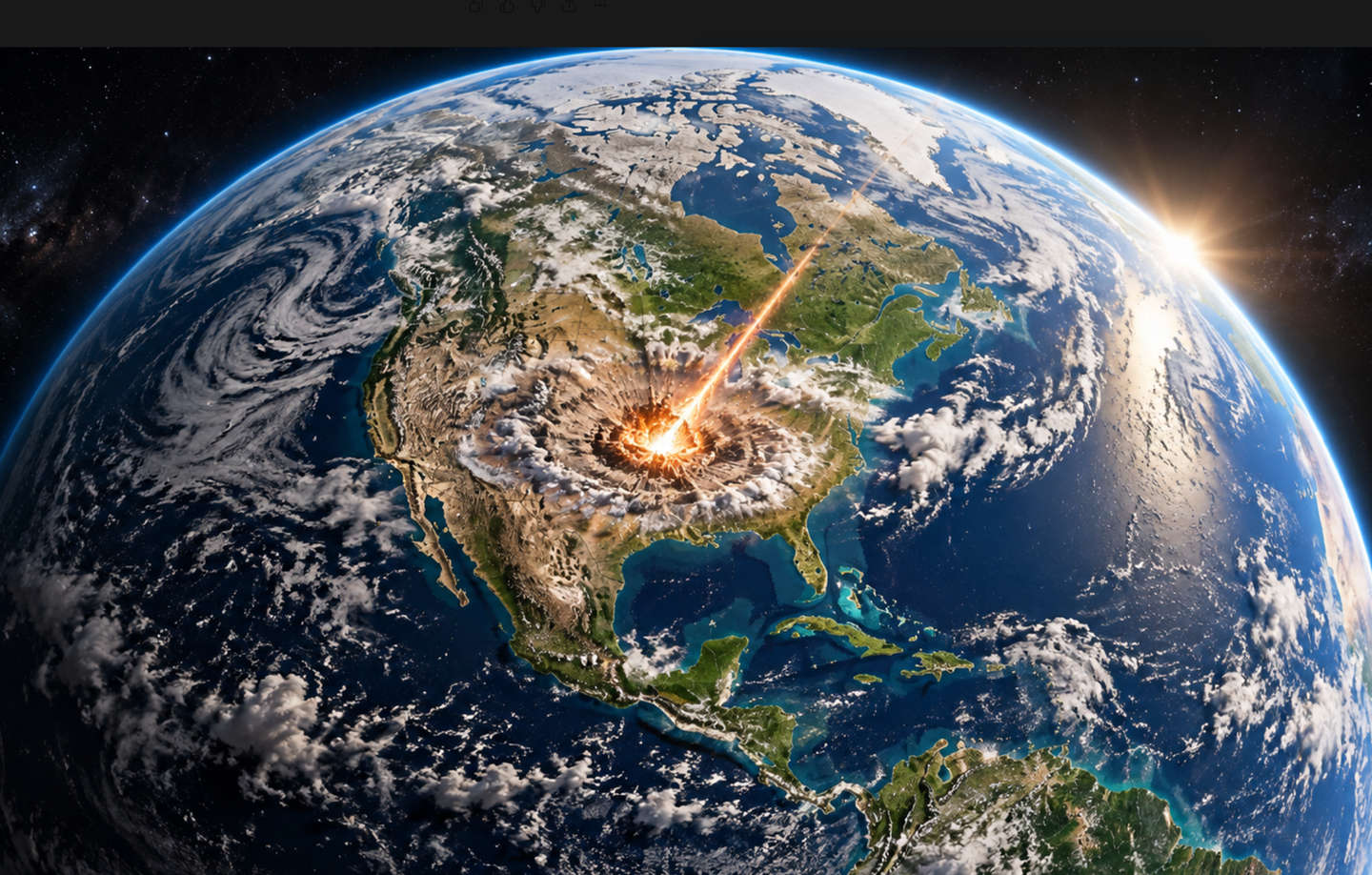
New zircon dating suggests Oklahoma’s Ames crater is about 100 million years younger than thought and may date to the Late Devonian. (CREDIT: Shutterstock)
- New uranium-lead dating of zircons from Oklahoma’s buried Ames impact structure points to a Late Devonian age near 370 million years, roughly 100 million years younger than its traditional Ordovician assignment.
- The revised chronology removes Ames from a group of craters used to support the hypothesis that Earth may have possessed an asteroid-debris ring during the Ordovician.
- The new age overlaps the broader interval of the Frasnian-Famennian mass extinction, but researchers stress that more dating is needed before connecting the Ames impact directly with that biological crisis.
A meteorite crater buried beneath northern Oklahoma may belong to a completely different chapter of Earth’s history than scientists have believed for decades.
The Ames impact structure, a 14- to 16-kilometer-wide crater beneath the town of Ames, had generally been placed in the Ordovician Period around 470 million years ago. That timing made it part of an unusual cluster of impacts associated with the Ordovician Meteor Event, an ancient bombardment that has even inspired the hypothesis that Earth temporarily possessed a ring of asteroid debris.
New radioisotopic evidence now challenges that interpretation. Researchers led by the University of Texas at Austin found a population of zircons dated to about 369.7 million years ago, placing a major high-temperature event at Ames in the Late Devonian instead.
The study, published in Meteoritics & Planetary Science, does not yet provide an unquestionable impact date. The authors consider the zircon results the strongest evidence so far that Ames is much younger than previously assumed, but they say additional samples will be needed to tie the date more firmly to crater formation.
Fossils may have dated the wrong event
The traditional age of Ames came largely from conodonts, tiny tooth-like fossils from extinct marine animals found in sediments associated with the crater. Those fossils indicated an Ordovician age between roughly 478 million and 458 million years.
That interpretation assumed the fossils entered the crater sediments close to the time of impact. The new work offers another possibility: the meteorite may have struck rocks that already contained Ordovician fossils, excavating and redepositing them inside the crater millions of years later.
In that scenario, the conodonts accurately date the rocks in which they originally formed, but not the collision that disrupted those rocks. Rapid excavation and redeposition could also explain why some of the small fossils remained well preserved despite being moved during a violent impact.
The distinction is crucial because Ames had never received a high-precision radioisotopic age that securely confirmed its fossil-based chronology.
“No matter what technique we used, it was coming back to this younger signal,” lead author Elizabeth Catlos said.
Zircons provide a different kind of clock
To establish a new timeline, the researchers examined zircon crystals extracted from impact-affected granite recovered from a deep core beneath Ames. Zircon is especially useful for geochronology because uranium becomes incorporated into the crystal when it forms while lead can accumulate through radioactive decay.
Scientists measured uranium and lead isotopes using two analytical techniques. Most zircons preserved much older ages associated with the original basement granite, including an approximately 1.4-billion-year crystallization age.
A younger group produced a weighted mean age of 369.7 million years, with an uncertainty of 5.9 million years. The researchers interpret this population as evidence of a major Late Devonian heating and recrystallization event associated with the impact history.
They also examined the crystals using cathodoluminescence imaging and electron backscatter diffraction, including work conducted with NASA. Some zircons contained microstructures consistent with shock deformation, strengthening the evidence that the rocks experienced the extreme pressures expected during an impact.
Other dating results were younger still, but those measurements came from plagioclase and showed disturbed argon systems. The team concluded that later burial, heating and hydrothermal activity probably partially reset those mineral clocks rather than recording the meteorite collision itself.
The result changes an Ordovician mystery
Moving Ames out of the Ordovician matters far beyond Oklahoma because the crater has played a role in attempts to reconstruct an extraordinary period of asteroid activity.
Around 466 million to 468 million years ago, the parent body of L-chondrite meteorites broke apart. Geological records subsequently show a dramatic increase in extraterrestrial material reaching Earth.
A 2024 study added an even more unusual possibility. Researchers examining the reconstructed positions of 21 Ordovician craters found that they were concentrated close to Earth’s ancient equator. They proposed that a large asteroid may have passed inside Earth’s Roche limit, broken apart and temporarily created a ring around the planet.
Material falling from such a ring could potentially explain the unusual geographic concentration of impacts. The idea remains a hypothesis, and accurate crater ages are essential for testing it.
Ames had been counted among significant North American structures linked with this period. If its true age is Late Devonian, it no longer belongs in that dataset, reducing the number of craters available to reconstruct the Ordovician bombardment.
A different extinction enters the picture
Moving Ames forward by roughly 100 million years creates another intriguing coincidence. The new zircon age overlaps, within uncertainty, the Late Devonian Frasnian-Famennian extinction interval around 372 million years ago.
That crisis devastated marine ecosystems and was particularly severe for reef-building organisms. Its causes remain debated, with ocean anoxia, climate disruption, volcanism and extraterrestrial impacts among the mechanisms investigated.
Several other North American impact structures or impact deposits also have Middle to Late Devonian ages. These include Flynn Creek in Tennessee, Nicholson Lake in Canada and the enormous Alamo impact deposits in Nevada.
That clustering raises the possibility that Ames belongs to a period of heightened Late Devonian impacts. It does not show that those collisions caused the extinction, however, and earlier studies have failed to establish the kind of clear global impact signature associated with the end-Cretaceous extinction.
The new chronology instead gives researchers another event to test against increasingly precise records of environmental change.
More zircons could settle the timeline
The study carries an important limitation: researchers had relatively little core material available and recovered only a small number of zircons suitable for analysis. The authors therefore describe additional dating as essential for confirming the relationship between the young zircon population and crater formation.
One alternative would be to locate ejecta thrown outward during the Ames impact. Material ejected from a crater can cool rapidly and may preserve a cleaner isotopic record than rocks subjected to long periods of hydrothermal alteration beneath the crater.
Researchers are now interested in searching Devonian rocks in Oklahoma and neighboring states for that debris.
The implications extend beyond the history of one buried crater. Impact chronology determines whether apparently unrelated events happened millions of years apart or close enough together to have shared environmental consequences.
By moving Ames from one period of Earth history to another, a handful of microscopic crystals may have removed an important piece from one ancient impact mystery and placed it beside another.
Dig deeper into ancient impacts and mass extinctions
These studies provide important context on the Ordovician impact spike, crater dating and the debated role of impacts during the Late Devonian extinction.
Shock deformation and U-Pb isotope systematics in zircon from impactites of the Rochechouart impact structure: Impact age and zircon provenance: This recent study demonstrates how zircon shock textures and uranium-lead isotope systems can be combined to reconstruct the ages of ancient impact structures. (Geochimica et Cosmochimica Acta, 2025)
Evidence suggesting that earth had a ring in the Ordovician: Researchers found an unusual equatorial concentration of Ordovician impact craters and proposed that debris from a disrupted asteroid may once have formed a temporary ring around Earth. (Earth and Planetary Science Letters, 2024)
The Ordovician meteorite event in North America: Age of the Slate Islands impact structure, northern Lake Superior, Ontario, Canada: Zircon dating of another major North American crater produced an age consistent with the Ordovician impact interval, illustrating why accurate individual crater dates matter. (Meteoritics & Planetary Science, 2024)
Precisely dating the Frasnian–Famennian boundary: implications for the cause of the Late Devonian mass extinction: High-precision zircon dating tightly constrains the timing of the Late Devonian extinction and helps researchers test proposed links with impacts and volcanism. (Scientific Reports, 2018)
Refined Ordovician timescale reveals no link between asteroid breakup and biodiversification: Precise dating placed the breakup of the L-chondrite parent asteroid at about 468 million years ago and challenged claims that the event triggered the Great Ordovician Biodiversification. (Nature Communications, 2017)
Research findings are available online in the journal Meteoritics & Planetary Science.
The original story "Oklahoma crater may be 100 million years younger than thought, shifting it toward a mass extinction event" is published in The Brighter Side of News.
Related Stories
- Rare meteorite crashes into New Jersey home revealing clues to the origin of life
- Meteorite 200x larger than the dinosaur killer reshaped the course of evolution on Earth
- Rare meteorite points to a long-lost planet from our early solar system
Like these kind of feel good stories? Get The Brighter Side of News' newsletter.
Joseph Shavit
Writer, Editor-At-Large and Publisher
Joseph Shavit, based in Los Angeles, is a seasoned science journalist, editor and co-founder of The Brighter Side of News, where he transforms complex discoveries into clear, engaging stories for general readers. With vast experience at major media companies like The Los Angeles Times, Times Mirror and Tribune Publishing, he writes with both authority and curiosity. His writing focuses on space science, planetary science, quantum mechanics, geology. Known for linking breakthroughs to real-world markets, he highlights how research transitions into products and industries that shape daily life.