Spider and horseshoe crab relatives emerged 20 million years earlier than scientists thought
A Utah fossil with the oldest known chelicera shows spider relatives emerged 20 million years earlier than scientists knew.

 Edited By: Joseph Shavit

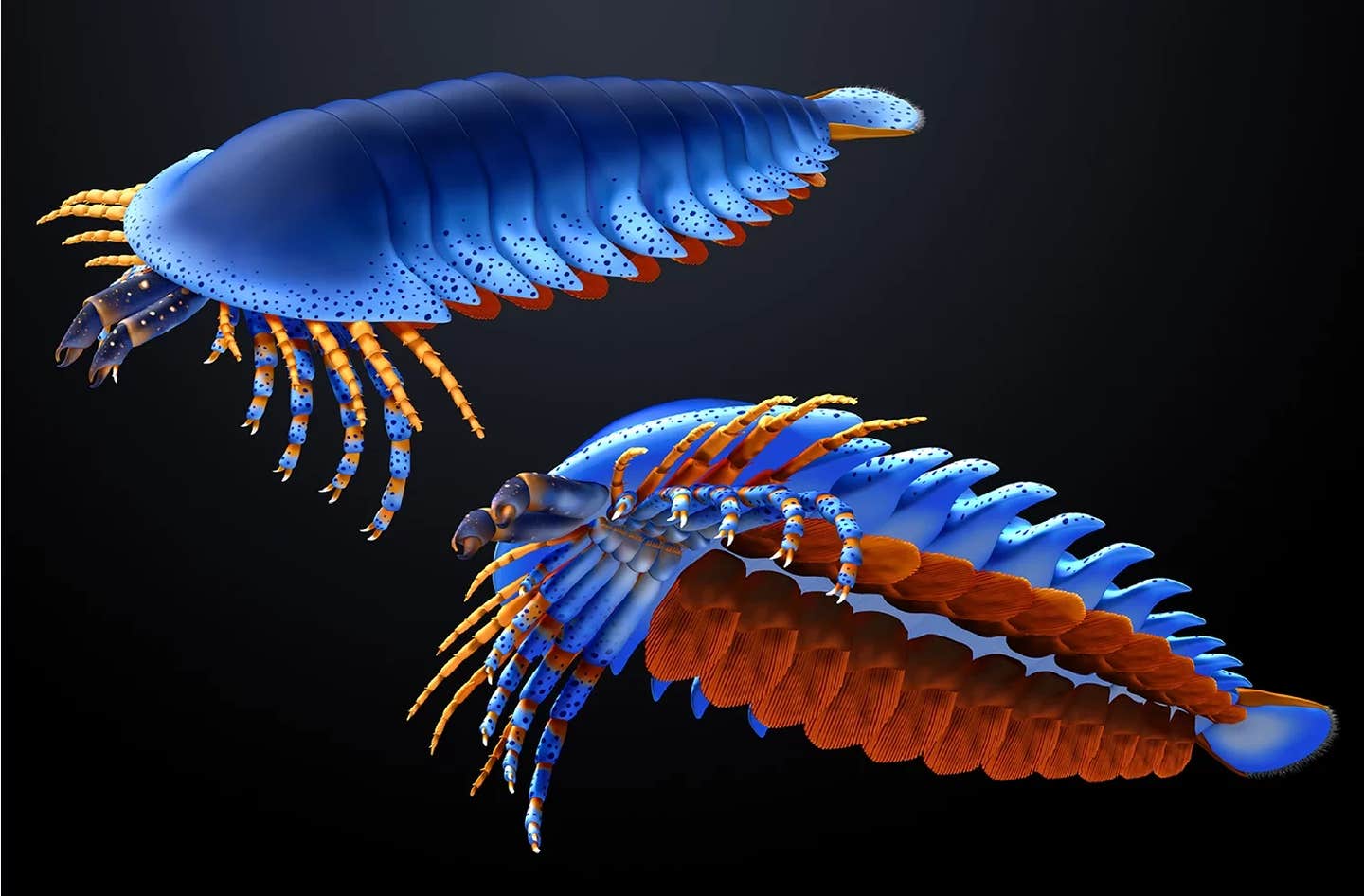
Artistic reconstructions by M. Hattori illustrating oblique views of the dorsal (top) and ventral (bottom) morphologies. The sanctacaridid-like morphology of the posteriormost body region is speculative. (CREDIT: Nature)
It looked, at first, like the sort of fossil Rudy Lerosey-Aubril knew well.
After a long day of teaching, the Harvard University researcher sat down to clean a Cambrian arthropod specimen under a microscope, working with a fine needle the way paleontologists often do when stone still hides the details that matter most. The fossil came from Utah’s House Range and seemed ordinary enough for its age. Then he uncovered an appendage where no Cambrian arthropod was supposed to have one.
It was a claw.
“Claws are never in that location in a Cambrian arthropod,” Lerosey-Aubril said. “It took me a few minutes to realize the obvious, I had just exposed the oldest chelicera ever found.”
That one feature changes a great deal.
In Nature, Lerosey-Aubril and Javier Ortega-Hernández of Harvard’s Department of Organismic and Evolutionary Biology describe a new fossil species, Megachelicerax cousteaui, a sea predator from about 500 million years ago. The animal comes from the middle Cambrian Wheeler Formation in Utah’s West Desert and is now the oldest known chelicerate, the arthropod group that includes spiders, scorpions, horseshoe crabs, mites and sea spiders.
The find pushes the history of chelicerates back by about 20 million years.
“This fossil documents the Cambrian origin of chelicerates,” Lerosey-Aubril said, “and shows that the anatomical blueprint of spiders and horseshoe crabs was already emerging 500 million years ago.”
The appendage that matters most
Most people can tell a spider from an insect by counting legs. But the deeper difference sits at the front of the body.
Insects carry sensory antennae. Chelicerates carry chelicerae, pincer-like feeding appendages that can grasp, chew, inject venom, groom, dig or help with reproduction, depending on the animal. These structures define the group. They are the trait that sets chelicerates apart from other arthropods.
That is why the new fossil matters so much. Cambrian rocks have produced plenty of arthropods, but no unambiguous chelicera-bearing specimen from that time had turned up before this one.
Before M. cousteaui, the oldest known chelicerates came from the Early Ordovician Fezouata Biota of Morocco, roughly 480 million years ago. Those fossils already looked more like later horseshoe crab relatives. The Utah specimen lands much earlier in the timeline and fills a gap that had been hard to explain.
It is not merely old. It is transitional.
The animal combines traits seen in more primitive Cambrian arthropods with features associated with later chelicerates. Its body had a head shield and nine body segments preserved in the fossil. Beneath that lay two functionally different regions: six pairs of appendages in the front of the body used for feeding and sensing, and plate-like structures under the rear region that appear tied to breathing and swimming.
“Megachelicerax shows that chelicera and the division of the body into two functionally specialized regions evolved before the head appendages lost their outer branches and became like the legs of spiders today,” Ortega-Hernández said, “it reconciles several competing hypotheses; in a way, everybody was partly right.”
A body plan ahead of its time
The fossil is about 84 millimeters long, a little over 8 centimeters, and preserves enough anatomy to show how unusual it was for its age.
Its dorsal exoskeleton included a semicircular head shield and at least nine rear segments. The most striking appendages were a pair of large, robust chelicerae near the front, each made of three segments and ending in a pincer. Behind them sat five pairs of post-cheliceral appendages. The fossil also preserves at least seven pairs of broad, plate-like rear appendages, each carrying around 35 long overlapping lamellae.
Those rear structures resemble, in general layout, the respiratory appendages of later chelicerates, including the book gills of modern horseshoe crabs.
That mix makes Megachelicerax important because it does not fit neatly into earlier categories.
It shares some aspects of its body shape with habeliids, Cambrian arthropods that lack chelicerae. Yet its feeding appendages place it firmly among chelicerates. It also resembles later synziphosurines, extinct horseshoe crab-like forms, but not closely enough to be placed within their known groups. The authors therefore stop short of assigning it to an existing order or family.
Instead, the fossil appears to sit on the stem of the chelicerate lineage, after older Cambrian forms but before better-known post-Cambrian relatives.
That helps settle a long-running argument over how the chelicerate body plan came together.
For years, paleontologists have debated when the defining features of chelicerates appeared, and in what order. The new fossil suggests that some key traits arose earlier than expected. The chelicerae were already in place by the middle Cambrian. So was a body divided into specialized front and rear regions. Other features associated with living spiders and horseshoe crabs came later.
Not a straight road to success
The fossil does more than shift a date on the family tree. It also complicates a simple story about evolutionary progress.
The animal lived during the aftermath of the Cambrian Explosion, the famous interval when many major animal body plans appeared and diversified rapidly. Yet Ortega-Hernández said the anatomy of Megachelicerax already looks surprisingly advanced.
“This tells us that by the mid-Cambrian, when evolutionary rates were remarkably high, the oceans were already inhabited by arthropods with anatomical complexity rivaling modern forms,” he said.
Still, that complexity did not immediately turn chelicerates into dominant players.
According to the authors, early chelicerates seem to have remained relatively inconspicuous for millions of years. Simpler-looking groups, including trilobites, appear to have overshadowed them for a long stretch of time. Only later did chelicerates become far more successful, especially after lineages began moving onto land.
That lag matters because it separates innovation from outcome. A useful structure can arise long before it turns into a major ecological advantage.
“A similar evolutionary pattern has been documented in other animal groups,” Lerosey-Aubril said. “This shows that evolutionary success is not only about biological innovation, timing and environmental context matter.”
That point gives the study some weight beyond arthropod classification. It suggests that major anatomical novelties do not always transform a lineage right away. Sometimes they sit in the background, waiting for conditions that make them matter.
How the fossil changes the debate
The authors argue that Megachelicerax bridges a morphological gap between earlier Cambrian arthropods with simpler front appendages and later chelicerates with a more familiar body plan.
Their phylogenetic analysis places total-group chelicerates, including several fossil lineages, as the sister clade to antenna-bearing artiopods. Within that broader chelicerate line, Megachelicerax usually falls between Cambrian habeliids and later synziphosurines. That fits its anatomy, which combines a habeliid-like back end with distinctly chelicerate front appendages.
The findings also bear on another debate: how chelicerae themselves evolved.
The study argues that the three-segmented chelicera in the new fossil likely represents an ancient condition for chelicerates rather than a late refinement. The authors say this weakens the idea that chelicerae evolved directly from long, multisegmented sensory antennae. Instead, they favor a scenario in which these structures arose from the raptorial “great appendages” of earlier megacheiran arthropods through reduction in the number of segments and terminal claws.
The new fossil does not answer every question. It leaves some open.
The position of pycnogonids, or sea spiders, still varies across analyses. Some anatomical details in Megachelicerax remain incomplete, including parts of the walking limbs and the very rear of the body. The reconstructions note that the shape of the posteriormost region is speculative. The researchers also do not assign the animal to a known chelicerate order or family because the combination of traits does not fit cleanly.
Even so, the fossil narrows the uncertainty around when core chelicerate features first appeared.
A fossil with a long wait behind it
There is also a quieter story here, one common in paleontology.
The specimen was found by avocational fossil collector Lloyd Gunther in the upper Wheeler Formation and donated in 1981 to the University of Kansas Biodiversity Institute and Natural History Museum. For decades, it sat among other Utah fossils that did not seem especially remarkable. Lerosey-Aubril later took a closer look as part of his research on early arthropods.
He then spent more than 50 hours cleaning the fossil under a microscope.
Without that patience, the crucial claw might have stayed buried.
The species name honors Jacques-Yves Cousteau, the French explorer whose films and advocacy helped generations see the ocean as both wondrous and vulnerable. Lerosey-Aubril, who is also French, said the choice felt apt.
“Cousteau and his crew inspired generations to look beneath the surface,” he said, “it seemed fitting to name this ancient marine animal after someone who changed the way we see ocean life.”
Today, chelicerates include more than 120,000 living species. They range from spiders and scorpions to mites, horseshoe crabs and sea spiders, and they occupy both land and water. Ortega-Hernández noted how deeply these animals touch human life, from culture to agriculture to medicine.
“This fossil discovery sheds new light on their origins,” he said.
Practical implications of the research
The most immediate impact of this work is on how scientists reconstruct the early history of major animal groups.
By placing a clear chelicerate in the middle Cambrian, the research tightens the timeline for when defining arthropod features arose. It also gives paleontologists a more concrete reference point for interpreting other puzzling Cambrian fossils, especially species that seem to sit near the boundary between early arthropod branches.
The fossil also changes how researchers think about evolutionary success. In this case, a complex body plan appeared well before the group became especially prominent. That makes Megachelicerax a useful example in broader debates about how new anatomical traits spread, persist and eventually shape the history of life.
For museums and fossil collections, the study is a reminder that major discoveries do not always arrive as fresh field finds. Sometimes they sit in drawers for decades, waiting for someone to recognize what is actually there.
Research findings are available online in the journal Nature.
The original story "Spider and horseshoe crab relatives emerged 20 million years earlier than scientists thought" is published in The Brighter Side of News.
Related Stories
- Ancient fossil reveals spiders and their relatives originated in the ocean, not on land
- Spider venom heart drug trial could revolutionize cardiac medicine
- Millipede chemistry could unlock the secret to defeating brain disease
Like these kind of feel good stories? Get The Brighter Side of News' newsletter.
Hannah Shavit-Weiner
Medical & Health Writer
Hannah Shavit-Weiner is a Los Angeles–based medical and health journalist for The Brighter Side of News, an online publication focused on uplifting, transformative stories from around the globe. Having published articles on AOL.com, MSN and Yahoo News, Hannah covers a broad spectrum of topics—from medical breakthroughs and health information to animal science. With a talent for making complex science clear and compelling, she connects readers to the advancements shaping a brighter, more hopeful future.