Astronomers map the climate of Earth-like exoplanets for the first time
JWST found huge temperature swings on two TRAPPIST-1 planets, a sign that both worlds likely lack dense atmospheres.

 Edited By: Joshua Shavit

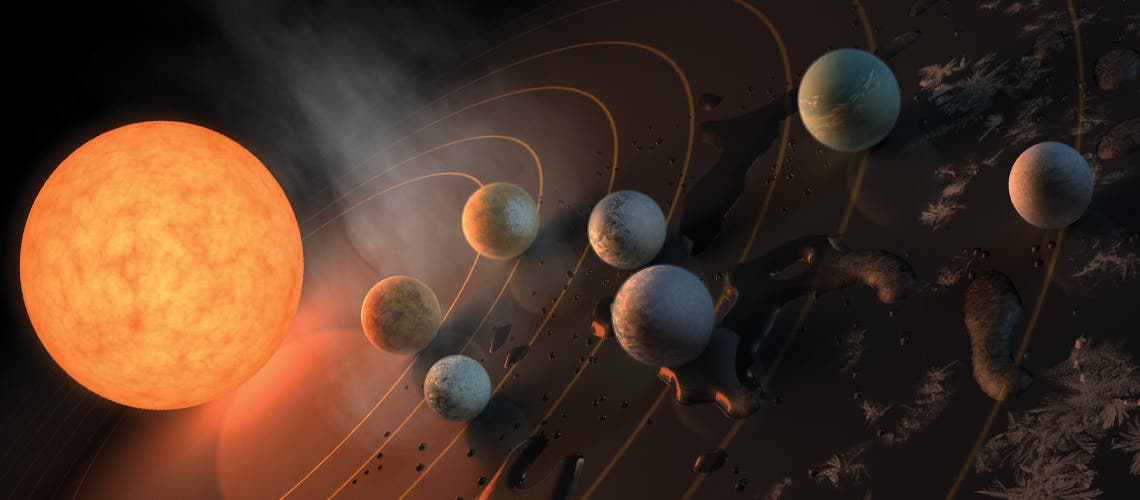
This artist’s impression displays TRAPPIST-1 and its planets reflected in a surface. The potential for water on each of the worlds is also represented by the frost, water pools, and steam surrounding the scene. (CREDIT: NASA/R. Hurt/T. Pyle)
A pair of scorched worlds circling the red dwarf TRAPPIST-1 now offer one of the clearest looks yet at what life may be up against around the most common stars in the Milky Way.
Using the James Webb Space Telescope, an international team that included researchers from the University of Bern and the University of Geneva has, for the first time, mapped the climate of rocky exoplanets with masses similar to Earth. Their target was not a giant gas planet or a bloated world with an easy-to-read atmosphere, but two small rocky planets in the famous TRAPPIST-1 system, known as TRAPPIST-1b and TRAPPIST-1c.
What they found was stark. The two worlds seem to swing between blistering daylight and brutal cold, with day-to-night temperature differences topping 500 degrees Celsius. That kind of contrast points to a simple conclusion: neither planet appears to have a dense atmosphere capable of moving heat from one side to the other.
The result, published in Nature Astronomy, sharpens one of the biggest questions in exoplanet science. Rocky planets around red dwarf stars are common. But can they actually hold onto atmospheres long enough to stay hospitable?
A system built for comparison
TRAPPIST-1 has held astronomers’ attention for years, and not just because it contains seven planets orbiting a single star. Several of those planets sit in the star’s habitable zone, where surface temperatures could allow liquid water.
That makes the system unusually useful. Instead of comparing distant worlds around very different stars, researchers can study several Earth-size planets that formed in the same system but now live under different levels of stellar punishment.
“The TRAPPIST-1 system is incredible! Seven planets, some with masses similar to Earth’s, orbit the same star,” said Emeline Bolmont, an associate professor in the Department of Astronomy at the University of Geneva, director of the university’s Centre for Life in the Universe, and a co-author of the research. “It is the perfect playground for comparative planetology, unraveling the mysteries of this type of planet and testing our hypotheses about the development of life around these stars.”
That matters because red dwarfs dominate the galaxy. More than 75 percent of the stars in the Milky Way fall into this class. They are smaller and cooler than the Sun, and astronomers have already shown that small Earth-like planets are common around them.
Yet common does not mean friendly.
Red dwarfs can be highly active, blasting nearby planets with ultraviolet radiation and energetic particles that may strip away atmospheres. Planets in their habitable zones also tend to orbit close in, where tidal forces can lock one side permanently toward the star and leave the other in endless darkness.
That setup changes everything.
One side always facing the star
A tidally locked planet does not spin like Earth does. Instead, one hemisphere remains in constant daylight while the other stays in permanent night, much like the Moon always shows the same face to Earth.
If such a planet has an atmosphere, that air can shift energy around, easing the contrast between its hot and cold halves. If it does not, the day side bakes while the night side freezes.
“The presence of an atmosphere around these tidally locked planets could allow for energy transfer between the day and night sides, resulting in more moderate temperatures across the planet, which would have a significant impact on their potential habitability,” said Brice-Oliver Demory, a professor and director of the Center for Space and Habitability at the University of Bern, and a co-author of the study.
That possibility turned the search for atmospheres on TRAPPIST-1’s planets into a central goal for JWST.
To test it, the team continuously observed the two innermost planets in infrared light over a full orbit. The observations, made from November 22 to November 25, 2023, lasted 59 hours, or about 60 hours in total, and used JWST’s Mid-Infrared Instrument. In all, the telescope gathered 5,336 integrations with a cadence of 39 seconds.
Those uninterrupted measurements let the researchers do something new for worlds this small. By tracking the changing light from the star and its planets as they moved through their orbits, they could estimate temperatures on both the day and night sides of TRAPPIST-1b and TRAPPIST-1c.
Heat with nowhere to go
The difference between the two hemispheres was dramatic.
On TRAPPIST-1b, the day side climbed above 200 degrees Celsius. On TRAPPIST-1c, daytime temperatures approached 100 degrees Celsius. Both planets, however, dropped below minus 200 degrees Celsius on their night sides.
That is not what you would expect from a thick atmosphere.
Instead, the readings point to little or no heat redistribution. The team’s nominal analysis rejected full heat redistribution for both planets. For TRAPPIST-1b, the nightside flux and phase-curve offset were consistent with zero, which matches a bare-rock case. TRAPPIST-1c was less clear, but its nightside flux and phase offset were also consistent with zero, even if some limited heat transport could not yet be excluded.
Taken together, the nightside signals supported the same broad picture. The combined nightside flux of the two planets was consistent with zero at the 2-sigma confidence level.
That does not just challenge the idea of dense atmospheres. It also helps sort through competing explanations raised by earlier observations. Prior measurements of the planets’ daysides had left room for some atmospheric scenarios, including low-density atmospheres and, in certain cases, carbon dioxide-rich or steam-rich possibilities. The new thermal phase curves added the missing nightside information, which proved crucial.
As predicted by earlier theoretical work, dayside measurements alone were not enough to settle the matter. The new study shows why phase curves matter. Nightside emission can reveal whether a planet is moving heat around or letting it pool on the side that faces the star.
What survived the modeling, and what did not
The research team did not stop with the telescope data. They tested the observations against both a day-night climate-photochemical model and a three-dimensional global climate model.
For TRAPPIST-1b, that exercise ruled out many atmospheric ideas that had once looked plausible. Models with substantial heat transport failed. So did several oxygen- or nitrogen-based atmospheres that could match broadband dayside measurements but sent too much warmth to the nightside once the full phase curve was considered.
Some thin or unusual atmospheric cases still technically fit, but the authors described the survivors as fine-tuned. One very tenuous nitrogen atmosphere could not hold up in the 3D climate model because carbon dioxide would collapse on the nightside surface. CO2-rich hazy cases also struggled unless the haze properties were pushed into unlikely territory.
The simplest reading, the team wrote, is that TRAPPIST-1b most likely has no atmosphere.
TRAPPIST-1c remains the trickier planet. The data rule out full heat redistribution and disfavor many dense-atmosphere cases, including steam-dominated atmospheres from 1 to 10 bar in the combined modeling results. Still, some thinner and lower-opacity atmospheres remain possible. Among the better fits were pure oxygen atmospheres around 0.1 to 1 bar, or thin atmospheres with small amounts of water or carbon dioxide.
That uncertainty may reflect real differences between the two worlds rather than a flaw in the method.
If both planets are airless, then their surfaces probably are not the same. The brightness temperature for planet b sat well above its equilibrium temperature, while the value for planet c did not depart as strongly from its own equilibrium estimate. That could mean planet c has a brighter surface, or it could mean some thin atmosphere is still moving a modest amount of heat.
One planet looks settled. The other still has room for argument.
Rocks, weathering, and the next target
Because TRAPPIST-1b now looks consistent with a world stripped bare, the team also modeled what its surface might be made of. Using a bare-rock model and a database of seven geologically fresh surface materials, they found the phase curve suggests the planet is not especially dark. When they combined that with eclipse measurements, the best fit pointed to ultramafic surface material.
The evidence did not favor ultramafic rock over other materials by 3 sigma, but it fit well enough to emerge as the leading option.
Space weathering could complicate that picture. In the Solar System, irradiation darkens and reddens the surfaces of airless bodies such as the Moon and Mercury. The authors noted that such weathering may be even more effective on the inner TRAPPIST-1 planets. When they included moderate weathering in their models, feldspathic and granitoid surfaces also became viable fits for TRAPPIST-1b.
The bigger story, though, lies farther out.
The two planets in this study sit closest to the star and take the heaviest punishment. That makes them useful stress tests, but not the final word on TRAPPIST-1 as a home for atmospheres or life. JWST is now observing TRAPPIST-1e, one of the planets in the habitable zone.
“TRAPPIST-1 serves as a reference system. Our theoretical models show that the outermost planets of the TRAPPIST-1 system can possess an atmosphere despite the absence of one on the two inner planets,” Bolmont said. “This is similar to Mercury, the closest planet to our Sun, which has no atmosphere, while Venus and Earth have retained theirs.”
Practical implications of the research (H3)
This work gives astronomers a stronger way to test whether small rocky worlds around red dwarfs still have atmospheres. Instead of relying only on dayside snapshots, they can use thermal phase curves to check whether heat reaches the nightside. That matters because red dwarfs are the galaxy’s most common stars, and many of their planets are roughly Earth-sized.
The new findings also narrow the search. TRAPPIST-1b is now highly unlikely to have a significant atmosphere, and TRAPPIST-1c appears to lack a dense one. That does not rule out atmospheres on the system’s outer planets, especially those in the habitable zone, but it does suggest that stellar radiation can strongly reshape the inner worlds.
Upcoming JWST observations of TRAPPIST-1c at 12.8 microns, along with transmission spectroscopy searches for gases such as carbon dioxide, should help decide whether the third planet from the star has managed to keep even a thin envelope of air.
Research findings are available online in the journal Nature Astronomy.
The original story "Astronomers map the climate of Earth-like exoplanets for the first time" is published in The Brighter Side of News.
Related Stories
- How NASA turned exoplanets into tourist destinations
- Exoplanets may capture dark matter and collapse into black holes
- Astronomers find exoplanets are far larger than previously believed
Like these kind of feel good stories? Get The Brighter Side of News' newsletter.
Joseph Shavit
Writer, Editor-At-Large and Publisher
Joseph Shavit, based in Los Angeles, is a seasoned science journalist, editor and co-founder of The Brighter Side of News, where he transforms complex discoveries into clear, engaging stories for general readers. With vast experience at major media companies like The Los Angeles Times, Times Mirror and Tribune Publishing, he writes with both authority and curiosity. His writing focuses on space science, planetary science, quantum mechanics, geology. Known for linking breakthroughs to real-world markets, he highlights how research transitions into products and industries that shape daily life.