Study reveals primates form cross-species friendships like humans
Study finds primates form social bonds with other species, revealing evolutionary roots of human animal companionship.
 University of Oxford Writer: Lizzie Dunthorne

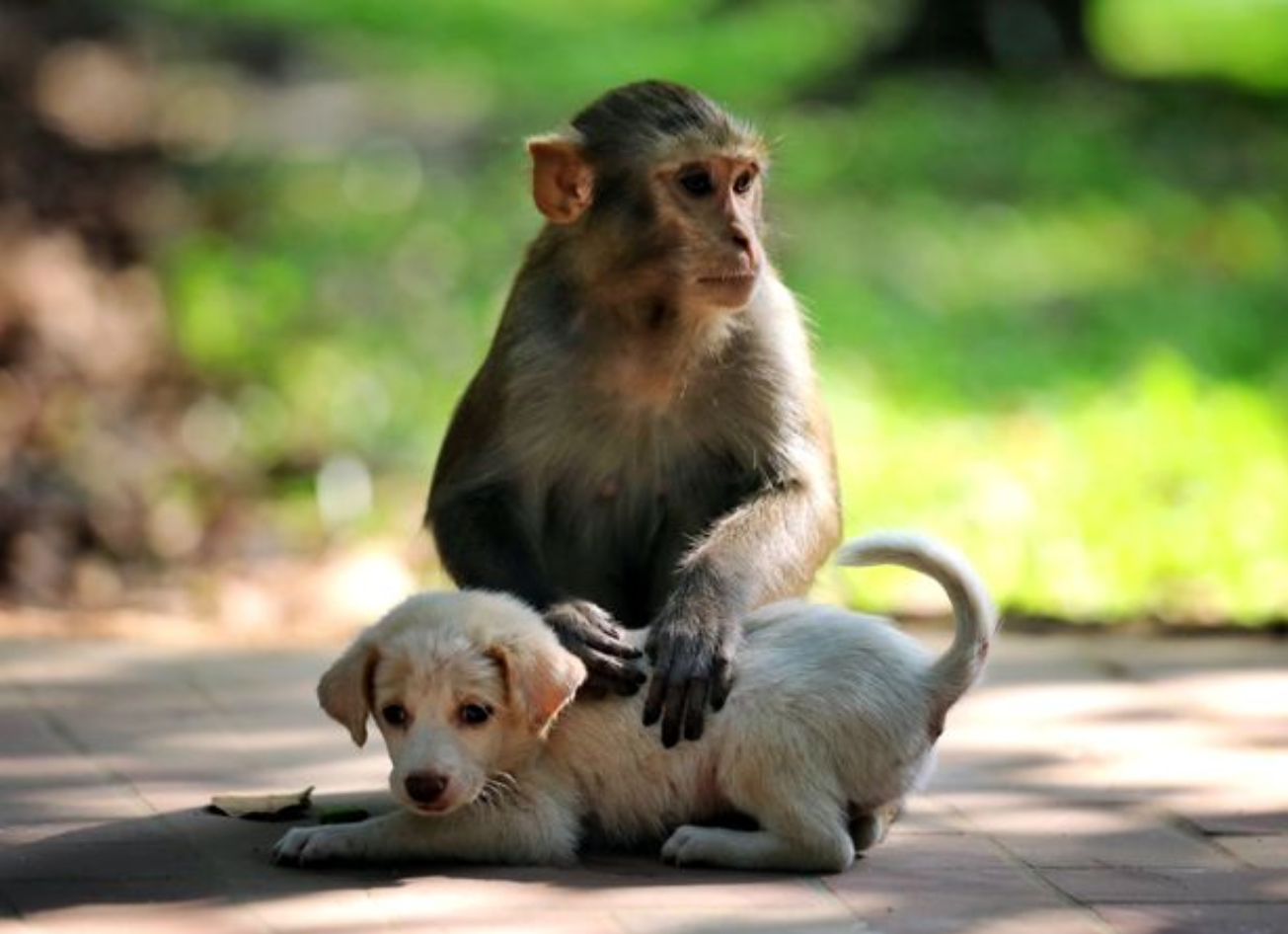
A global study shows primates play, groom, and care for other species, offering new insight into the origins of human-animal bonds. (CREDIT: Shutterstock)
- An international study led by the University of Oxford documented 427 friendly cross-species interactions involving 88 primate species and 127 partner species, including dogs, pigs, birds, squirrels, and reptiles.
- Play and grooming were the most common behaviors, while some primates also carried, adopted, or cared for animals from other species. Juveniles played most often, while adult females showed the highest levels of grooming and caregiving.
- The findings suggest that curiosity, tolerance, empathy, and cross-species bonding may have deep evolutionary roots, potentially representing early foundations of the close relationships humans now form with animals.
A monkey gently grooming a dog, a young ape playing with another species, or a primate carrying an infant that is not its own. These moments can feel strangely familiar, echoing the way humans bond with animals. A new international study suggests those connections may run deeper than once believed, reaching far back into evolutionary history.
Researchers led by the University of Oxford have documented hundreds of cases in which primates form friendly relationships with other species. The findings challenge the long-held idea that humans are unique in their ability to build social bonds across species lines.
A Broad Look At Cross-Species Bonds
The study brings together the most comprehensive dataset yet on this behavior. Researchers analyzed 427 documented interactions involving 88 primate species and 127 partner species. Of those, 55 were not primates.
The team drew from multiple sources. They examined 303 cases from scientific literature, 58 from media reports, and 66 from a global survey of primatologists. This wide approach helped capture behaviors that are often overlooked in formal research.
Lead author Associate Professor Cyril C. Grueter explained the broader meaning of the findings.
“Humans have long been considered unique in forming close social relationships with other species,” Grueter said. “Our study shows that many primates also display remarkable curiosity, tolerance and even caregiving towards animals that are not their own species.”
These interactions were not rare accidents. They appeared across continents and environments, from dense forests to human-influenced landscapes.
Play And Grooming Take Center Stage
Two behaviors stood out across the dataset. Play appeared in 139 cases, while grooming occurred in 136. Both are core parts of social life within primate groups.
Play often involved younger individuals. Juveniles approached other species with curiosity, engaging in light physical interaction. These moments looked strikingly similar to the playful behavior seen between human children and pets.
Grooming, on the other hand, was more common among adult females. This behavior involves cleaning and touching another individual, often to build trust or maintain bonds.
Examples from the study highlight this range. Stump-tailed macaques in Thailand groomed domestic dogs. Tufted gray langurs in Sri Lanka gently stroked giant squirrels. Ring-tailed lemurs in Madagascar groomed bamboo lemurs.
In each case, the behavior served no clear survival purpose. Instead, it reflected a social drive that extended beyond species boundaries.
When Curiosity Turns Into Care
Some of the most striking cases involved caregiving. In one example from Brazil, capuchin monkeys adopted an infant marmoset. They carried and cared for it over several months.
Such behavior resembles early forms of nurturing. It suggests that the instinct to care for others may not be limited to one’s own species.
Another example involved young black-and-white snub-nosed monkeys playing with domestic pigs in China. These interactions showed patience and tolerance, even between species with very different behaviors.
Researchers note that most interactions were initiated by the primates themselves. This pattern points to a strong internal motivation, driven by curiosity and social interest.
Not Every Interaction Ends Well
Despite the warmth seen in many cases, the relationships were not always safe. The study recorded 13 instances in which the partner animal died.
In some cases, primates handled smaller animals too roughly. What may begin as curiosity or care can cross into harm, especially when the animals involved differ greatly in size or strength.
One example involved a baboon in Saudi Arabia that carried a domestic puppy for extended periods. The behavior resembled care, but it raised concerns about the animal’s well-being.
These findings highlight the complexity of cross-species interaction. They are not purely nurturing or harmful. Instead, they reflect a mix of instinct, curiosity, and limited understanding.
Patterns Of Age And Gender
The study also found clear patterns based on age and sex. Juveniles were far more likely to engage in play. This aligns with their developmental stage, where exploration and learning are key.
Adult females showed the highest rates of grooming and caregiving. Their behavior mirrors their role within their own groups, where they often care for offspring and maintain social bonds.
Adult males, in contrast, were much less likely to take part in friendly interactions. This difference may reflect broader social roles or priorities within primate societies.
These patterns suggest that cross-species behavior follows similar rules to within-species social life.
Familiar And Unfamiliar Partners
Primates most often interacted with closely related species. Shared traits such as body language and behavior may make these interactions easier.
However, many cases involved distant species. These included dogs, birds, squirrels, and even reptiles. The diversity of partners shows that primates are willing to engage beyond familiar boundaries.
The study also found that most interactions occurred in natural environments. This suggests that such behavior is not simply a result of captivity or human influence.
Still, areas near human settlements showed higher contact with domesticated animals. This increases opportunities for interaction and may shape behavior over time.
A Window Into Human Behavior
The findings offer new insight into why humans form close bonds with animals. Behaviors such as play, grooming, and caregiving appear to have deep evolutionary roots.
Dr Grueter emphasized that these actions are not the same as human pet keeping. However, they may represent early building blocks of that behavior.
“These behaviours don’t amount to pet-keeping as we know it,” he said, “but they may represent some of the evolutionary building blocks from which human-animal companionship eventually emerged.”
The parallels are striking. Humans and primates both show curiosity, empathy, and a willingness to connect with other species. These shared traits may explain why relationships with animals feel so natural.
Encouraging Further Research
The authors hope their work will lead to more systematic observation of these interactions. Many cases likely go unnoticed or unrecorded during field studies.
By paying closer attention, researchers may uncover patterns that deepen understanding of social behavior and evolution.
The study also raises new questions. Why do some species form these bonds more often than others? What environmental factors encourage or limit interaction?
Answering these questions could reveal more about the origins of empathy and social flexibility.
Practical Implications Of The Research
The findings have important implications beyond theory. Understanding cross-species social behavior can improve animal welfare in managed settings such as zoos and sanctuaries.
By identifying which species are more likely to form positive relationships, caretakers can design environments that support healthy interactions. This may reduce stress and improve quality of life for animals in captivity.
The research also offers insight into conservation. Recognizing social flexibility in primates may help predict how species adapt to changing environments. This is especially important as habitats shrink and human contact increases.
More broadly, the study deepens understanding of empathy and connection. It shows that the roots of these traits extend beyond humans, appearing in other primates in meaningful ways.
These insights may shape future research in psychology, biology, and animal behavior. They also remind us that the capacity to form bonds across difference is not uniquely human, but part of a shared evolutionary story.
Research findings are available online in the journal Primates.
The original story "Study reveals primates form cross-species friendships like humans" is published in The Brighter Side of News.
Related Stories
- New fossil findings help clarify the history of primate evolution
- The odd ways mammals descend trees and what it means for primate evolution
- Researchers reveal a complete history of primate evolution
Like these kind of feel good stories? Get The Brighter Side of News' newsletter.
Joshua Shavit
Writer and Editor
Joshua Shavit is a NorCal-based science and technology writer with a passion for exploring the breakthroughs shaping the future. As a co-founder of The Brighter Side of News, he focuses on positive and transformative advancements in technology, physics, engineering, robotics, and astronomy. Having published articles on AOL.com, MSN, Yahoo News, and Ground News, Joshua's work highlights the innovators behind the ideas, bringing readers closer to the people driving progress.