Taylor Swift inspires scientists to name a new genus of Australian insects
Four newly described Australian insects now carry Taylor Swift-inspired names after spending decades hidden in museum collections.
 De Gruyter Brill Writer: Vassiliki Gortsas

(CREDIT: Wikimedia / AI-Generated / CC BY-SA 4.0)
- Scientists have named a new genus of Australian plant bugs Swiftiephylus after Taylor Swift, with four newly described species drawing their names from the singer and several of her albums.
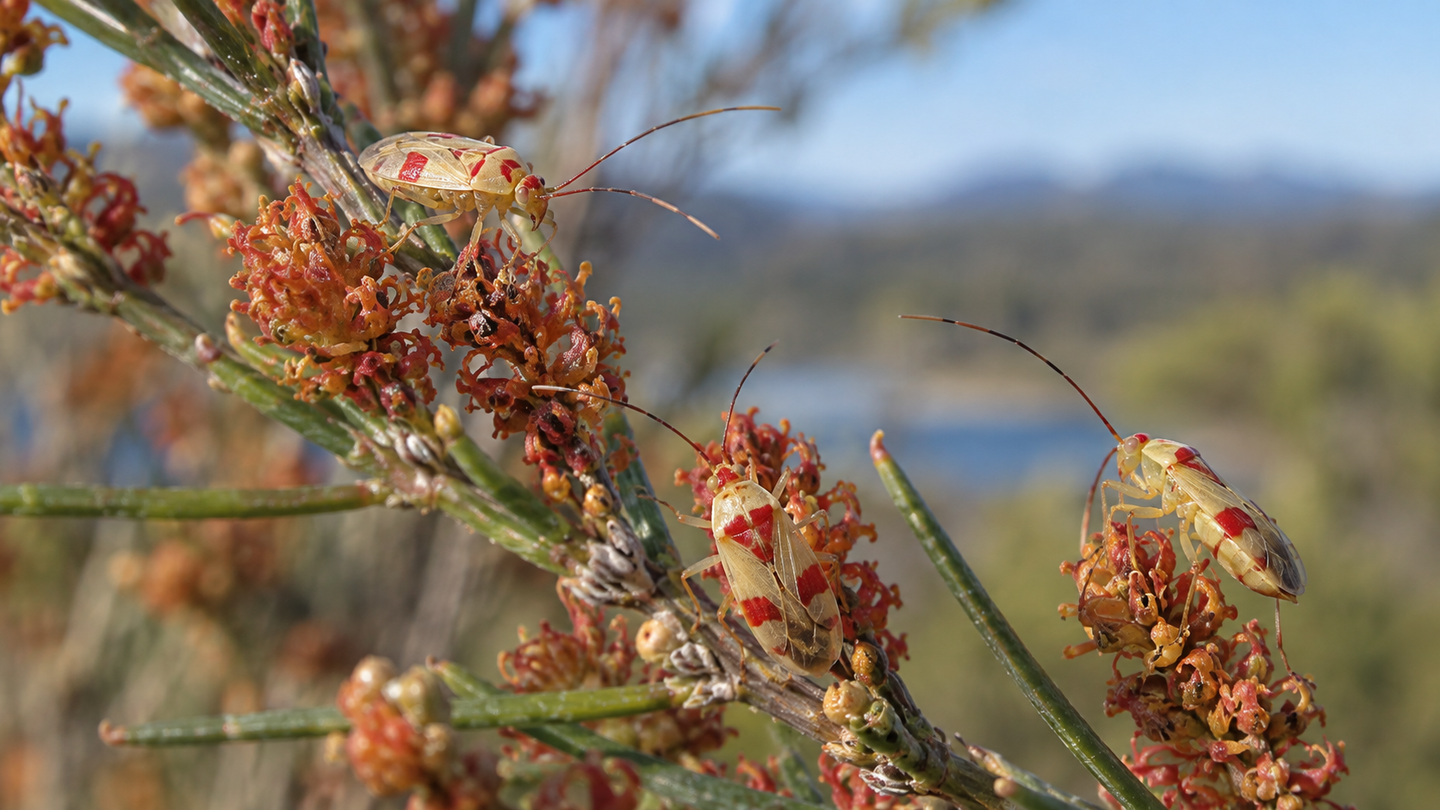
- The insects’ pale yellow bodies and vivid red markings reminded lead author Sarah Schroeder of Swift’s blonde hair and red lipstick, but the colors may also help the bugs camouflage themselves against Australian she-oak flowers.
- The specimens were collected between 1995 and 2004 and remained largely unstudied in museum collections for years, highlighting how natural history collections can still contain species unknown to science.
A group of tiny Australian insects has entered its Taylor Swift era.
Scientists have named a newly described genus of plant bugs Swiftiephylus in honor of the singer, giving four species names inspired by Swift herself and three of her albums. The insects are pale yellow with splashes of red, a combination that reminded lead author Sarah Schroeder of Swift’s blonde hair and signature red lipstick.
The four species are part of a much larger scientific story. They belong to the family Miridae, the world’s largest family of true bugs, with more than 11,000 described species. Yet many Australian members of the group remain poorly documented.
Schroeder and co-author Christiane Weirauch described Swiftiephylus as part of research published in Insect Systematics & Evolution. Their broader study describes 12 new species of Australian plant bugs associated with she-oaks, showing just how much biodiversity can remain hidden even inside long-established scientific collections.
“I didn’t know if I would ever have the opportunity to name a species again, so I wanted to do something both meaningful to science and authentic to me,” Schroeder said.
Four bugs carry references to Swift and her music
One species, Swiftiephylus taylorae, takes its name directly from Taylor Swift. The remaining species are S. amator, S. intrepidus and S. poetorum.
Their names translate roughly to “lover,” “fearless” and “poets,” references to the albums Lover, Fearless and The Tortured Poets Department.
Scientific names are governed by formal zoological conventions. A species receives a two-part Latinized name consisting of its genus followed by its species designation. Within those rules, taxonomists have considerable freedom to choose names commemorating people, places, physical characteristics or other meaningful associations.
The naming also reflects a visual connection. The insects are pale yellow with strong red markings, colors Schroeder associated with Swift’s familiar blonde-and-red appearance.
Those colors likely serve a biological purpose beyond providing inspiration for a memorable name.
The bugs live on Australian she-oaks, members of the plant family Casuarinaceae. These trees and shrubs can produce red or orange reproductive structures against pale or greenish stems. Similar cream-and-red coloration occurs in several unrelated groups of plant bugs living on these plants.
Researchers think the pattern provides camouflage, allowing the insects to blend into their host plants and potentially avoid predators.
Their striking colors may have evolved repeatedly
The Swift connection represents only a small part of what makes the insects scientifically interesting.
The broader study focuses on Australian plant bugs associated with Casuarinaceae. Researchers described 12 new species that share variations of the same pale-and-red coloration despite belonging to distinct evolutionary groups.
That pattern suggests similar camouflage may have evolved independently several times.
Such repeated evolution is known as convergence. Unrelated organisms exposed to similar environmental pressures can independently develop comparable characteristics because those traits solve the same problem.
For plant bugs living on she-oaks, matching the stems and reddish flowers could make the insects harder for predators to detect.
The phenomenon also illustrates why host plants can play such an important role in insect evolution. Different bug lineages may independently become associated with the same plants and then experience similar pressures favoring similar colors.
Australia provides particularly fertile ground for studying those relationships because Casuarinaceae reach their greatest diversity there.
The insects spent decades waiting in collections
The newly described bugs were not collected during a recent expedition.
Their story began decades ago.
Between 1995 and 2004, researchers conducted hundreds of collecting events in Australia as part of work that later fed into the National Science Foundation-supported Planetary Biodiversity Inventory for Plant Bugs. The effort ultimately produced more than 50,000 specimens of Australian Miridae.
Many were deposited in natural history collections, where some remained unidentified or undescribed for years.
That backlog is common in taxonomy. Field expeditions can collect specimens much faster than specialists can examine, compare and formally describe them.
Museum collections therefore function as more than archives of known species. They can hold organisms that science has collected but has not yet recognized as distinct.
Schroeder compared the situation to Swift’s unreleased songs that later appeared as “vault tracks.”
“I suppose we could say that revisiting these collections and describing hidden species makes them ‘vault species,’ much like Taylor’s ‘vault tracks’ on her re-recordings,” Schroeder said. “These hidden gems just hadn’t quite made it out into the world yet, and it took the right set of circumstances for them to be described.”
Australia’s plant bugs remain surprisingly underexplored
The scale of undiscovered diversity becomes clearer when considering how rapidly scientific knowledge of Australian plant bugs has expanded.
Around the turn of the millennium, only about 50 species from one major subgroup, the Phylinae, had been formally described from Australia. Years of collecting and taxonomic work pushed that total above 300.
Even that may represent only part of the true diversity.
Miridae occur around the world and include thousands of species with close relationships to particular host plants. Australia’s extraordinary botanical diversity creates opportunities for similarly rich insect diversity, especially among bugs that specialize on specific plants.
The specimens described in the new study belong to Phylinae, the second-largest subfamily of Miridae, containing more than 2,800 described species worldwide.
The researchers used both morphology and emerging molecular phylogenetic information to determine where the newly described bugs belong. That combination helps taxonomists distinguish between insects that merely look similar and those that actually share a close evolutionary history.
A celebrity name can spotlight overlooked biodiversity
Naming organisms after famous people has a long history in taxonomy. Scientists have honored figures ranging from naturalist David Attenborough to musicians, politicians and other cultural figures.
Such names can attract attention to organisms that otherwise might receive little public notice.
That may be especially useful for insects. Despite their enormous ecological importance and extraordinary diversity, a vast number of insect species remain undescribed.
Schroeder described natural history museums as “treasure troves of scientific discovery,” and the new genus demonstrates why. Specimens collected decades earlier can become scientifically important once researchers have the tools, time and expertise to recognize what they represent.
For Swiftiephylus, a pop-culture reference now sits alongside a serious taxonomic contribution. Four tiny Australian bugs have names likely to attract unusual attention, but the science behind them points to a much larger challenge.
Much of Earth’s insect diversity remains unnamed, including species already sitting quietly in museum drawers.
Dig deeper into Australian plant bugs and scientific naming
These resources provide background on Australian Miridae, host-plant specialization and the formal rules scientists follow when describing and naming new animal species.
Wallabicoris, new genus (Hemiptera, Miridae, Phylinae, Phylini) from Australia, with the description of 37 new species and an analysis of host associations: Describes 37 Australian plant bug species and examines how evolutionary groupings correspond with their host plants. (Bulletin of the American Museum of Natural History, 2010)
Myrtaceae-feeding Phylinae (Hemiptera, Miridae) from Australia: description and analysis of phylogenetic and host relationships for a monophyletic assemblage of three new genera: Documents three genera and 25 species while examining the close evolutionary relationship between Australian plant bugs and particular plant groups. (Bulletin of the American Museum of Natural History, 2010)
Revision of Leucophoropterini: diagnoses, key to genera, redescription of the Australian fauna, and descriptions of new Indo-Pacific genera and species: Provides a major systematic treatment of an Indo-Australian group of Miridae, including revisions of Australian genera and species. (Bulletin of the American Museum of Natural History, 2011)
Plant Bug Planetary Biodiversity Inventory: Documents the large international effort to collect, identify and describe Miridae, including the extensive Australian material that revealed how strongly the continent’s plant bug diversity had been underestimated. (American Museum of Natural History)
International Code of Zoological Nomenclature: Establishes the formal rules governing animal names, including binomial naming, name formation and the standards taxonomists follow when establishing new genera and species. (International Commission on Zoological Nomenclature)
Research findings are available online in the journal Insect Systematics & Evolution.
The original story "Taylor Swift inspires scientists to name a new genus of Australian insects" is published in The Brighter Side of News.
Related Stories
- Why don't giant prehistoric insects still exist?
- Scientists reveal the staggering number of insects flying in the sky above the US
- Scientists rethink animal consciousness: Reptiles, fish, and insects may be sentient
Like these kind of feel good stories? Get The Brighter Side of News' newsletter.
Joseph Shavit
Writer, Editor-At-Large and Publisher
Joseph Shavit, based in Los Angeles, is a seasoned science journalist, editor and co-founder of The Brighter Side of News, where he transforms complex discoveries into clear, engaging stories for general readers. With vast experience at major media companies like The Los Angeles Times, Times Mirror and Tribune Publishing, he writes with both authority and curiosity. His writing focuses on space science, planetary science, quantum mechanics, geology. Known for linking breakthroughs to real-world markets, he highlights how research transitions into products and industries that shape daily life.