The Moon’s far side could open a window into the universe before the first stars were born
New lunar radio missions could use the Moon’s silent far side to probe the cosmic dark ages before stars and galaxies appeared.
 Edited By: Joseph Shavit

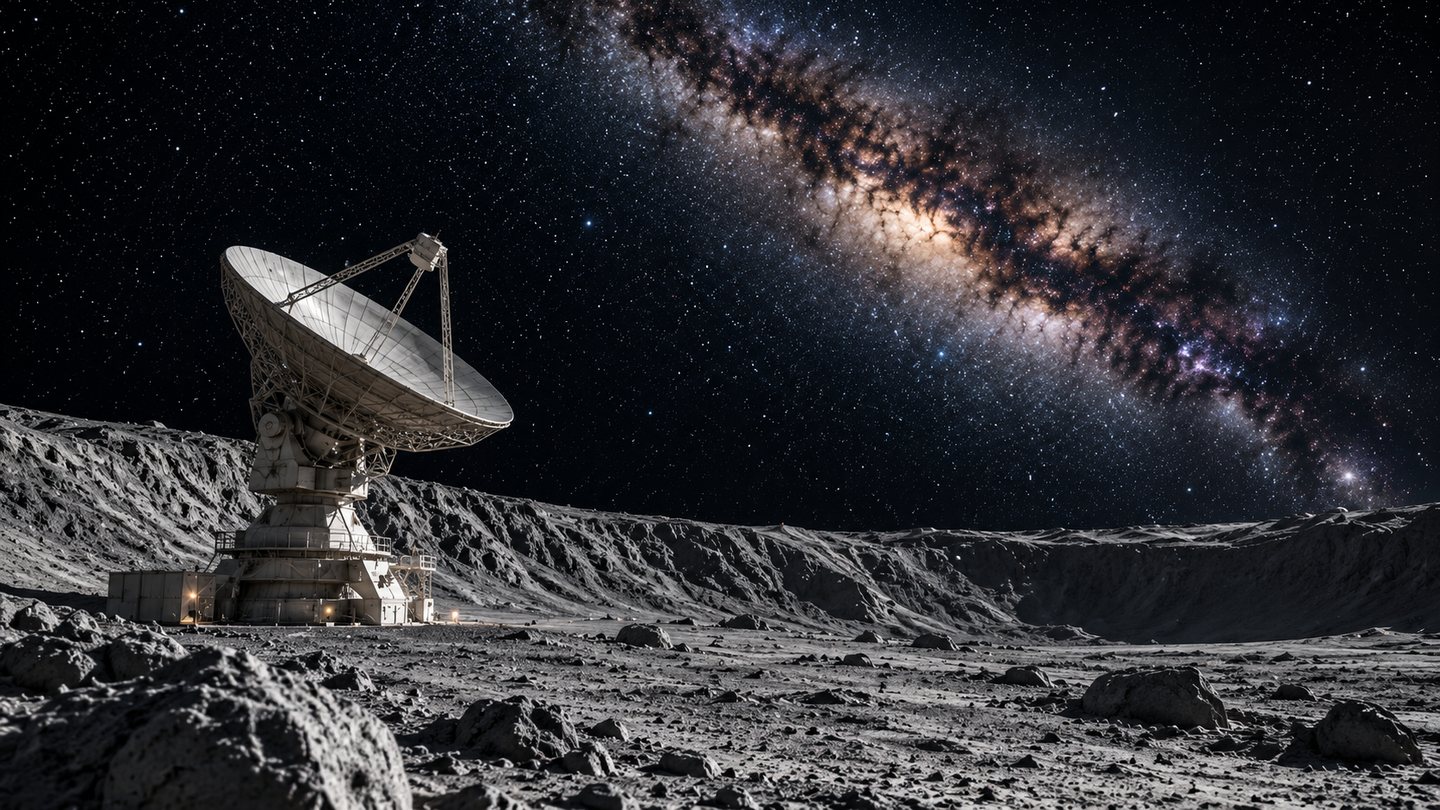
Radio telescopes on the Moon’s far side could detect ancient hydrogen and reveal the universe before the first stars formed. (CREDIT: Shutterstock)
- The Moon’s far side could give astronomers access to radio signals from the cosmic “dark ages,” a period before the first stars and galaxies formed.
- The idea has moved beyond theory. NASA’s first lunar radio telescope has already operated on the Moon, while LuSEE-Night is being prepared for a far-side landing and new missions such as CosmoCube are taking shape.
- Astronomers are also racing against a new problem: growing lunar activity could contaminate one of the quietest radio environments available anywhere near Earth.
The far side of the Moon is a battered landscape of mountains, basins and overlapping craters, strikingly different from the broad dark plains familiar to anyone looking up from Earth. But its most valuable feature for astronomers may be something that cannot be seen at all.
The Moon itself blocks much of the radio noise pouring outward from Earth. With virtually no atmosphere to distort very low-frequency signals, the far side offers an observing environment unavailable to telescopes on our planet. NASA now describes it as the only known place in the solar system permanently shielded from Earth’s radio noise.
That isolation could allow astronomers to investigate one of the least explored chapters in cosmic history: the dark ages between the formation of the first neutral atoms and the appearance of the first stars.
The long-discussed idea is moving closer to reality. NASA’s first radio telescope has already gathered data from the lunar surface, a far-side radio experiment is being prepared for a future commercial landing, and a newly published research proposal describes another route into this unexplored era using a spacecraft orbiting the Moon.
Listening for hydrogen before the stars
About 380,000 years after the Big Bang, the universe had cooled enough for electrons and protons to combine into neutral hydrogen. Stars had not yet begun illuminating space, leaving the cosmos without the galaxies and other bright structures visible today.
Hydrogen, however, was not completely silent.
Neutral hydrogen can emit or absorb radiation associated with a wavelength of 21 centimeters, corresponding to a frequency of about 1,420 megahertz. As the universe expanded, radiation produced in the distant past became stretched to much longer wavelengths and lower frequencies.
Those ancient signals could preserve information about the distribution of matter before stars, galaxies and galaxy clusters complicated the picture. Researchers studying dark-age 21-centimeter cosmology argue that such observations could test basic cosmological models and provide new constraints on properties including dark matter and neutrino masses.
The difficulty is hearing the signal.
Earth’s ionosphere disrupts low-frequency radio observations and becomes effectively opaque at the lowest frequencies. Human communications add another layer of interference. The 2026 CosmoCube proposal notes that ground-based instruments are effectively prevented from probing frequencies below roughly 45 megahertz, cutting them off from much of the dark-age signal.
The first lunar radio telescope has already listened
The transition from concept to actual lunar observations began earlier than many of the original mission plans anticipated.
NASA’s Radiowave Observations at the Lunar Surface of the photoElectron Sheath instrument, known as ROLSES-1, reached the Moon aboard Intuitive Machines’ Odysseus lander in February 2024. It carried four 2.5-meter monopole antennas and was designed to study frequencies from 2 kilohertz to 30 megahertz.
ROLSES landed near the lunar south pole on the side facing Earth, so it could not provide the radio isolation of the far side. Even so, its brief operation demonstrated that low-frequency astronomy could be carried out from the lunar surface.
Despite problems with the lander and imperfect antenna deployment, ROLSES collected data during its journey and during two days on the Moon. Researchers reported detecting terrestrial shortwave transmissions along with the low-frequency background of the Milky Way. The measurements also demonstrated exactly why the far side matters: Earth remained a powerful source of radio interference.
LuSEE-Night aims for the quiet side
The next major step is LuSEE-Night, the Lunar Surface Electromagnetics Experiment-Night. Unlike ROLSES, it is designed specifically to operate on the radio-quiet far side.
The experiment will use four monopole antennas arranged as crossed dipoles and observe at frequencies below about 50 megahertz. It must also survive the approximately two-week lunar night without relying on an operating lander, whose electronics could create interference of their own.
LuSEE-Night is scheduled to travel aboard Firefly Aerospace’s Blue Ghost Mission 2. Firefly now says that mission will launch no earlier than 2027. After landing, Blue Ghost is supposed to shut down before lunar night so its electronics do not contaminate LuSEE-Night’s observations. The telescope could continue working for as long as two years.
The mission is a pathfinder rather than the enormous array eventually needed to map the dark ages in fine detail. Its immediate goal includes understanding the far side’s radio environment well enough to determine what larger observatories must overcome.
A new idea would observe from lunar orbit
A Nature Astronomy paper published in August 2026 adds another possible approach.
Called CosmoCube, the proposed mission would make 21-centimeter observations while orbiting through the radio-quiet region behind the Moon. Researchers led by Eloy de Lera Acedo of the University of Cambridge argue that an orbital experiment could probe both the dark ages and cosmic dawn without first constructing a large observatory on the lunar surface.
The concept reflects a broader shift in lunar radio astronomy. Scientists are considering everything from individual antennas and orbiting spacecraft to sprawling arrays covering many square kilometers.
One especially ambitious concept, FarView, proposes roughly 100,000 dipole antennas spread across about 200 square kilometers of the lunar far side. Its designers have even explored manufacturing parts of the array from metals extracted from lunar soil rather than transporting every component from Earth.
The quiet window may not remain quiet
The renewed push toward the Moon creates an irony. The same surge in spacecraft, communications systems and surface activity making these observatories possible could eventually damage the environment they need.
The International Telecommunication Union recognizes a Shielded Zone of the Moon covering part of the far side and surrounding space. Earth-based transmissions are naturally blocked there, but spacecraft radios, navigation equipment, radar and unintended electromagnetic emissions from lunar electronics can still introduce interference.
That concern has grown enough that international regulators are examining how radio astronomy should coexist with expanding lunar operations.
For cosmologists, the stakes are unusually high. The ancient hydrogen signal is not merely another view of objects already known from optical astronomy. It could provide access to a time before those objects existed.
After decades of proposals, prototypes and mission studies, astronomers are finally beginning to put radio ears on and around the Moon. If they can preserve its silence, the far side may allow them to listen farther into cosmic history than any telescope has before.
Dig deeper into lunar radio astronomy and the cosmic dark ages
These resources explore the 21-centimeter signal, lunar radio telescope technology and the increasingly ambitious plans to turn the Moon’s far side into an observatory for the early universe.
Prospects for precision cosmology with the 21 cm signal from the dark ages: This analysis examines how dark-age hydrogen measurements could constrain cosmological parameters, the cosmic helium abundance and neutrino masses, while showing the enormous collecting area required for precision mapping. (Nature Astronomy, 2023)
Design and Characterization of the Engineering Model of the Spectrometer Onboard LuSEE-Night: This paper describes the spectrometer being developed for LuSEE-Night and the technical challenges involved in making extremely sensitive low-frequency measurements from the radio-quiet lunar far side. (Radio Science, 2024)
FarView: An in-situ manufactured lunar far side radio array concept for 21-cm Dark Ages cosmology: FarView proposes a much larger future observatory containing about 100,000 dipole antennas across roughly 200 square kilometers, with some components potentially manufactured from resources found on the Moon. (Advances in Space Research, 2024)
Results from NASA's First Radio Telescope on the Moon: Terrestrial Technosignatures and the Low-Frequency Galactic Background Observed by ROLSES-1 Onboard the Odysseus Lander: The first results from ROLSES-1 describe radio measurements gathered during transit and from the lunar surface, including terrestrial transmissions and the low-frequency galactic background. The experiment provides an important practical test for later lunar radio observatories. (arXiv, 2025)
Cosmology from the Moon in a radio-quiet environment: This technical overview examines why the Moon’s shielded zone is valuable for dark-age cosmology and why increasing communications, radar and spacecraft emissions could threaten that environment without coordinated protections. (International Telecommunication Union, 2026)
The original story "The Moon’s far side could open a window into the universe before the first stars were born" is published in The Brighter Side of News.
Related Stories
- Compact X-ray telescope could deliver the first full chemical map of the Moon
- NASA’s Roman Space Telescope launches to map billions of galaxies and hunt distant worlds
- NASA’s giant space ‘starshade’ could help ground telescopes photograph another Earth
Like these kind of feel good stories? Get The Brighter Side of News' newsletter.
Joseph Shavit
Writer, Editor-At-Large and Publisher
Joseph Shavit, based in Los Angeles, is a seasoned science journalist, editor and co-founder of The Brighter Side of News, where he transforms complex discoveries into clear, engaging stories for general readers. With vast experience at major media companies like The Los Angeles Times, Times Mirror and Tribune Publishing, he writes with both authority and curiosity. His writing focuses on space science, planetary science, quantum mechanics, geology. Known for linking breakthroughs to real-world markets, he highlights how research transitions into products and industries that shape daily life.