Students turn to AI as physics searches decline worldwide
A global study finds physics searches falling as students increasingly use AI tools for science learning.

 Edited By: Joseph Shavit

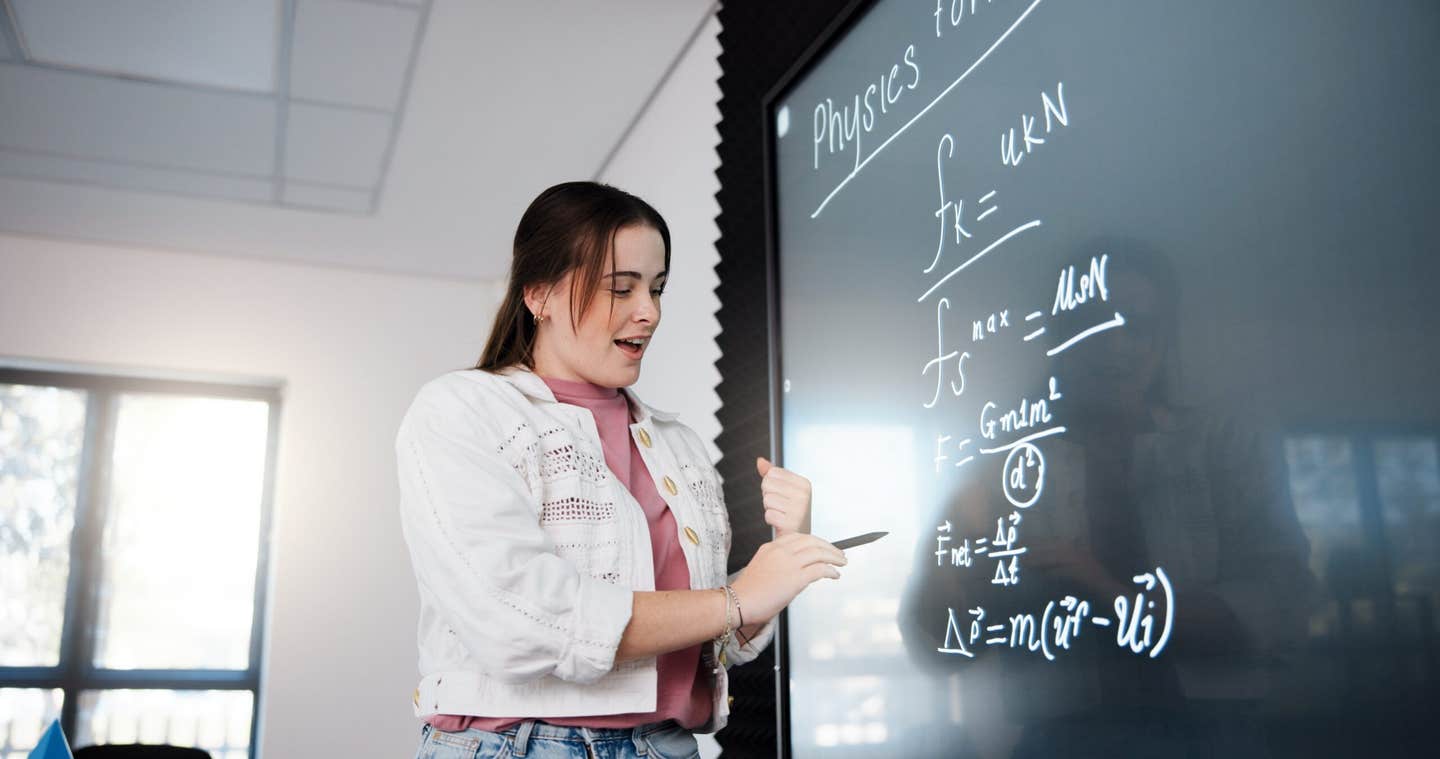
Bar-Ilan University researchers found declining physics searches worldwide, suggesting students are shifting toward AI tools like ChatGPT. (CREDIT: Shutterstock)
- Google searches for common physics concepts fell steadily between the 2022-23 and 2024-25 academic years as generative AI became more widely used.
- The decline was strongest for mechanics topics and in many non-English-speaking countries, while physics-related Wikipedia traffic showed a similar pattern.
- The findings do not show that students are learning less. They suggest students may increasingly prefer conversational AI tools that deliver direct explanations instead of searching across websites.
Students once turned to Google almost by reflex when physics got confusing. A new international study suggests that habit may be changing as generative artificial intelligence becomes a common study partner.
Researchers led by Bar-Ilan University found a steady drop in Google searches for physics concepts from 2022 to 2025. They also found similar declines in visits to physics-related Wikipedia pages across several languages.
The study does not show that students are learning less physics. Instead, it suggests many students may now seek help from AI tools such as ChatGPT.
A Shift In How Students Seek Help
The research was conducted by Dr. Yossi Ben-Zion and Omer Michaeli of Bar-Ilan University’s Department of Physics. They worked with Prof. Noah Finkelstein of the University of Colorado Boulder.
The team analyzed search data from more than 20 countries. They focused on physics concepts commonly studied in classrooms, including mechanics, electromagnetism and optics.
“The findings do not suggest that students are learning less,” said Ben-Zion. “Rather, they indicate that many students are shifting from searching across multiple websites to receiving direct, conversational explanations from AI systems.”
That shift matters because search and AI ask students to think differently. Search engines push students to compare pages, scan results and judge sources. AI tools often provide one smooth answer within seconds.
Following The Academic Calendar
The researchers used Google Trends to track relative search activity. This tool does not show raw search counts. Instead, it shows how search interest changes over time and across places.
To avoid confusion from everyday words such as “force” or “energy,” the team filtered searches through Google’s science category. They also used topic groupings rather than exact phrases.
The study covered three academic years. The 2022-23 year served as the period before broad student use of generative AI. The 2023-24 year marked a transition. The 2024-25 year showed AI becoming more routine.
Physics searches still followed the school calendar. Interest rose during academic terms and dipped during breaks. ChatGPT searches in science-related contexts showed the same school-year rhythm.
That pattern suggests students still seek help when classes are active. What may be changing is where they go.
Mechanics Searches Fell Most
The decline was broad, but it did not affect every physics area equally. Searches for mechanics topics dropped more sharply than searches for electromagnetism or optics.
Mechanics includes topics such as kinetic energy, momentum, torque and Newton’s laws of motion. These ideas can often be explained through words and everyday examples.
Worldwide, 28 of 30 mechanics topics showed large declines. Eighteen showed very large declines.
Electromagnetism and optics also fell, but less strongly. These fields often depend more heavily on diagrams, graphs, waves, lenses and spatial reasoning.
The researchers suggest this pattern may reflect AI’s current strengths and limits. Large language models can produce clear verbal explanations. They may still struggle more with complex visual learning tasks.
Language May Shape The Change
One of the study’s clearest findings involved geography and language. English-speaking countries showed more stable physics search patterns than many non-English-speaking countries.
In the United States, the United Kingdom and Australia, searches for many physics topics stayed relatively steady. In many other countries, they fell sharply.
The researchers propose that AI may help reduce the “language tax” faced by students. Many high-quality physics resources online appear first or most fully in English.
For students learning in other languages, that can create extra difficulty. They must search, translate and interpret at the same time.
“Generative AI has the potential to reduce the ‘language tax’ faced by millions of students,” the researchers explain. “By making complex scientific concepts more accessible in many languages, these tools may help democratize access to knowledge.”
Wikipedia Showed The Same Pattern
To check whether the decline was limited to Google, the team also studied Wikipedia page views. They examined physics articles in seven languages.
Those languages included English, Hindi, Spanish, Arabic, Portuguese, Italian and German. The page-view data showed similar declines across many physics topics.
English Wikipedia pages generally saw smaller drops. Other languages often saw much sharper declines.
That finding supported the larger conclusion. Students may not simply be changing search terms. They may be moving away from traditional web-based information sources.
This does not prove that every lost Wikipedia visit became an AI prompt. But the timing and language patterns make AI adoption a strong possible explanation.
Direct Answers Change The Learning Task
The study raises an important question for science education. What happens when students no longer hunt for answers, but receive them conversationally?
AI can be helpful. It can explain a concept in simpler language, translate ideas and respond to follow-up questions.
For a student struggling alone at night, that can feel powerful. It may reduce frustration and make physics feel more approachable.
But direct answers can also hide weaknesses. A confident explanation may be incomplete or wrong. A student may feel they understand before they can solve a problem.
Physics learning requires more than reading a clear paragraph. Students must apply equations, draw diagrams, reason through situations and test assumptions.
What Teachers May Need To Do
The researchers do not frame AI as simply good or bad. Instead, they argue that educators must adapt to changing student behavior.
If students use AI for physics help, teachers may need to teach AI literacy directly. That means helping students judge generated explanations.
A class might ask students to critique an AI answer about Newton’s third law. Another assignment might compare an AI explanation with a textbook solution.
Students could also be asked to revise a generated answer until it matches correct physics reasoning. This turns AI from a shortcut into a learning object.
The goal would not be to ban quick explanations. It would be to help students question them.
What The Study Cannot Prove
The authors are careful about the limits of their findings. Google Trends measures relative search interest, not exact numbers of searches.
The study also cannot track individual students. It cannot prove that a specific person stopped using Google and started using ChatGPT.
It also cannot show whether students understand physics better or worse now. The research tracks information-seeking behavior, not learning outcomes.
Still, the evidence points to a major shift. Physics students seem to be changing how they look for help, especially outside English-speaking contexts.
That shift is likely still unfolding. As AI tools become more visual, accurate and widely available, student habits may change again.
Practical Implications Of The Research
This research can help educators understand how students now approach science learning. If students are moving from search engines to AI tools, teaching must respond to that reality.
The findings may push physics instructors to teach students how to evaluate AI-generated explanations. Students need to know when an answer is useful, when it lacks context and when it may be wrong.
The study also suggests AI could improve access to science education across languages. Students who once struggled to find clear physics resources in their native language may now get faster support. That could make learning more equal for millions of people.
For humanity, the benefit depends on how schools adapt. Used well, AI can make hard concepts more approachable. Used carelessly, it can create false confidence. The future of science education may depend on teaching students not just to get answers, but to test them.
Dig deeper into generative AI, physics education and student learning
These resources examine how generative AI is being used in physics and science education, what it may do to learning outcomes and how educators can integrate it without removing the reasoning students need to develop.
Physics instructors’ acceptance and implementation of generative AI: This study examines how physics instructors understand, adopt and use generative AI in their teaching. It provides a useful companion to changing student search behavior by showing how the other side of the classroom is responding to the same technology. (Physical Review Physics Education Research, 2025)
The Impact of Generative AI Applications on Student Learning Outcomes in Science Education: A Systematic Review: This systematic review examines studies of generative AI in science education and reports potential benefits for achievement, conceptual understanding, scientific literacy and personalized learning. It also helps place AI-assisted physics learning within the broader science classroom. (Journal of Education in Science, Environment and Health, 2025)
Effect of generative artificial intelligence on university students learning outcomes: A systematic review and meta-analysis: Drawing on 57 studies and 97 estimates, this meta-analysis examines how generative AI affects academic achievement, higher-order thinking, motivation and other university learning outcomes. It found positive effects in several areas but no statistically significant improvement in metacognition. (Educational Research Review, 2025)
Integrating generative Artificial Intelligence into student learning: A systematic review from a TPACK perspective: This review analyzes 71 empirical studies and finds that generative AI can support cognitive and affective learning outcomes, while emphasizing that instructional design and pedagogical guidance strongly influence the results. (Educational Research Review, 2025)
How ChatGPT impacts student engagement from a systematic review and meta-analysis study: Researchers analyzed empirical evidence on how ChatGPT affects behavioral, cognitive and emotional engagement. The work helps address a central question raised by changing search habits: whether conversational AI alters not just where students seek information, but how actively they engage with learning. (Computers and Education: Artificial Intelligence, 2025)
Research findings are available online in the journal Physical Review Physics Education Research.
The original story "Students turn to AI as physics searches decline worldwide" is published in The Brighter Side of News.
Related Stories
- Digital ‘super-brain’ with a physics education speeds up technology development
- AI is forcing a complete reimagining and reconfiguration of education
- How podcasts are revolutionizing health education and behavior
Like these kind of feel good stories? Get The Brighter Side of News' newsletter.
Shy Cohen
Writer