The Universe may have begun inside a black hole, not a Big Bang
A new model argues the universe may have formed inside a black hole, replacing the Big Bang singularity with a bounce.

 Edited By: Joseph Shavit

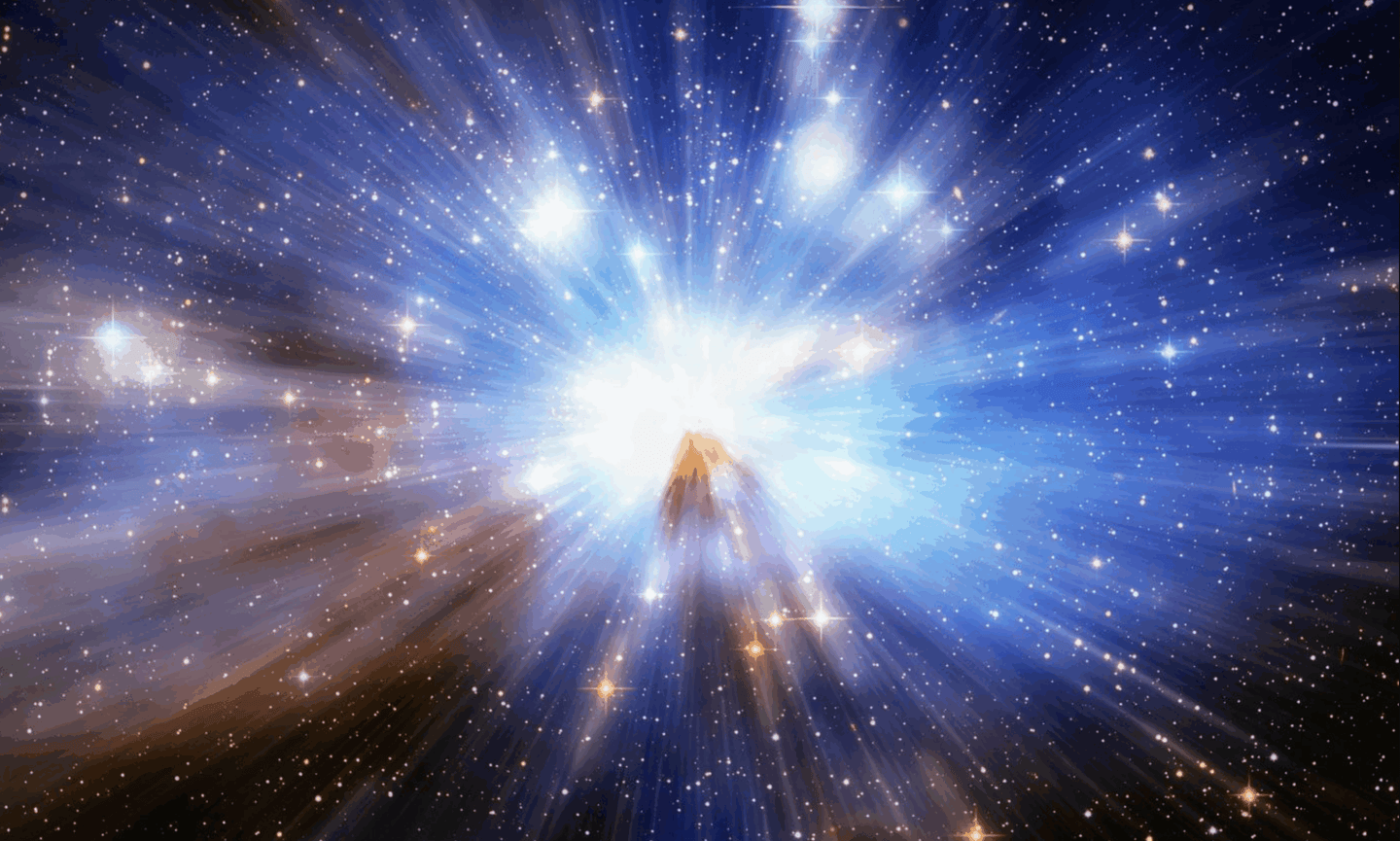
A new physics model suggests the universe began with a bounce inside a black hole, not a singular Big Bang. (CREDIT: Wikimedia / CC BY-SA 4.0)
For nearly a century, modern cosmology has treated the Big Bang as the opening moment of everything, the instant when space, time, and energy burst into existence from an infinitely dense point. That picture has explained a great deal, from the cosmic microwave background to the large-scale distribution of galaxies. It has also left behind some stubborn problems, including the question of what happened at the singularity itself, where the known laws of physics break down.
A new proposal from physicists led by Enrique Gaztañaga at the University of Portsmouth takes aim at that deepest starting point. Instead of a universe born from a singular beginning, the team describes a cosmos that emerged from collapse, then rebounded. In their account, what looks from the outside like a black hole could, on the inside, become the cradle of a new expanding universe.
The idea, laid out in Physical Review D, is called the Black Hole Universe model. It combines general relativity with quantum principles and argues that collapse does not have to end in a singularity. Under the right conditions, the researchers say, it ends in a bounce.
Gaztañaga put the shift in perspective this way: the group’s examination “looks in, rather than out.” Instead of beginning with an already expanding universe and asking how it started, they asked what happens when a very large cloud of matter collapses under gravity. In that framework, he said, “gravitational collapse does not have to end in a singularity.”
Where the collapse stops
The model starts with a finite, nearly uniform cloud of matter embedded within a larger background. As gravity pulls that cloud inward, its density rises. In standard treatments, that process can end in a singularity. Here, the team argues that quantum mechanics changes the outcome.
Their reasoning rests on the exclusion principle, which says fermions cannot all occupy the same quantum state. As the cloud becomes extremely dense, that restriction generates a degeneracy pressure. Similar physics helps support white dwarfs and neutron stars against further collapse. In the new work, the authors extend that logic to far more extreme conditions.
At the point where the density reaches a quantum ground state, the pressure takes on an unusual form, effectively becoming negative and approaching P = −ρ. That matters because negative pressure can drive accelerated expansion. In the model, collapse slows, halts, and reverses. The bounce then feeds directly into a rapid inflation-like phase.
This is one of the paper’s central claims: the same process that prevents singular collapse can also explain why the early universe expanded so quickly. The analysis gives an inflationary period with about 57 e-folds, a figure the authors say is consistent with values tied to Planck measurements of the scalar spectral index.
They also argue that this setup can address several long-running puzzles at once, including the horizon problem, the flatness problem, and the origin of cosmic acceleration, without introducing exotic new particles or changing Einstein’s equations.
A universe hidden behind an event horizon
From the outside, the collapsing region would look like an ordinary black hole. Once the shrinking cloud crosses its Schwarzschild radius, no external observer could see what follows. Inside, though, the picture is very different. The matter reaches a high-density quantum state, rebounds, and begins expanding into a new region of spacetime.
That leads to the paper’s most arresting possibility: our observable universe may have formed inside a black hole that existed in some larger parent universe.
The researchers are careful to root this in a specific relativistic setup, a finite closed Friedmann–Lemaître–Robertson–Walker cloud matched smoothly to a Schwarzschild exterior. They contrast that with “baby universe” or bubble models that require thin shells or exotic boundary layers. In their version, they say, no added surface layer or exotic matter is needed.
The work also ties the universe’s present-day accelerated expansion to the same broader picture. The authors argue that the cosmological constant, Λ, can be interpreted as a boundary effect linked to the gravitational radius of a finite universe. Using observational values for ΩΛ and H0, they estimate a Schwarzschild radius of about 5.1 ± 0.1 gigaparsecs and a total mass of roughly (5.4 ± 0.1) × 10^22 solar masses.
Another striking prediction concerns spatial curvature. The model requires positive spatial curvature in the collapsing cloud, which translates into a slightly closed universe. The team gives a present-day curvature estimate of Ωk ≈ −0.07 ± 0.02 times a scale factor tied to the cloud’s size, and argues that upcoming surveys could test whether the universe is very slightly closed rather than exactly flat.
Why curvature matters
Curvature is not a side detail here. It is the condition that allows the bounce to happen before collapse reaches a singular state. In the paper’s equations, an infinite or flat cloud does not bounce. A finite, closed one can.
That finite structure also leads to a cutoff in very large-scale perturbations. The authors connect that feature to long-discussed anomalies in the cosmic microwave background, including an apparent lack of structure beyond about 66 degrees on the sky and a low quadrupole signal. They cite a homogeneity scale of 65.9 ± 9.2 degrees, corresponding to a comoving scale of 15.93 ± 2.22 gigaparsecs.
If that interpretation is right, traces of the bounce may still be visible in the oldest light in the universe.
The model further suggests that the pressureless collapse phase, the bounce, inflation, and even late-time acceleration are all parts of one continuous story rather than separate episodes requiring different explanations. In that sense, the Big Bang does not disappear. It changes meaning. It becomes a transition, not an absolute beginning.
A theory that can be checked
Gaztañaga argues that the idea stands or falls on whether it can be tested. “One of the main strengths of the model,” he said, “is that it makes predictions that can be tested in the real world.”
The paper points to several. One is the small but nonzero spatial curvature. Another is the existence of a large-scale cutoff in primordial perturbations. The authors also suggest that future work could explore how the model relates to dark matter, black hole growth, and the formation of galaxies.
They link that effort in part to ARRAKIHS, a European Space Agency mission that Gaztañaga coordinates scientifically. The mission is designed to study the faint outer regions of galaxies, where astronomers look for the fossil record of how galaxies formed. If the universe emerged through a bounce rather than a singular bang, the paper argues, subtle traces of that origin may survive in those dim outskirts.
The model does come with clear limitations. The analysis assumes uniformity and spherical symmetry, which makes the problem tractable but idealized. The authors also note that a realistic treatment will require fully relativistic simulations with more realistic equations of state, boundary conditions, and perturbation tracking through the bounce. Quantum effects near the bounce may also alter the dynamics in ways this work does not yet capture.
Even so, the proposal presses on a question that has never gone away. If singularities mark the end of physics, perhaps they are telling us not where the story begins, but where our descriptions fail. In this version of the cosmos, the universe did not erupt from nothing. It passed through a collapse, hit a limit, and came back out the other side.
Practical implications of the research
If this model holds up, it could reshape how physicists think about the universe’s beginning, cosmic inflation, spatial curvature, and dark energy within a single framework.
It also offers concrete observational targets, especially a slight positive curvature and large-scale signatures in the cosmic microwave background and galaxy structure.
Just as important, it gives astronomers a way to test whether the Big Bang was a true beginning or a rebound from an earlier gravitational collapse.
The original story "The Universe may have begun inside a black hole, not a Big Bang" is published in The Brighter Side of News.
Research findings are available online in the journal Physical Review D.
Related Stories
- Massive black hole from the early universe has astronomers looking back to the Big Bang
- Black hole GW190521 may be a wormhole from another universe
- Expanding catalog of black hole collisions is rewriting the history of the universe
Like these kind of feel good stories? Get The Brighter Side of News' newsletter.
Joshua Shavit
Writer and Editor
Joshua Shavit is a NorCal-based science and technology writer with a passion for exploring the breakthroughs shaping the future. As a co-founder of The Brighter Side of News, he focuses on positive and transformative advancements in technology, physics, engineering, robotics, and astronomy. Having published articles on AOL.com, MSN, Yahoo News, and Ground News, Joshua's work highlights the innovators behind the ideas, bringing readers closer to the people driving progress.