The world’s first test flight of a water-powered airplane just took off in China
A 16-minute flight in Zhuzhou may reshape the global race to build hydrogen-powered aircraft.

 Edited By: Joseph Shavit

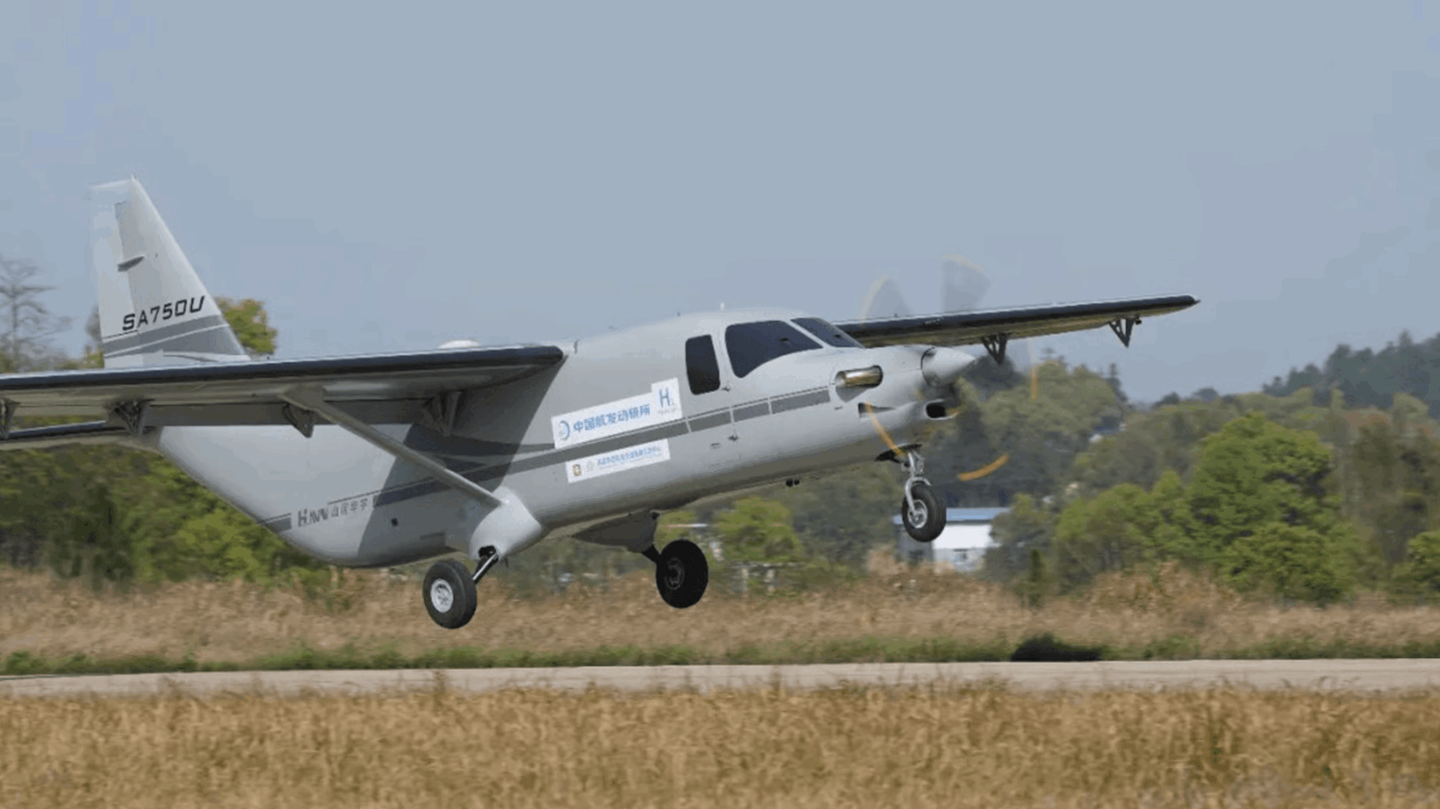
China’s state-owned aerospace manufacturer has completed the 36km maiden flight of a hydrogen turboprop airplane. (CREDIT: AECC)
An aircraft powered by a turboprop engine took off at Zhuzhou Airport. It flew for 16 minutes and attained an altitude of 300 meters, traveling at a speed of 220 km/h for a distance of 36 km before safely returning to the runway. This may seem like a short flight simply to complete a test, but in fact it is a significant achievement: the first successful flight of a megawatt-class hydrogen-powered turboprop engine.
The unmanned cargo aircraft weighed 7.5 tonnes and was outfitted with the AEP100 engine developed by the Aero Engine Corporation of China (AECC). In the test report, AECC indicated that the engine functioned as expected throughout the entire flight profile and performed steadily.
While many would say the fact that this flight utilized hydrogen was significant, what is even more important is how that hydrogen was used. The AEP100 does not utilize hydrogen fuel cells to power an electric motor. Rather, it burns liquid hydrogen in a turbine cycle, as you would do with conventional jet or turboprop engines that use kerosene for fuel.
With this approach, China has taken a different path than most of the Western aviation industry, where hydrogen has been largely viewed as a source of energy for hydrogen fuel cells.
Two Paths To Hydrogen Flight
Hydrogen fuel cells are designed to convert hydrogen to electricity through chemical means. The only by-product is water vapor, and the fuel cell will be very efficient. Airbus has pointed toward hydrogen fuel cells as a major part of its hydrogen aircraft strategy, and it has set a goal of developing a hydrogen-powered commercial aircraft by 2035. It also tested a 1.2-megawatt fuel cell demonstrator on the ground.
Combustion is more difficult from an engineering perspective and causes a greater mess during operation than any other method of generating energy. However, it presents an opportunity to develop a significant advantage with respect to power density. Unlike aircraft engines powered by kerosene, where you would need large amounts of fuel, turbine engines provide a much greater amount of power per unit of fuel consumed. This allows for better scaling for use in larger aircraft. This is particularly relevant within the realm of aviation, where the amount of weight in kilograms and volume in cubic meters of all aircraft components are critical factors when it comes to their design and ultimate operation.
The combustion characteristics of hydrogen as a fuel differ greatly from those of kerosene. Hydrogen burns at a significantly higher temperature than kerosene, with a much more rapid flame propagation rate compared to hydrocarbons such as kerosene. Additionally, due to hydrogen's lower volumetric energy density relative to hydrocarbons, hydrogen must be kept at cryogenic temperatures near -253 degrees Celsius during fuel system operation and engine operation.
Thus, successful engine operation is only a portion of the many components required to operate a hydrogen-powered aircraft. All of the fuel systems, the hydrogen storage tank, thermal management, and control systems for the aircraft must work in a cooperative manner within a narrow temperature range throughout the operation of the engine.
From Laboratory To Flight Testing
Experts at AECC state that China has developed an integrated technology chain for hydrogen-based aviation engines, from the engine's core components to complete engine integration, as a result of the successful demonstration flight. Even though the demonstration flight occurred on April 4 and has not yet undergone multiple flight tests or developed endurance for this engine, the demonstration flight was the first instance of taking the technology from the laboratory into actual flight testing.
Why did the demonstration flight occur at this time?
There are two driving forces behind the timing of the demonstration flight. First, there is a growing concern regarding the environmental impact of aviation on climate change. The second force driving the timing of the demonstration flight is the increasing demand for clean, renewable energy sources for the global community's energy needs.
As of today, aviation is responsible for approximately 2% of total global carbon emissions. However, if global aviation continues to operate with fossil fuel-based propulsion systems, the global carbon emissions arising from aviation will rapidly increase, potentially exceeding 10% of total global emissions by the year 2050. Aviation fuel combustion is responsible for the majority of carbon emissions produced in aviation.
Why Hydrogen Matters Now
In response to the growing concern regarding aviation's impact on climate change, various international aviation industries and regulatory bodies have established long-term net-zero carbon emission goals. China has likewise announced carbon and energy targets for its civil aviation sector.
One reason that hydrogen is still a common topic of discussion is that it has many of the qualities of kerosene and also has some advantages over kerosene. Hydrogen has a very high gravimetric energy density. Burning hydrogen does not produce carbon dioxide. Hydrogen can also be used for many different types of propulsion systems, including turbine engines, fuel cell-powered aircraft, and hybrid systems. For countries looking to reduce their greenhouse gas emissions while also relying less upon imported fossil fuels, hydrogen offers an appealing combination of benefits.
While these benefits are important, they take on an added dimension given the current energy situation around the world. The global oil supply chain has been disrupted due to geopolitical upheaval, including issues relating to oil transit routes such as the Strait of Hormuz and skyrocketing crude oil prices, as well as strategic releases of reserves. As a result, hydrogen is not just considered a climate change technology. Hydrogen is also a part of a broader strategy that emphasizes energy resilience.
Where hydrogen-powered aircraft are expected to emerge
Where Hydrogen-Powered Aircraft Are Expected To Emerge
While no one should expect to see a hydrogen-powered commercial aircraft routinely boarding customers anytime soon, the most recent test flight was a very short flight. It will take some time before hydrogen-powered aircraft are certified for commercial use.
Chinese planners believe that the first practical applications of hydrogen will occur through what they refer to as the low-altitude economy. This will include the use of unmanned cargo aircraft, cargo logistics systems for island reaction, and the establishment of controlled freight transport routes. In those settings, the development of hydrogen fueling and supporting infrastructure would be easier and more predictable than at major commercial airports.
This makes sense when considering that the majority of hydrogen fueling and supporting infrastructure has not yet been established outside of a test environment. Therefore, the development of standards for certification for hydrogen-powered aircraft is still relatively in the development stage. The uncertainties surrounding operational costs are as well.
A flight of 16 minutes does demonstrate an effective engine, but the overall effectiveness of an engine will not be known until much longer trials are completed. Many more things will need to be validated, including longevity, maintenance, how much fuel it requires over a life cycle, and how long it will be able to operate for thousands of hours before being retired.
The Roadmap and the Bottlenecks
The national roadmap for developing hydrogen-powered combustors is phased with the intention that by 2028 all the key technologies will be validated and will have completed test flights of small unmanned aircraft, small helicopters, urban air mobility-type aircraft, and regional aircraft with short-range turboshaft and turboprop engines. By 2035, this will continue to other wider regional applications for larger aircraft. By 2050, the goal will be for mainline airframes with large turbofan power.
This timeline presents a lot of great goals, but there is a long list of technical bottlenecks that will need to be overcome to continue to achieve these goals.
The hard problems still remain.
They are are just as much engineering challenges as they are part of the larger story of the industry as a whole.
The Hard Problems Still Remain
Stabilizing hydrogen combustion while minimizing nitrogen oxide emissions will need to be managed. The reason for this is that hydrogen is a highly flammable gas with a very wide flammability range and an extremely fast flame speed. Therefore, systems have to be designed to mitigate the risks of autoignition, flashback, combustion oscillations, and related problems. Thermal management will be another big hurdle to contend with, due to the fact that the hydrogen that begins in its liquid state will need to be preheated as it transitions to its gaseous state in the fuel system.
The issue of precise metering will be huge. Hydrogen is an extremely compressible substance and will shift between phases rapidly inside the fuel pipelines of an engine due to the rapid variation of its pressure, phase state, and temperature. Because of this, controlling hydrogen's flow will be much more difficult than controlling that of kerosene or other traditional fuels.
With regard to hydrogen storage, hydrogen has a very high energy per mass but also a very low energy density per volume. Liquid hydrogen in its cryogenic state is thought to be the most viable storage option for aerial transportation, but designing a tank to fit a given aircraft's specifications requires heavy insulation, highly sealed structures, cryogenic cooling capabilities, and custom tank designs that are not easy to integrate into airframe geometries.
The shapes of the aircraft will need to change to accommodate carrying hydrogen as a fuel. Therefore, the challenge of hydrogen use will also push through to redesigning the airframes.
Different Paths, Same Uncertainty
In the quest for the right path moving forward in hydrogen aviation technology, there will be differing approaches.
China appears to be pursuing a path related to direct combustion technology, while Airbus has embraced fuel cell technology for current and future large commercial uses. Nevertheless, both approaches to the use of hydrogen as fuel are not necessarily mutually exclusive. Airbus had previously been studying hydrogen combustion before choosing to focus more heavily on fuel cells as its primary developmental path, and it has not completely closed the door on its potential involvement with hydrogen combustion systems in the future.
Simultaneously, China continues to conduct research and pursue the development of fuel cells for use with smaller aircraft.
It remains to be seen whether there will be a common solution for the use of hydrogen fuel in aircraft. It is possible for the various classes of hydrogen-powered aircraft to have different applications for their hydrogen fuel, depending on range, payload, capital cost, and airport infrastructure.
At this time, China's latest testing of a hydrogen engine does not demonstrate that hydrogen has reached the maturity to be used in aircraft services. What the testing does demonstrate is that a hydrogen turboprop engine with a peak output of 1 megawatt can become airborne and operate as intended, then successfully return to its launch point intact.
In a field with a great deal of theoretical work and long development timelines, this is a very positive indication of the current state of hydrogen-powered aviation.
Research findings are available online in the journal Strategic Study of CAE.
The original story "The world’s first test flight of a water-powered airplane just took off in China" is published in The Brighter Side of News.
Related Stories
- Former SpaceX engineer plans to turn small planes into the next family car
- Scientists find cheap way to fight global warming using airplanes
- Scientists Use Bird Feathers to Make Planes Safer
Like these kind of feel good stories? Get The Brighter Side of News' newsletter.
Joshua Shavit
Writer and Editor
Joshua Shavit is a NorCal-based science and technology writer with a passion for exploring the breakthroughs shaping the future. As a co-founder of The Brighter Side of News, he focuses on positive and transformative advancements in technology, physics, engineering, robotics, and astronomy. Having published articles on AOL.com, MSN, Yahoo News, and Ground News, Joshua's work highlights the innovators behind the ideas, bringing readers closer to the people driving progress.