Why do astronauts still act like gravity exists in space?
Months in orbit do not erase Earth’s influence on how astronauts grip and move objects.

 Edited By: Joshua Shavit

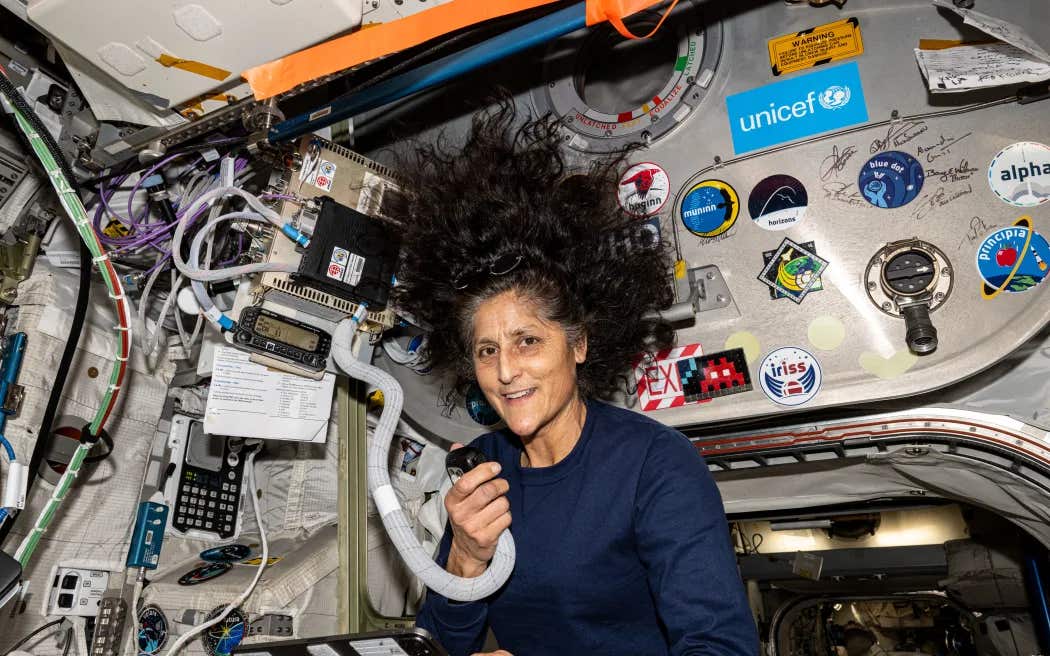
NASA astronaut and Boeing Crew Flight Test Pilot Suni Williams. Astronauts still grip objects as if gravity matters, even after months in space, a new study finds. (CREDIT: NASA)
An astronaut can hold a tool in space, loosen their fingers, and watch it stay put. Nothing drops. Nothing tugs downward. Yet the brain does not simply forget gravity because the body has left Earth.
That mismatch sits at the center of a new study on how people grip and move objects in orbit. The research found that even after months in weightlessness, astronauts still handled objects as if gravity might interfere. Their hands applied too much force, especially during movement, suggesting the brain kept predicting a pull that was no longer there.
The work, led by Philippe Lefèvre and colleagues at Université catholique de Louvain and Ikerbasque, looked at one of the most ordinary actions people perform, picking up and moving an object, and placed it in one of the least ordinary environments possible.
A habit the nervous system does not easily erase
On Earth, the brain constantly coordinates two related forces when a person handles an object. One is grip force, the pressure from the fingers. The other is load force, the force generated by the object’s movement and weight. In daily life, those forces stay closely linked. The brain predicts what the object will do and adjusts the hand before trouble starts.
That prediction system matters because a weak grip can let an object slip, while too much force wastes effort and can make movement clumsy. On Earth, gravity is always part of the calculation.
In orbit, that rule changes. A held object no longer has weight in the usual sense, even though it still has mass. If an astronaut keeps the object still and lets go, it does not fall. But once the object is moved, inertia still matters. The object can keep traveling in whichever direction it was pushed if the grip and control are not steady.
The researchers wanted to know how the brain handles that shift. Does it quickly rewrite its expectations in weightlessness, or does gravity leave a deeper mark?
To examine that question, the team studied 11 astronauts, including two women and nine men, as they manipulated objects on Earth in normal gravity and during spaceflight in a stable 0G environment.
What emerged was not a clean switch from one control system to another.
Overgripping in orbit
The astronauts tended to overcompensate in space. Their grip force remained higher than needed for an environment without weight, and the effect became especially clear when they were actively moving objects around.
The finding points to a lingering expectation in the nervous system. Even without gravity acting on the object in the same way, the brain appeared to behave as though some kind of downward pull still needed to be managed.
The researchers describe this as evidence that gravity leaves an imprint on the brain that remains visible even after months of living in weightlessness. In other words, experience in orbit does not instantly erase what a lifetime on Earth has taught the hands and brain to expect.
Their interpretation goes even further. The team argues that the astronauts’ behavior may reflect an “Anti-Bayesian” anticipation, meaning the central nervous system may be making an incorrect prediction in 0G, almost as though objects could float upward with a kind of negative weight. That prediction would help explain why the hand applies more grip than the environment seems to require.
This was not just a story about excess caution. The researchers also found a new relationship in how grip force changed in weightlessness.
More than slip, the brain also seems to weigh consequences
A close look at the data suggested that grip force in 0G was tied not only to load force but also to the kinetic energy of the object. The best description, the researchers report, was a quadratic dependence of grip force on both load force and kinetic energy.
That matters because it changes the way grip control is understood. Standard thinking has focused heavily on slip risk. If an object might slip, the hand tightens.
This study suggests the brain may be considering something else too: what happens if the slip occurs.
An accidental slip with a slow, light object is one thing. A slip involving a faster-moving object with greater kinetic energy could have more serious consequences. The authors conclude that control strategies are shaped not only by the chance of an accident but also by the possible impact of that accident.
That idea fits the unusual demands of space. In orbit, a loose object does not fall to the floor and stop there. It can drift, collide, or become harder to recover. The hand may be acting with that broader risk in mind, even when its prediction about gravity is off.
The return to Earth is not instant either
The adaptation problem did not end when astronauts came home.
After returning to Earth, they initially made incorrect predictions again about how they were holding and manipulating objects. During the first movements with the object, the researchers observed progressive kinematic adjustments, along with signs that the astronauts were misjudging the expected load forces.
Their movements improved over time, but not immediately. The transition back to 1G was gradual, just as the earlier transition into 0G had been.
That matters because it reinforces the central point of the study. The brain’s handling of objects depends strongly on prediction, and those predictions do not update all at once when the physical world changes. The neural processes behind grip and movement appear to adapt slowly and, at least over the observed period, incompletely.
The study frames that lag as evidence of how predictive the system really is. The brain is not simply reacting to current forces in the moment. It is carrying prior expectations into each action, then slowly correcting them when reality pushes back.
Lefèvre noted how long the work took to reach publication. Coordinating with a space agency, waiting for successful spacecraft flights, compiling the data, and carrying out the analyses stretched the effort across close to 20 years.
The team says more findings are still on the way. They plan to publish additional data on point-to-point movement accuracy with objects, how astronauts adjust after object collisions, and how skin friction affects those adjustments.
Research findings are available online in the journal JNeurosci.
The original story "Why do astronauts still act like gravity exists in space" is published in The Brighter Side of News.
Related Stories
- Radiation 'cavity' near the moon could lower astronaut exposure to cosmic radiation
- Space travel accelerates stem cell aging - threatening astronaut health
- Flexible wearables revolutionize astronaut health monitoring in space
Like these kind of feel good stories? Get The Brighter Side of News' newsletter.
Joseph Shavit
Writer, Editor-At-Large and Publisher
Joseph Shavit, based in Los Angeles, is a seasoned science journalist, editor and co-founder of The Brighter Side of News, where he transforms complex discoveries into clear, engaging stories for general readers. With vast experience at major media companies like The Los Angeles Times, Times Mirror and Tribune Publishing, he writes with both authority and curiosity. His writing focuses on space science, planetary science, quantum mechanics, geology. Known for linking breakthroughs to real-world markets, he highlights how research transitions into products and industries that shape daily life.