Giant crocodylians may have ruled South America’s food chain 12 million years ago
Purussaurus neivensis predator evidence comes from bite marks on Miocene herbivore fossils from ancient South America.
 University of Helsinki Writer: Juha Merimaa

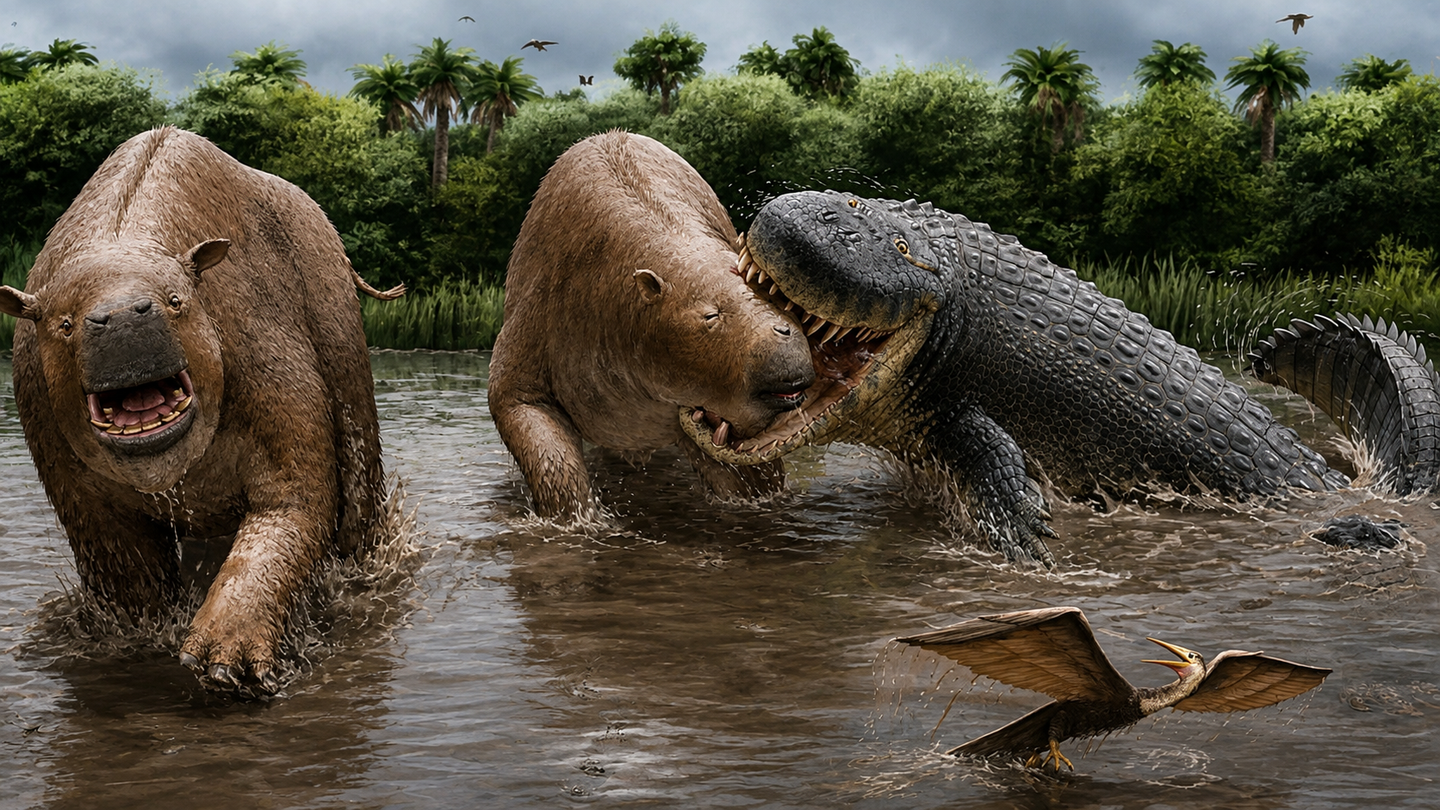
Reconstruction of Purussaurus neivensis attacking Pericotoxodon platignathus. (CREDIT: Miguel Hernandez)
- Bite marks on fossil bones suggest giant crocodylians were major predators in Miocene South America.
- The marks point especially to Purussaurus neivensis, a seven-meter relative of modern caimans.
- The finding helps show that large reptiles, not only mammal predators, shaped ancient food webs around a vast lake system.
A broken fossil bone can hold the last trace of an attack. In Miocene South America, some of those marks point to giant crocodylians ruling the edges of an ancient lake.
More than 10 million years ago, a vast lake covered much of the continent. Its waters and shores supported giant turtles, crocodylians, anacondas, saber-toothed mammals, flightless “terror birds” and sebecids, terrestrial relatives of crocodylians.
The prey were enormous too. Giant ground sloths, glyptodonts and several kinds of ungulates lived along the lake’s shores. Some of those hoofed mammals, including astrapotheres and toxodontids, could weigh well over a tonne.
A recent study argues that crocodylians were the most significant predator group in this habitat. The conclusion comes from bite and tooth marks preserved on herbivore fossils between 10.5 million and 16 million years old.
Teeth left the clearest evidence
Bite marks are rare but powerful clues. They are direct evidence that two species interacted, either through hunting or feeding on a carcass.
Oscar Wilson, a postdoctoral researcher at the University of Helsinki, said the marks change how scientists view this ancient ecosystem.
“There was so much prey available that mammalian predators couldn’t have eaten it all,” Wilson says.
“Our new study shows that crocodylians in particular were the region’s most important predators, especially when it came to hunting large prey.”
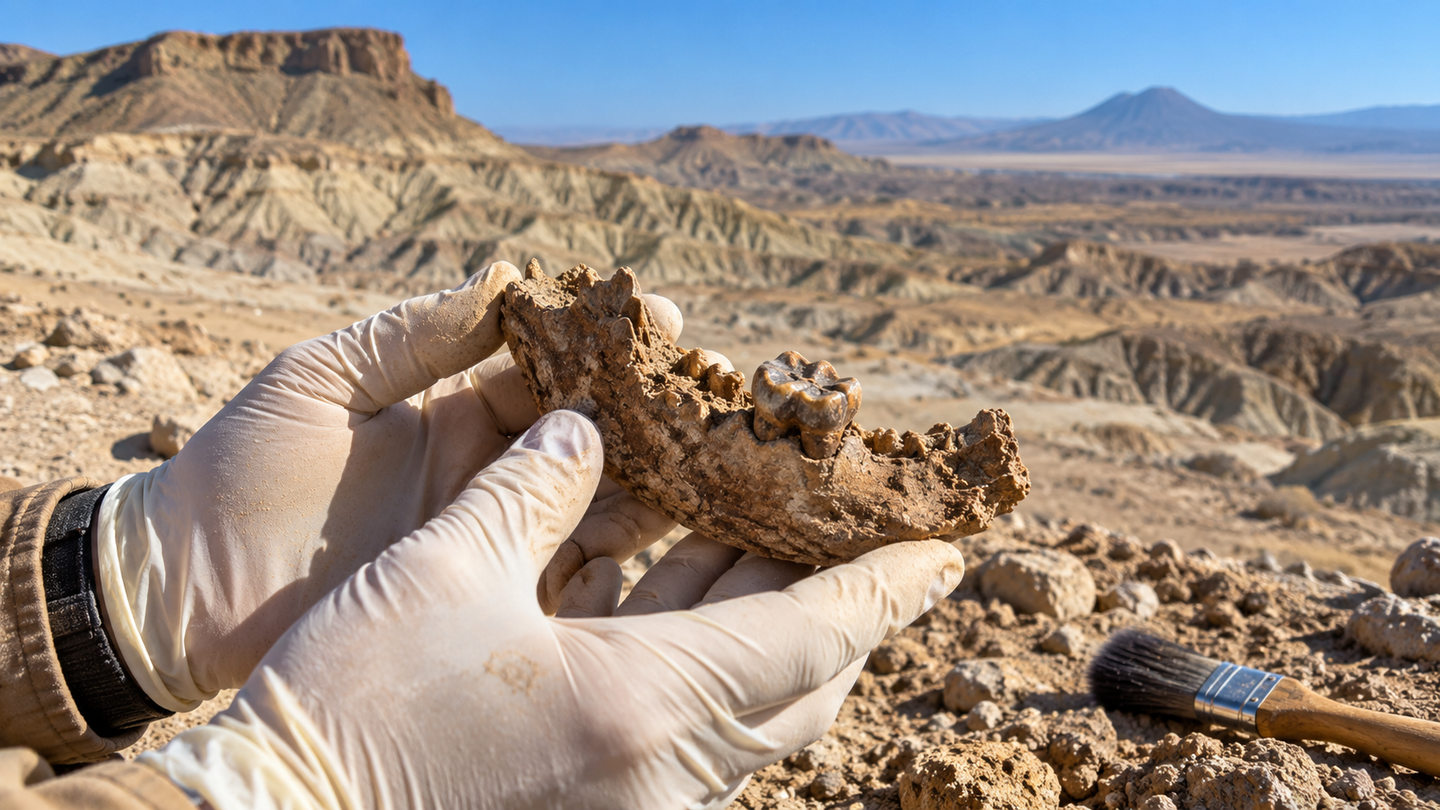
The research used fossils held in museum collections. The team examined damage left on herbivore bones and compared those marks with the teeth and body sizes of possible predators.
That evidence pointed toward large crocodylians as major hunters. In particular, the frequency of marks likely made by Purussaurus neivensis suggested that this animal played a central role.
“The frequency of marks likely made by Purussaurus suggests that it was an important predator in these tropical ecosystems,” Wilson comments.
A caiman relative at the top
Purussaurus neivensis was a relative of modern caimans, but it was far larger. The largest predator in the habitat reached about seven meters long and weighed around 1,800 kilograms.
That size put it at the top of the food chain. The new study suggests it may even have influenced the size of herbivore populations.
Such an animal would have been capable of attacking prey much larger than most mammalian carnivores could handle. Around the lake, it likely shared the predator landscape with saber-toothed mammals, anacondas, terror birds and sebecids.
But the fossil marks indicate that crocodylians were not just occasional scavengers in this ecosystem. They were a major part of the predatory pressure on large plant-eaters.
The study does not say every damaged bone records a live attack. Some marks may come from scavenging. Still, tooth traces on bones remain the strongest available evidence for feeding interactions in deep time.
A crowded shore of giants
The ancient lake habitat was unusually rich. Large herbivores supplied abundant prey, and the warm, wet setting supported many predators.
Glyptodonts, relatives of armadillos, carried heavy body armor. Giant ground sloths browsed nearby. Astrapotheres, sometimes called “lightning beasts,” and toxodontids added more large-bodied mammals to the shoreline community.
Those animals created a food supply that could sustain many hunters. Wilson’s point is that mammalian predators alone likely could not account for all of it.
That helps explain why crocodylians became so important. They could hunt at the border between land and water, where thirsty or grazing mammals came within striking range.
Modern crocodiles can attack animals at riverbanks and drag prey into water. The study does not need to prove identical behavior in Purussaurus to show the broader pattern. The fossils themselves show that large herbivores carried tooth marks consistent with giant crocodylian feeding.
Reading violence in old collections
Museum fossils can keep evidence that is easy to overlook. A skull, jaw or limb bone may hold punctures, grooves or crushed areas that reveal how an animal died, or how its remains were eaten.
In this case, the fossils examined were not new animals. They were specimens already preserved in collections. The new information came from looking closely at damage on the bones.
That makes the study a reminder of how museum collections can keep producing discoveries long after fossils are first collected. A bone may be important not only because it identifies a species, but because it preserves a moment of contact between predator and prey.
The team focused on bite and tooth marks because they provide direct evidence. Other methods can suggest who might have eaten whom. Tooth damage shows that a predator actually touched the bone.
In a lost ecosystem with many possible carnivores, that distinction matters. It helps separate likely roles from assumptions based only on body size or tooth shape.
Reptiles as dominant predators
The findings challenge any simple picture of ancient South America as a mammal-dominated predator world. Mammalian hunters were present, but they were not alone.
Crocodylians appear to have held a leading role, especially for large prey. In this habitat, reptiles may have been the most important predators at the top of the food web.
That fits the unusual setting. A vast lake with rich shores would have favored predators that could use both water and land edges. Purussaurus, with its massive body and powerful jaws, was well placed for that role.
The study also suggests that this predator could have affected the broader ecosystem. If Purussaurus regularly hunted large herbivores, it may have helped shape which prey survived, how they behaved and how their populations changed.
Those are difficult questions to answer directly from fossils. But the bite marks show that large crocodylians were not background animals. They were active participants in the lives and deaths of the mammals around them.
Practical implications of the research
The research gives paleontologists a clearer way to reconstruct ancient food webs in South America. By using bite marks as direct evidence, scientists can test which predators actually fed on large prey instead of relying only on guesses from body size.
The findings also help refine the ecological role of Purussaurus neivensis. Rather than treating it only as an impressive giant, researchers can place it as a major predator in a specific tropical ecosystem.
More broadly, the work shows why fossil collections remain valuable for understanding behavior. Bones can preserve interactions, not just anatomy. In this case, damaged herbivore fossils reveal that crocodylians helped shape one of Miocene South America’s most formidable predator communities.
Dig deeper into Purussaurus, Miocene predators and ancient South American food webs
These studies examine giant caimans, predator competition and direct fossil evidence of feeding interactions, helping place the La Venta bite marks within the broader ecology of Miocene South America.
Direct evidence of trophic interaction between a crocodyliform and a large terror bird in the Middle Miocene of La Venta, Colombia: A fossil terror bird leg bone from La Venta preserves bite marks attributed to a large caimanine, possibly Purussaurus neivensis. The evidence reveals a feeding or scavenging interaction between two major predators within the same ancient ecosystem. (Biology Letters, 2025)
The role of climate on the emergence of giant caimanines (Crocodylia, Alligatoroidea) from the Miocene western Amazonian region: This research examines how climate and environmental conditions contributed to the evolution of unusually large caiman relatives in western Amazonia, providing context for why giants such as Purussaurus flourished during the Miocene. (Palaeogeography, Palaeoclimatology, Palaeoecology, 2024)
Low predator competition indicates occupation of macro-predatory niches by giant Miocene reptiles at La Venta, Colombia: Ecological modeling found relatively little predator competition at La Venta and indicated that carnivorous reptiles consumed a large share of available prey biomass. The results support the idea that crocodyliforms filled major predatory roles that mammalian carnivores did not. (Palaeogeography, Palaeoclimatology, Palaeoecology, 2023)
Predation of the giant Miocene caiman Purussaurus on a mylodontid ground sloth in the wetlands of proto-Amazonia: Bite marks on a ground sloth tibia provide direct evidence of a feeding encounter with a young or subadult Purussaurus. The study helps establish that these giant caimans attacked or consumed substantial terrestrial mammals in Miocene wetlands. (Biology Letters, 2020)
Morphometry, Bite-Force, and Paleobiology of the Late Miocene Caiman Purussaurus brasiliensis: Researchers estimated the body dimensions, feeding requirements and bite force of the larger Purussaurus brasiliensis, concluding that its extraordinary size allowed it to tackle a broad range of prey and function as an apex predator. (PLOS ONE, 2015)
Research findings are available online in the Journal of Vertebrate Paleontology.
The original story "Giant crocodylians may have ruled South America’s food chain 12 million years ago" is published in The Brighter Side of News.
Related Stories
- New Triassic fossil reveals bird-like reptile related to crocodiles
- Ancient crocodile-like predators rewrite current knowledge of how animals adapted to the land
- Crocodile-eating apex dinosaur reveals missing link in predator evolution
Like these kind of feel good stories? Get The Brighter Side of News' newsletter.
Joshua Shavit
Writer and Editor
Joshua Shavit is a NorCal-based science and technology writer with a passion for exploring the breakthroughs shaping the future. As a co-founder of The Brighter Side of News, he focuses on positive and transformative advancements in technology, physics, engineering, robotics, and astronomy. Having published articles on AOL.com, MSN, Yahoo News, and Ground News, Joshua's work highlights the innovators behind the ideas, bringing readers closer to the people driving progress.