A honey bee colony is more than a community, it acts as a superorganism
Following a queen rather than a hive changes how a review interprets honey bee reproduction, colony lifetimes and parental care.
 Lund University Writer: Lotte Billing

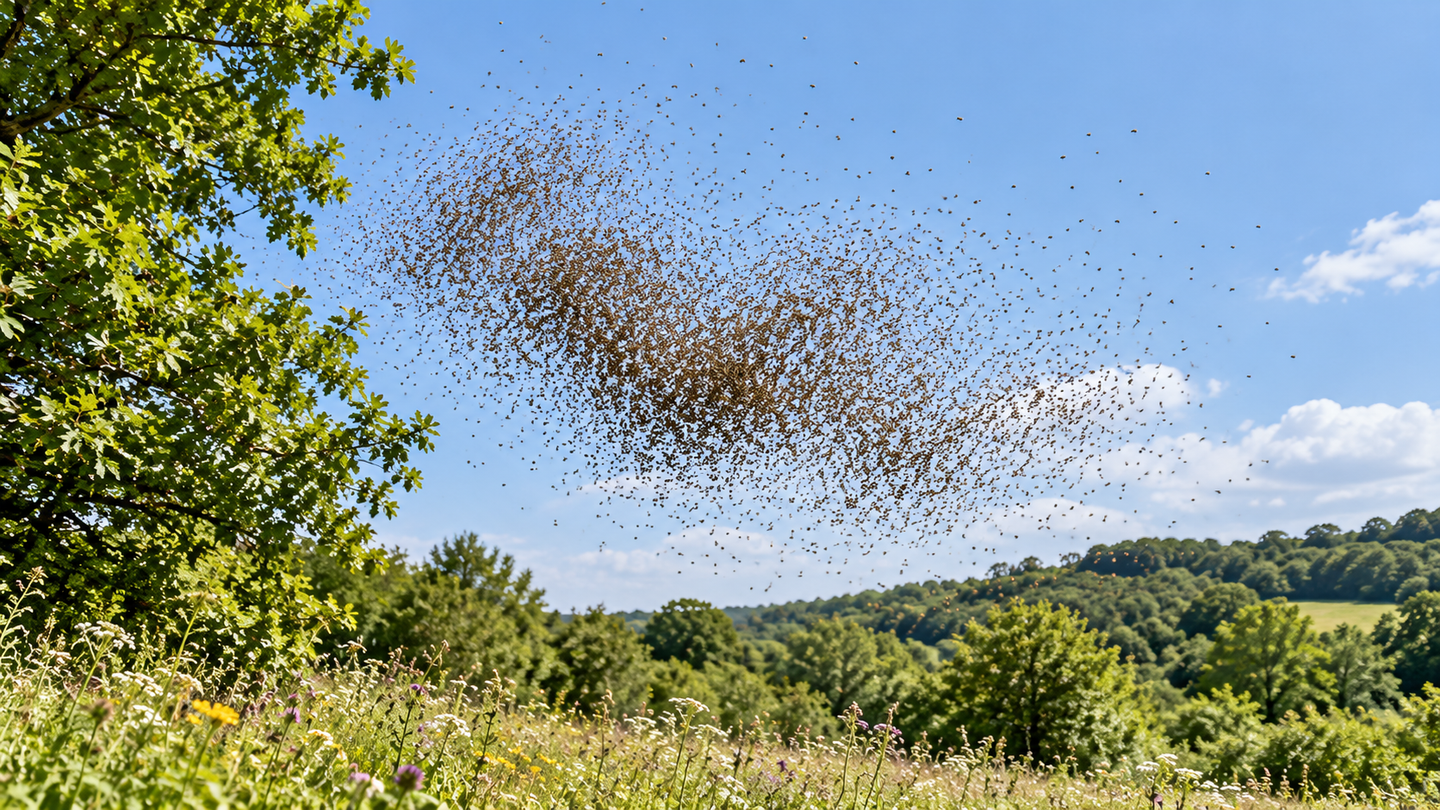
A review follows queens to redefine honey bee colony generations, raising questions about swarming, parental care and beekeeping. (CREDIT: Shutterstock)
- A review argues that a honey bee colony should be understood as a succession of mortal superorganisms, each associated with a queen.
- The framework reinterprets swarming, queen replacement and worker care as parts of reproduction and development at the colony level.
- Its implications for parasite research and beekeeping remain proposals, rather than results from new management experiments.
A hive can remain busy for years while nearly every bee inside it changes. To a beekeeper watching the entrance, that may look like one continuous colony. But when a daughter replaces the queen, is the same biological individual still living there, or has a new generation taken over?
That question sits at the center of a review published in Insectes Sociaux. Hannes A. Bonhoff of Lund University and Heikki Helanterä of the University of Oulu argue that the answer changes how honey bee lives should be counted and understood.
Their framework treats each queen and her associated workers as a mortal superorganism. A continuously occupied nest can therefore house successive generations, rather than one indefinitely surviving individual. The paper develops a biological interpretation from existing literature, without presenting a new colony experiment.
An old idea with a different family tree
Treating social insect colonies as superorganisms is not new. More than a century ago, William Morton Wheeler compared specialized insect castes with the tissues of an animal. Honey bees have long provided an important example of coordinated life above the individual insect.
Workers perform different jobs as they age, including tending brood, guarding the nest and gathering food. Together, those changing roles sustain the larger system. The authors compare this division of labor with the specialized functions of tissues within a body.
The new review focuses on where one such individual ends and another begins. One influential interpretation allows a colony to continue through repeated queen replacements, making it potentially immortal. Another ties its identity to the queen and the genetic contributions of the drones she mated with.
Bonhoff and Helanterä favor the second interpretation. A daughter queen, after mating, produces a genetically different workforce. Under their model, that transition marks a new superorganism, even when the nest remains occupied and some older workers are still present.
The distinction becomes especially clear during the first swarm of a reproductive cycle. The old queen leaves with workers, while a young queen remains behind. Following the occupied nest identifies the original colony differently from following the original queen.
Development inside a living workforce
The authors extend their model by comparing a colony’s development with an animal’s development. A newly mated queen plays a role analogous to a fertilized egg, while her workers represent the developing body. These are comparisons between biological levels, not claims that bees literally become cells.
Initially, workers produced by the previous queen provide the care. As the new queen lays eggs, her own offspring emerge and gradually take over tasks. The authors describe this period as a form of gestation within the maternal superorganism.
Their proposed stages include embryonic, fetal, juvenile and adult phases. The juvenile phase begins when the new workforce can perform the full range of necessary functions. Adulthood corresponds to reproductive maturity, including the production of drones and, subsequently, new queens.
Unlike most cells within an animal, the workers are not genetically identical copies. The analogy concerns their coordinated functions and reproductive organization. The review also recognizes unusual reproductive pathways, illustrating that the comparison has biological qualifications.
Swarming changes who bears the risk
In the familiar description, swarming creates another colony when bees depart to establish a nest. The review separates that visible movement from reproduction itself. It argues that the departing first swarm contains the existing maternal superorganism, relocating rather than becoming its own offspring.
“Parental care therefore goes so far that the offspring inherits the mother's nest, whilst she herself risks her life by swarming away to settle elsewhere,” Bonhoff said.
The established nest offers shelter, stored food and constructed comb. Meanwhile, the old queen’s swarm must find a suitable location, build comb and gather provisions. That work creates substantial risks, particularly before winter in temperate environments.
Later swarms complicate the picture because they carry young, unmated queens. The authors interpret their accompanying workers as portions of the maternal body that support developing offspring. They also describe queen replacement without swarming as reproduction, showing why nest splitting alone cannot define the process.
Care may extend beyond feeding and protection. Experienced foragers can communicate food locations through waggle dances, and earlier experiments show that social experience shapes dance performance. The review interprets overlap between older and younger workers as a potential channel for parental guidance.
Counting lifetimes changes parasite research
The proposed framework also challenges what researchers measure when they record colony survival. If a nest stays occupied through several queen generations, its occupancy duration is not necessarily the lifespan of one superorganism. Those two measurements answer different questions.
That matters when studying Varroa destructor, a damaging parasitic mite. A nest that becomes empty years after infestation could have housed several successive superorganisms. Meanwhile, the initially affected queen might have departed in a swarm and reproduced elsewhere.
This does not demonstrate that mites are harmless or that affected populations will thrive. It shows why nest occupancy alone may give an incomplete account of survival and reproduction. Tracking queens, swarms and genetic changes could help distinguish those outcomes.
The authors acknowledge practical difficulties. Occasional nest checks may miss queen replacement, departures or recolonization. Genetic sampling can reveal some generational changes, but cannot by itself establish how many swarms departed or what happened to them.
What the argument means for beekeeping
Queen replacement becomes particularly contentious under this interpretation. Beekeepers may introduce a young queen to maintain performance or reduce losses. The authors argue that this replaces a superorganism instead of rejuvenating the same individual.
That argument changes the ethical description of the practice, but does not establish its overall health effects. The review acknowledges evidence that colonies with younger queens may be healthier and more productive. It does not experimentally compare alternative management systems or establish that avoiding replacement improves welfare.
Likewise, reinterpreting swarming does not demonstrate that every colony benefits from unrestricted swarming. Management outcomes require direct evidence about reproduction, disease, survival and local conditions. The review raises questions about current practices without supplying a universally tested replacement.
The broader evolutionary interpretation also remains debated. Other researchers have questioned whether eusocial colonies meet the criteria for a major transition in biological individuality. Bonhoff and Helanterä argue that their account strengthens the superorganism concept, while identifying clearer definitions and better population tracking as important next steps.
Dig deeper into honey bee colonies and superorganisms
These five publications explore colony individuality, communication, survival and management from complementary perspectives.
- Superorganismality and caste differentiation as points of no return: how the major evolutionary transitions were lost in translation: Examines how specialized social insect castes relate to the evolution of higher-level biological individuals. (Biological Reviews, 2018)
- Eusociality is not a major evolutionary transition, and why that matters: Presents an alternative interpretation of worker castes and challenges a common account of evolutionary individuality. (Insectes Sociaux, 2024)
- Social signal learning of the waggle dance in honey bees: Reports experimental evidence that social experience influences how young bees communicate through dances. (Science, 2023)
- How Honey Bee Colonies Survive in the Wild: Testing the Importance of Small Nests and Frequent Swarming: Tests how nest size and swarming relate to mite infestation, disease and colony survival. (PLOS ONE, 2016)
- Honey bee colony winter loss rates for 35 countries participating in the COLOSS survey for winter 2018–2019, and the effects of a new queen on the risk of colony winter loss: Examines winter losses and associations with queen replacement across an international beekeeping survey. (Journal of Apicultural Research, 2020)
Research findings are available online in the journal Insectes Sociaux.
The original story "A honey bee colony is more than a community, it acts as a superorganism" is published in The Brighter Side of News.
Related Stories
- Bee venom helps preserve memory in new Parkinson’s disease study
- The hidden costs of climate change for bees and wasps
- Southern California bees are keeping deadly mites in check
Like these kind of feel good stories? Get The Brighter Side of News' newsletter.
Joshua Shavit
Writer and Editor
Joshua Shavit is a NorCal-based science and technology writer with a passion for exploring the breakthroughs shaping the future. As a co-founder of The Brighter Side of News, he focuses on positive and transformative advancements in technology, physics, engineering, robotics, and astronomy. Having published articles on AOL.com, MSN, Yahoo News, and Ground News, Joshua's work highlights the innovators behind the ideas, bringing readers closer to the people driving progress.