Wormholes may enable time travel, astrophysicists find
Physicists say a ring wormhole could, in theory, become a time machine when gravity throws its two mouths out of sync.

 Edited By: Joshua Shavit

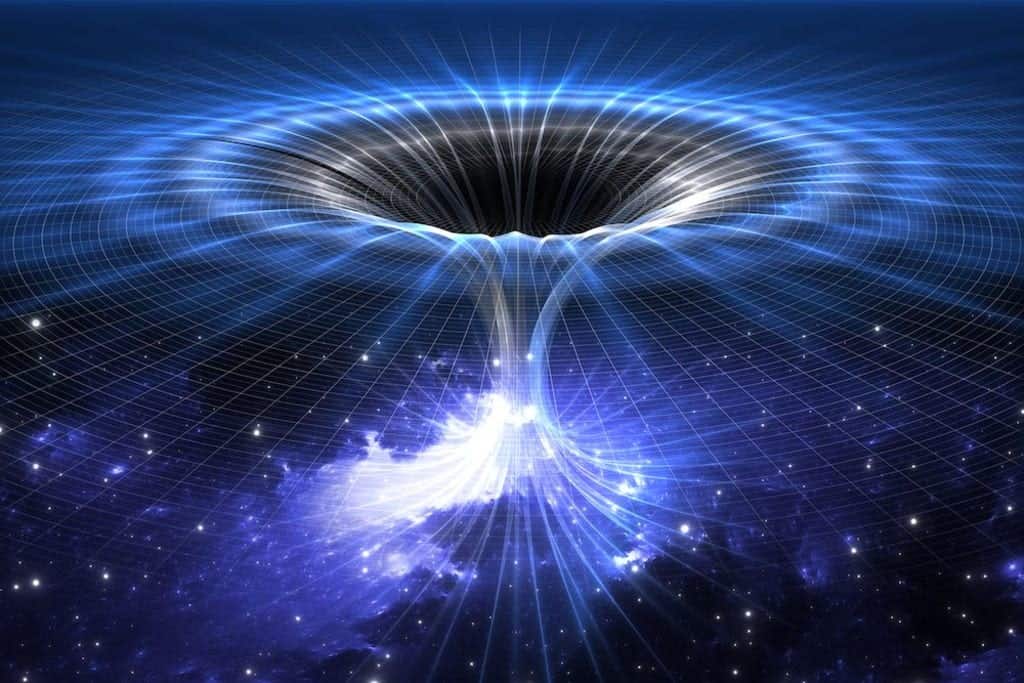
A new analysis suggests a ring wormhole could, in theory, form closed timelike curves under the right gravitational conditions. (CREDIT: Wikimedia / CC BY-SA 4.0)
A ring in space, at least on paper, can do something a black hole cannot. It can connect distant regions without forcing anything through crushing gravity or a singularity. In a new theoretical analysis, physicists say that under the right conditions, such a ring wormhole could do even more than link faraway places. It could, in principle, become a time machine.
That does not mean anyone is about to build one. The work lives deep inside general relativity, in a part of the theory where geometry behaves in ways that rarely match ordinary intuition. But it does show that a peculiar kind of wormhole may admit a path around one of physics' most stubborn limits, at least mathematically.
Valeri P. Frolov and Andrei Zelnikov of the University of Alberta, working with Pavel Krtouš of Charles University in Prague, studied what happens when gravity acts near a traversable ring wormhole. Their paper was posted on arXiv and accepted for publication in Physical Review D.
A shortcut shaped like a ring
Wormholes have been part of physics discussions for decades. In the simplest picture, they act as tunnels through spacetime, linking places that would otherwise be far apart. Most familiar models come with a problem. They pinch off too quickly, form singularities, or require matter that behaves in exotic ways.
The version studied here is different. It builds on a ring wormhole model proposed by Gary Gibbons and Mikhail Volkov. Instead of a spherical throat, this model connects spaces through a disk bounded by a circular ring.
Outside that ring, the geometry is flat. The authors note that a particle passing through the disk would not have to travel through a region of strong gravity or through negative energy density itself. That makes the setup unusual among wormhole ideas.
The catch sits at the ring. The geometry there contains a conical curvature singularity, which the paper identifies with a cosmic string carrying negative energy. That matters because ordinary wormholes usually need some violation of standard energy conditions to remain open.
Gravity changes the story
The new paper asks a more specific question. What if one mouth of a ring wormhole sits inside a surrounding mass distribution?
To study that, the team examined the weak gravitational field created by a thin, oblate spheroidal shell of mass placed around one mouth. They considered two cases. In one, the wormhole connects two separate flat spaces. In the other, it connects two distant regions of the same space.
That second case turns out to be the more interesting one.
In ordinary Newtonian thinking, a static gravitational field comes from a potential, and the work done around a closed path vanishes. Here, the authors found that the geometry's topology gets in the way. The gravitational field remains well defined, but the potential can become multivalued. In their words, the field becomes non-potential.
That single shift has large consequences. If the two mouths of the wormhole are connected through spacetime, but one sits in a different gravitational environment from the other, clocks at the mouths no longer stay synchronized in the same way for a distant observer.
When clocks fall out of step
The paper shows how this desynchronization can grow.
The authors imagine a ring wormhole whose two mouths are far apart, with one mouth surrounded by a massive thin shell. Because the mouths are still identified through the wormhole, proper time at the two disks remains linked. But for an observer at infinity, the rate of coordinate time differs between them once gravity around one mouth changes.
That mismatch creates what the paper calls a time gap.
A light ray can then travel toward one mouth, pass through the wormhole, emerge from the other, and return through ordinary space. After enough time has passed, the analysis shows that the ray can get back to its starting point earlier than it was emitted. At that stage, a closed timelike curve forms.
A closed timelike curve is exactly the kind of object physicists worry about in time-travel discussions. It is a path through spacetime that loops back onto the same point in both space and time.
The paper gives an estimate for when that would happen. In the weak-field approximation, the characteristic time depends on the shell's radius, the distance between the wormhole mouths, and the shell's mass. Restoring dimensions, the estimate is given as T ≈ RLc/GM.
A loophole, with many caveats
The result does not mean the universe permits practical time travel. The paper is explicit about the limits.
For one thing, the wormhole itself is already exotic. The ring carries the kind of matter distribution needed to violate the null energy condition. The analysis also stays in the weak-field regime and uses approximations, especially when the wormhole mouths are assumed to be far apart.
Then there is the old objection raised by Stephen Hawking. The paper revisits the chronology protection problem, the idea that quantum effects may prevent closed timelike curves from ever forming in a real spacetime. Earlier work on more standard wormholes suggested that vacuum fluctuations could grow without bound as a time machine is about to appear, making backreaction impossible to ignore.
The authors do not resolve that issue. They say the ring-wormhole model may offer a mathematically simpler setting for studying quantum effects near time-machine formation, and they point to that as a natural next step.
That may be the real value of the work. It is less a blueprint for a machine than a stress test for relativity.
Why theorists keep pushing these edges
Even highly speculative wormhole studies can clarify where Einstein's theory bends and where it may break. The new paper shows that topology alone can reshape the meaning of something as familiar as a gravitational potential. In one setup, the field is trapped by the wormhole. In another, asymmetry around the two mouths can turn a traversable passage into a source of closed timelike curves.
The broader lesson is not that time travel is around the corner. It is that spacetime still allows strange, partly unexplored behavior when geometry, gravity, and global structure interact.
For now, ring wormholes remain mathematical objects. But by probing them, physicists get a little closer to understanding how general relativity handles its own loopholes, and whether quantum physics eventually closes them.
Practical implications of the research
The immediate impact is theoretical. The work offers a cleaner model for studying how wormholes behave when gravity around one mouth differs from gravity around the other.
It also provides a specific framework for testing Hawking's chronology protection idea in a mathematically simpler setting than many older wormhole models.
More broadly, it sharpens questions about how general relativity, topology, and quantum effects fit together when spacetime is pushed into its most extreme forms.
Research findings are available online in the journal Physical Review D.
The original story "Wormholes may enable time travel, astrophysicists find" is published in The Brighter Side of News.
Related Stories
- New tachyon theory could unlock the secrets of time travel and causality
- The unexpected consequence of time travel: complete memory loss
- Light can travel for billions of years yet experience no time
Like these kind of feel good stories? Get The Brighter Side of News' newsletter.
Joseph Shavit
Writer, Editor-At-Large and Publisher
Joseph Shavit, based in Los Angeles, is a seasoned science journalist, editor and co-founder of The Brighter Side of News, where he transforms complex discoveries into clear, engaging stories for general readers. With vast experience at major media companies like The Los Angeles Times, Times Mirror and Tribune Publishing, he writes with both authority and curiosity. His writing focuses on space science, planetary science, quantum mechanics, geology. Known for linking breakthroughs to real-world markets, he highlights how research transitions into products and industries that shape daily life.