JWST reveals how young solar systems may lose the gas needed to build planets
JWST observations reveal a changing sequence of winds that may control how long young solar systems can keep building planets.
 University of Arizona Writer: Mikayla Mace Kelley

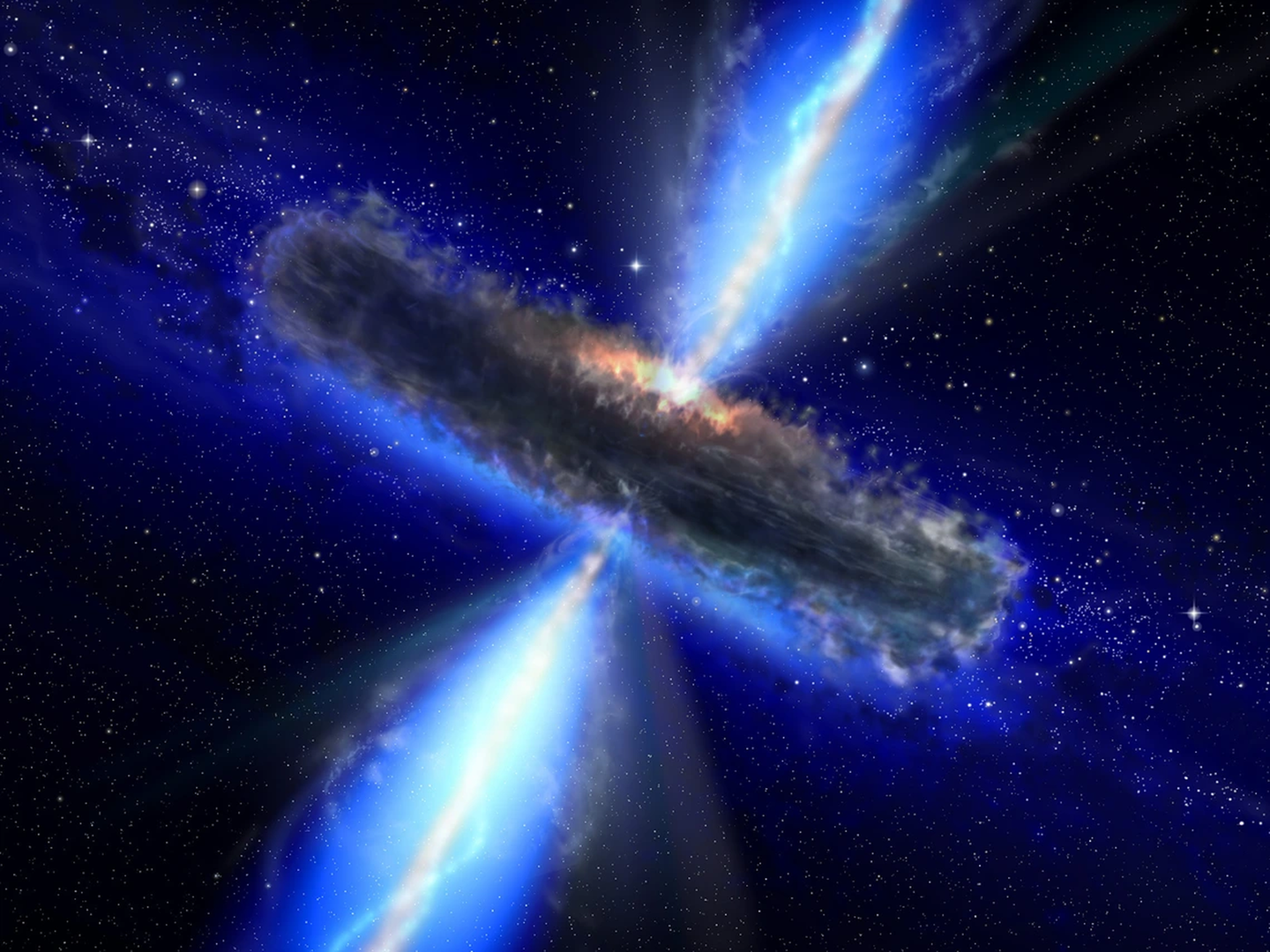
An artist’s impression of a young star surrounded by a planet-forming disk, with powerful winds blasting gas from the emerging planetary system. (CREDIT: SA/NASA, the AVO project and Paolo Padovani)
- JWST observations of 72 young planetary systems suggest powerful magnetic winds dominate early disk evolution before giving way to gentler atomic winds.
- Molecular hydrogen winds were common around younger, more actively accreting stars, while ionized neon increasingly traced slower winds as disks evolved.
- The findings help explain how planet-forming disks lose their gas and why giant planets such as Jupiter must assemble before that material disappears.
The solar system looks calm today, but its earliest years were anything but empty. Around the newborn Sun, a dense disk of gas and dust churned with the raw material that would eventually become planets.
That young disk contained about 100 times more gas than dust. Most of that gas disappeared within the first 10 million years, setting a deadline for planets such as Jupiter to gather their enormous atmospheres.
A new analysis of James Webb Space Telescope observations now provides one of the clearest pictures yet of how that disappearance may have unfolded. The results suggest that powerful magnetic winds dominated first, followed later by gentler winds driven by high-energy radiation from the young star.
The study, led by University of Arizona Lunar and Planetary Laboratory doctoral student Naman Bajaj, was published in The Astronomical Journal. The team analyzed 72 young star systems surrounded by protoplanetary disks.
Watching planetary systems at different ages
The researchers used archival observations from JWST’s Mid-Infrared Instrument, or MIRI. Each target represented a planetary system at a different stage of development.
Taken together, the 72 systems acted like individual frames in a movie. By comparing them, the team could trace how jets and winds change as disks evolve and accretion onto their stars declines.
Most of the systems were Class II disks. The team concentrated on two gas tracers. Molecular hydrogen, made of two bonded hydrogen atoms, traces broad molecular winds. Ionized neon can reveal either high-speed jets or slower atomic winds.
Extended molecular hydrogen emission appeared in 64 of the 72 systems. Forty-six showed a wind-like shape in at least one molecular hydrogen line.
Extended ionized neon appeared in 57 systems. Forty showed evidence of jets based on their shape or motion.
Magnetic winds dominate early
At earlier stages, jets and molecular winds were most common around systems with higher accretion rates.
The picture begins with a young star surrounded by a gas-rich disk carrying a large magnetic field. Gas can move along magnetic field lines and escape in magnetohydrodynamic, or MHD, winds.
These winds can travel at roughly 10 to 100 miles per second. Fast, narrow jets can also emerge near the star.
The observations found a close relationship between those jets and wider winds. About 85% of systems with ionized-neon jets also had an extended molecular hydrogen wind. Where molecular winds were not detected, available atomic oxygen observations still revealed winds in the systems that could be checked.
That connection supports a magnetic origin for much of the early mass loss.
Dense molecular winds may also shield the outer disk from X-rays and ultraviolet radiation. That shielding would limit another gas-loss process, photoevaporation, during the more active stage.
The winds change as the disk ages
The pattern shifts as accretion weakens.
Hotter molecular winds became less common at lower accretion rates, while cooler molecular hydrogen winds persisted longer. Jets also faded before all molecular winds disappeared.
Photoevaporation offers an explanation for the later stage. When dense inner winds weaken, high-energy X-rays and ultraviolet radiation can penetrate farther into the disk. The radiation heats gas until some of it escapes the star’s gravity.
The researchers found ionized neon changing roles across this sequence. In younger, more active systems, neon often traced fast jets. In more evolved systems, it appeared in slower, broader emission consistent with atomic winds.
“Neon initially traces the fast-moving jets while molecular hydrogen is tracing wider winds. Later, we see neon in the slower, broader motion of the photoevaporative wind when the magnetic jets and winds weaken, and the X-ray photons can excite neon,” Bajaj said.
“During this phase, molecular hydrogen seems to trace weaker winds or nothing at all.”
A race to build giant planets
The changing winds matter because planets can only grow from material that remains in the disk.
“After a few million years, the jets disappear and the molecular winds fade, leaving behind only gentler atomic winds that quietly erode what remains,” Bajaj said.
“This means that every planetary system with a sun-like star, including our own, likely underwent a vigorous phase of magnetic wind-driven mass loss early in its history, before transitioning to a calmer dispersal phase.”
For gas giants, the timing is especially important because their thick atmospheres require large quantities of gas.
“Planet formation is therefore a race against time,” Bajaj said. “Gas giants like Jupiter must assemble their massive atmospheres while the disk is still substantial enough to supply them, before winds and jets carry that raw material away into space.”
JWST confirms an earlier prediction
The results also test an idea proposed before JWST could directly observe these molecular winds.
In 2020, University of Arizona professor Ilaria Pascucci and colleagues studied 31 Class II disks using other gas tracers. They proposed that dense molecular winds around rapidly accreting stars could block X-rays from reaching the outer disk.
As the disks evolved, those winds should weaken, allowing radiation to penetrate farther out and drive photoevaporative winds.
JWST can now trace molecular hydrogen directly. The new observations support that predicted sequence.
The study does not settle every detail. In lower-accretion systems, some molecular hydrogen winds could still arise through either magnetic processes or photoevaporation. Modeling individual sources will be needed to distinguish between them.
Bajaj and his colleagues next want to determine how much gas the winds remove over time and where that gas launches from the disk. That distance could help show which regions remain capable of forming particular kinds of planets.
The young solar system eventually lost nearly all of its original disk gas. JWST is now showing that the disappearance may have occurred through a changing sequence of winds that transformed the environment where planets were being born.
Dig deeper into protoplanetary disk winds and planet formation
These studies examine molecular and atomic winds, magnetic launching, photoevaporation and the processes that disperse the gas reservoirs from which planets form.
Characterizing the Extended Molecular Hydrogen Winds in Protoplanetary Disks from the JWST Disk Infrared Spectroscopic Chemistry Survey
An analysis of 34 protoplanetary disks found extended molecular hydrogen emission to be common, with 16 systems showing clear wide-angle wind signatures. The inferred properties were consistent with slow MHD-driven winds capable of contributing substantially to disk dispersal. (The Astrophysical Journal, 2026)
Photoevaporation can reproduce extended H2 emission from protoplanetary disks imaged by JWST/MIRI-MRS
Radiation-hydrodynamic models show that photoevaporation can reproduce several features of JWST molecular hydrogen wind images, including their broad shapes and spatial extent. The results caution that morphology alone may not distinguish thermal winds from magnetic ones. (Astronomy & Astrophysics, 2026)
The nested morphology of disk winds from young stars revealed by JWST/NIRSpec observations
JWST observations of four young stars revealed fast jets nested inside wider molecular hydrogen flows. That layered structure closely matches predictions for radially extended magnetohydrodynamic disk winds. (Nature Astronomy, 2024)
Direct evidence for magnetohydrodynamic disk winds driving rotating outflows in protostar HOPS 358
Observations of rotating molecular outflows provide direct evidence that gas can launch from a disk through magnetohydrodynamic processes rather than simply being swept up by a fast jet. The work strengthens the case for magnetic winds as an important part of disk evolution. (Nature Communications, 2026)
JWST MIRI MRS Observations of T Cha: Discovery of a Spatially Resolved Disk Wind
JWST detected spatially extended ionized neon around the evolved disk T Cha, providing evidence for a wind powered by high-energy stellar radiation. The system offers a useful example of the later, more atomic phase of disk dispersal. (The Astronomical Journal, 2024)
Research findings are available online in the Astronomical Journal.
The original story "JWST reveals how young solar systems may lose the gas needed to build planets" is published in The Brighter Side of News.
Related Stories
- Astronomers may have finally detected a moon located outside our solar system
- Iron meteorites unlock secrets of the early solar system and Earth's origin
- Mysterious dust ring beyond Jupiter formed many of our Solar System’s earliest worlds
Like these kind of feel good stories? Get The Brighter Side of News' newsletter.
Joshua Shavit
Writer and Editor
Joshua Shavit is a NorCal-based science and technology writer with a passion for exploring the breakthroughs shaping the future. As a co-founder of The Brighter Side of News, he focuses on positive and transformative advancements in technology, physics, engineering, robotics, and astronomy. Having published articles on AOL.com, MSN, Yahoo News, and Ground News, Joshua's work highlights the innovators behind the ideas, bringing readers closer to the people driving progress.