Astronomers discover a lost galaxy buried in the Milky Way’s ancient star clusters
Hubble traced 12 ancient star clusters to a vanished dwarf galaxy that merged with the young Milky Way about 12 billion years ago.

 Edited By: Joshua Shavit

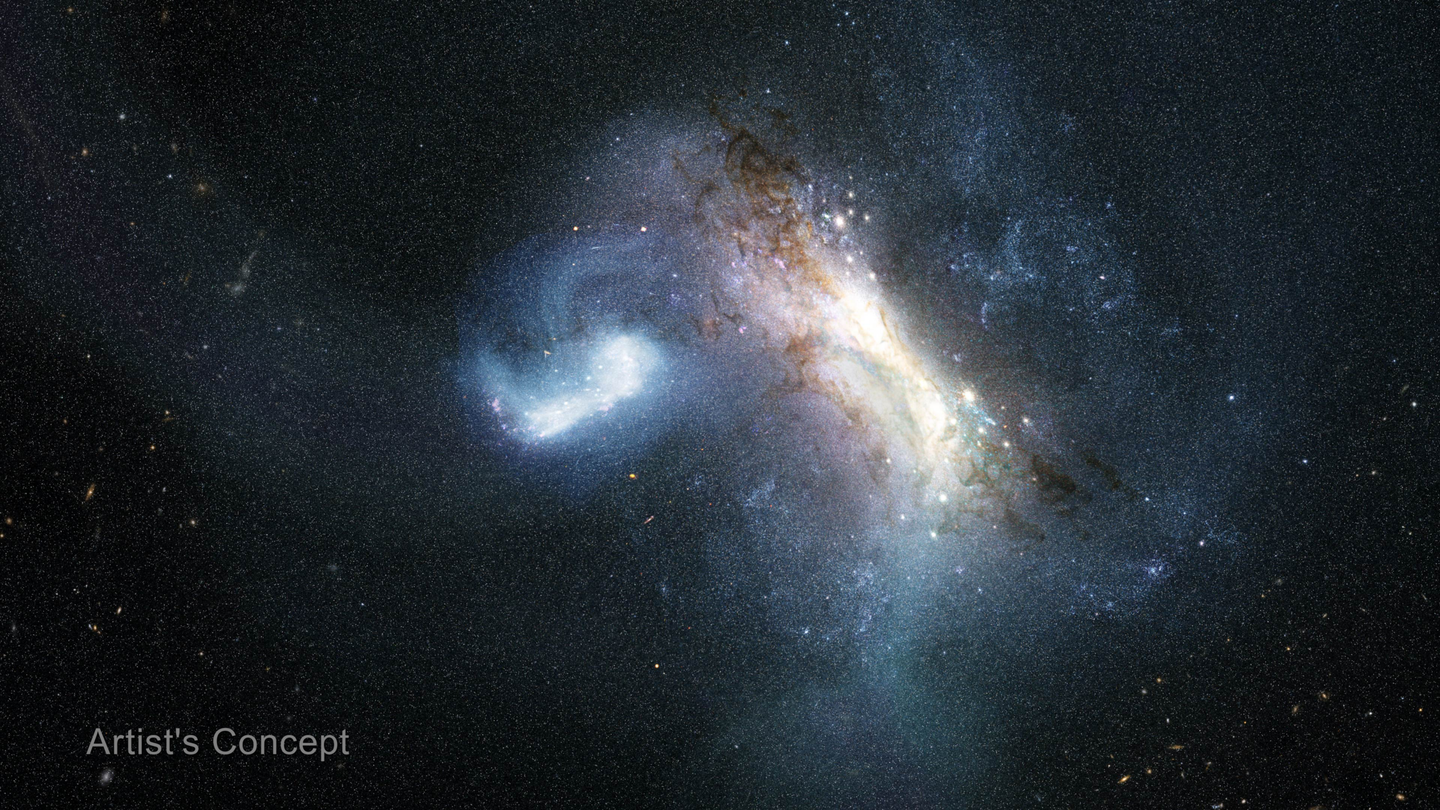
Artists concept. About 12 billion years ago, a dwarf galaxy known as LKH collided with a young Milky Way and merged with it. (CREDIT: NASA, ESA, Joseph Olmsted (STScI))
- The Milky Way absorbed a large dwarf galaxy about 12 billion years ago, pushing the known history of major galactic mergers much farther back in time.
- Hubble observations of ancient star clusters revealed a distinct population that could not have formed in either the early Milky Way or the later Gaia-Sausage-Enceladus merger.
- The discovery gives astronomers a new way to reconstruct the Milky Way’s earliest growth and may help separate stars born here from those brought in by vanished galaxies.
The Milky Way carries the remains of galaxies it swallowed billions of years ago. Some of its oldest star clusters now point to an especially ancient meal, one that helped build the galaxy when the universe was still young.
NASA’s Hubble Space Telescope has provided evidence that the early Milky Way merged with a substantial dwarf galaxy roughly 12 billion years ago. The event occurred about 1.8 billion years earlier than the previously established Gaia-Sausage-Enceladus merger.
The findings extend the known record of a major Milky Way merger into the galaxy’s earliest stages.
“Our home is the Milky Way galaxy, but we do not know how our house was built,” said Davide Massari, lead author from the Astrophysics and Space Science Observatory of Bologna in Italy. “In this paper we discover where the first significant batch of bricks came from: a dwarf galaxy that we call LKH.”
A missing chapter in the Milky Way’s growth
Today, the Milky Way contains hundreds of billions of stars. It reached that scale partly by forming stars from its own gas and partly by absorbing stars, gas and dark matter from smaller galaxies.
Some of those mergers are already well known. The Sagittarius dwarf galaxy began falling into the Milky Way more than 6 billion years ago, and that interaction continues today.
Farther back, the Milky Way merged with Gaia-Sausage-Enceladus, or GSE, about 10 billion years ago. That event had a mass ratio of roughly 1-to-4 or 1-to-5 and helped shape the galaxy’s thick stellar disk through gravitational heating and increased star formation.
Evidence had also suggested that another important merger happened even earlier. But separating those ancient stellar populations has proved difficult.
The young Milky Way was smaller, making its size more comparable with the galaxies it absorbed. Its inner regions were also dynamically chaotic. Over billions of years, that mixing can erase much of the orbital evidence showing where individual stars originated.
Ancient star clusters preserve the evidence
Massari and his colleagues turned to globular clusters, dense spherical collections containing tens of thousands to millions of stars.
These clusters include some of the oldest stars in the Milky Way. Because their ages can be measured more precisely than those of many individual stars, they can preserve chronological evidence of long-vanished galaxies.
“Thanks to the high resolution and depth of Hubble imaging, we could measure the age and the metal content of these clusters with unprecedented precision,” said Chiara Zerbinati of the University of Bologna. “Coupled with measurements from Gaia, this made it possible to distinguish a population of globular clusters that are different from the others. These are the clusters that were born in LKH, and they tell us when that galaxy was devoured by ours, and how massive it was.”
The researchers analyzed 39 globular clusters with homogeneous age measurements. Seventeen lie in the inner Milky Way and were examined using Hubble observations in two optical bands.
Fifteen of those 17 had previously been associated with a group known as the Low-energy population.
The team compared cluster ages, metallicities and orbital properties. Metallicity measures the abundance of elements heavier than helium and can help trace how a population of stars changed chemically over time.
A Bayesian statistical analysis tested whether two, three or four distinct progenitor populations best explained the data.
The three-progenitor model produced the strongest evidence.
A third population emerges
The analysis separated the clusters into three groups: those formed within the Milky Way, those associated with Gaia-Sausage-Enceladus and an intermediate population belonging to neither.
Twelve of the 15 clusters previously classified in the Low-energy group fell into this third population. They remain concentrated within about 6 kiloparsecs of the galactic center.
Their age-metallicity sequence was distinct from both the native Milky Way clusters and the GSE population.
That difference allowed the researchers to conclude that the clusters formed in a separate galaxy later absorbed by the Milky Way.
The team named the progenitor Low-energy-Kraken-Heracles, or LKH. The name combines three earlier research lines that had separately pointed toward an ancient accretion event or associated stellar population.
The researchers estimate that LKH had roughly 500 million solar masses in stars, comparable within the uncertainties to Gaia-Sausage-Enceladus.
Its merger with the Milky Way took place about 12.3 billion years ago, at a redshift greater than 4. Because the early Milky Way was much smaller than it became later, the merger’s mass ratio was probably greater than 0.2 to 0.3.
That means LKH represented a substantial fraction of the proto-Milky Way’s mass.
An old debate gets a clearer answer
The finding bears directly on a long-running question about the oldest stars near the center of the Milky Way.
Astronomers have debated whether these ancient populations formed mainly inside the early galaxy or arrived through mergers. Chemical and orbital measurements alone have struggled to separate those possibilities.
“Some past studies have argued that the earliest phases of our galaxy’s evolution were defined by stars born only in our galaxy,” Massari said. “Here, we have shown that stars born in external galaxies also need to be considered.”
The LKH population may also be connected with stars previously identified as Heracles, a metal-poor population concentrated in the inner galaxy. The researchers caution that other early progenitors may still be missing, particularly galaxies that contained no surviving globular clusters or whose clusters were completely destroyed.
Cosmological simulations support the broader picture. Milky Way-like galaxies commonly experience between one and four substantial mergers, and several simulated galaxies reproduce age-metallicity patterns resembling the three populations identified in the observations.
Practical implications of the research
The work gives astronomers a more precise chronological tool for reconstructing the first stages of the Milky Way’s growth.
Instead of relying only on stellar chemistry or present-day orbital motion, researchers can combine the ages and metallicities of globular clusters to separate populations that became mixed together billions of years ago.
The team plans to extend the analysis to additional clusters that Hubble is observing for the first time.
“Hubble is observing globular clusters that have never been studied before, and this will help us characterize the merger events that are far back in time in the Milky Way galaxy’s history,” said Fernando Aguado-Agelet of the University of Vigo and the University of La Laguna in Spain.
Future stellar-age measurements from missions such as PLATO, along with age estimates derived from Gaia data, could help reconstruct the sequence of events during the Milky Way’s first billion years in even finer detail.
Dig deeper into Milky Way mergers and ancient star clusters
These resources explore how mergers, stellar chemistry, globular clusters and Gaia observations are helping astronomers reconstruct the Milky Way’s earliest assembly history.
A simulation-based inference of the Milky Way merger history
This analysis uses simulations to reconstruct the Milky Way’s accretion history and estimate the stellar mass contributed by disrupted galaxies, including Gaia-Sausage-Enceladus and Sagittarius. It provides a broader framework for understanding how repeated mergers built the Galaxy. (Monthly Notices of the Royal Astronomical Society, 2026)
Modelling the density and mass of the Milky Way’s proto-galaxy components with APOGEE-Gaia
Using APOGEE and Gaia observations, researchers separated ancient stellar populations associated with the Milky Way’s main progenitor from populations linked to accreted systems, including Heracles. The work directly addresses how astronomers distinguish stars formed inside the early Galaxy from those acquired through mergers. (Monthly Notices of the Royal Astronomical Society, 2025)
The formation and survival of the Milky Way’s oldest stellar disk
Researchers identified a disk-like stellar population more than 13 billion years old and examined how it survived subsequent mergers. The findings help establish what the Milky Way looked like during the same early period when major accretion events were shaping the young Galaxy. (Nature Astronomy, 2025)
Galactic Archaeology with Gaia
This expert review examines how Gaia transformed the reconstruction of the Milky Way’s history by revealing stellar motions, chemical populations and remnants of destroyed satellite galaxies. It provides broad context for interpreting ancient merger signatures such as Gaia-Sausage-Enceladus and other proposed progenitors. (New Astronomy Reviews, 2024)
In-situ versus accreted Milky Way globular clusters
This study investigates which Milky Way globular clusters formed within the Galaxy and which arrived inside accreted dwarf galaxies. That distinction is central to using ancient clusters as archaeological records of long-disappeared merger events. (Monthly Notices of the Royal Astronomical Society, 2024)
Research findings are available online in the journal Nature Astronomy.
The original story "Astronomers discover a lost galaxy buried in the Milky Way’s ancient star clusters" is published in The Brighter Side of News.
Related Stories
- Cosmic collision: The Milky Way once flipped by more than 90 degrees
- New findings revise the Milky Way-Andromeda collision odds into a cosmic coin toss
- For the first time, astronomers identify the edge of the Milky Way's disc
Like these kind of feel good stories? Get The Brighter Side of News' newsletter.
Joseph Shavit
Writer, Editor-At-Large and Publisher
Joseph Shavit, based in Los Angeles, is a seasoned science journalist, editor and co-founder of The Brighter Side of News, where he transforms complex discoveries into clear, engaging stories for general readers. With vast experience at major media companies like The Los Angeles Times, Times Mirror and Tribune Publishing, he writes with both authority and curiosity. His writing focuses on space science, planetary science, quantum mechanics, geology. Known for linking breakthroughs to real-world markets, he highlights how research transitions into products and industries that shape daily life.