Dark matter and star clusters work together to reshape the centers of galaxies
A four-billion-year simulation links two very different stellar structures growing around the centers of barred galaxies.
 AIP Potsdam Writer: Janine Fohlmeister

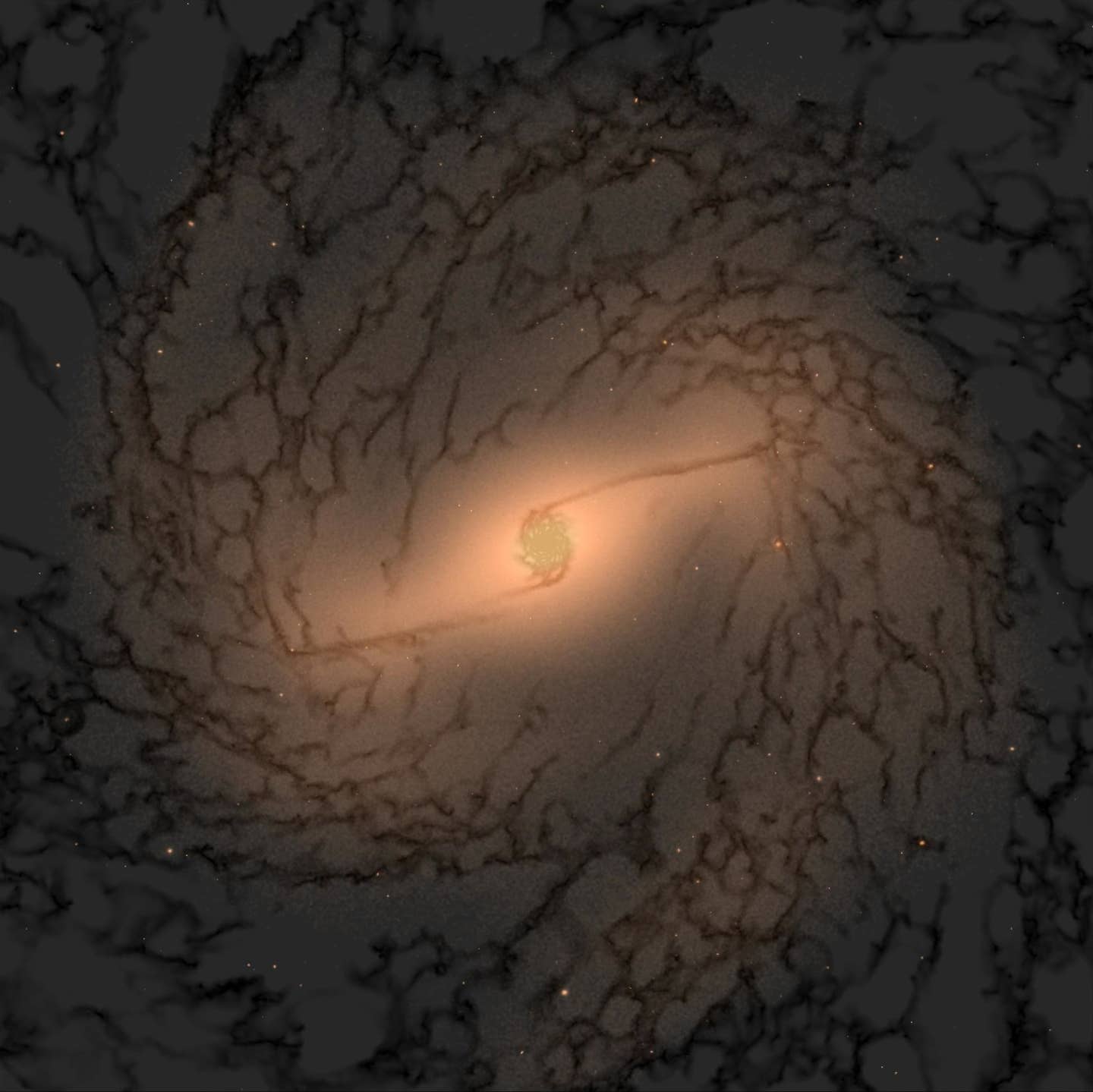
Face-on projections of the stacked surface density distribution of stars and gas in the X-Y plane. (CREDIT: Dr. SungWon Kwak et al, Astronomy & Astrophysics)
- A galaxy simulation shows that nuclear star clusters and nuclear stellar disks can grow together as a stellar bar funnels gas toward the galactic center.
- Repeated shocks from stellar feedback move gas inward and trigger new star formation, while the surrounding nuclear disk gradually expands from the inside out.
- The connection can become difficult to recognize as the two structures evolve at different rates, and mergers with massive star clusters can further reshape the galactic center.
At the heart of a barred galaxy, two stellar structures can grow around the same central region. One is compact and pressure-supported. The other spreads outward as a rotating disk. Their apparent disconnect has obscured a shared origin.
A simulation from the SMUGGLE-Ring project shows how both structures can emerge together in a Milky Way-mass galaxy. It examines nuclear star clusters, or NSCs, and nuclear stellar disks, or NSDs. Observational surveys have found no clear correlation between their masses and sizes, reinforcing the idea that they form separately.
The work follows their development over four billion years.
A stellar bar becomes a gas conveyor
The model instead points to the galaxy’s stellar bar as a common engine. The simulated bar forms naturally around 1 billion years after the start of the run, without researchers imposing a fixed bar potential.
“Our simulation achieves this by showing how the galactic bar acts like a cosmic conveyor belt, channeling gas inward to feed both structures simultaneously from the same reservoir,” said Leibniz-Institüt für Astrophysik Potsdam (AIP) researcher Dr. SungWon Kwak.
As the bar grows stronger and longer, reaching about 5 kiloparsecs, it pushes gas toward the inner kiloparsec. A nuclear gas disk begins forming shortly after the bar appears and stabilizes around 1.5 billion years into the simulation.
Stellar feedback disrupts that gas. At about 1.6, 2.8 and 3.5 billion years, cavities appear in the outer gas distribution while mass increases inside 0.1 kiloparsec. The shocks redistribute angular momentum and push gas inward.
Those events trigger sharp increases in star formation. Over several billion years, the central structures assemble hundreds of millions of solar masses of stars.
The nuclear disk grows from the inside out
The nuclear stellar disk does not appear at a fixed size. Its star-forming edge moves outward as the system evolves, producing an inside-out growth pattern.
The youngest stars remain near the disk’s outer edge, and the peak in stellar birth time migrates outward. The simulation also develops metallicity gradients resembling observed trends.
Feedback can briefly reverse that expansion. Around 2.8 billion years, the NSD radius temporarily falls from 0.5 to 0.4 kiloparsec during a feedback event.
The team defines the nuclear star cluster as the central pressure-supported region where the ratio of rotational velocity to velocity dispersion is below 0.3. That region generally stays within 0.1 kiloparsec, apart from a sudden expansion caused by a merger.
Both structures otherwise grow together. Their masses and star formation rates follow similar patterns, including bursts tied to shocks in the nuclear gas disk.
Why galaxies can hide the connection
That shared growth history helps explain why real galaxies do not show a simple relationship between NSCs and NSDs.
“The apparent disconnection does not mean that the stars themselves differ fundamentally in age, chemical composition, or motion,” said AIP scientist Dr. Cristina Chiappini, a co-author.
Instead, the relative sizes and masses of the two structures drift apart over long evolution. In the simulation, the NSC-to-NSD radius ratio falls from 0.4 to 0.2, while the mass ratio drops from 6 to 2, even though the galaxy’s mass remains unchanged.
Galaxies observed at different stages can therefore look very different on mass-size diagrams despite sharing a common formation process. The age of a galaxy’s bar may be important when comparing nuclear structures across systems.
The live treatment of dark matter also changes the picture. Unlike models that place the bar and dark matter halo in fixed background potentials, this simulation uses particles that interact.
“Previous studies rely on fixed background potentials for the galactic bar and dark matter halo, but the realistic dynamical treatment of stars and the dark matter halo using live particles in our model allows us to form a realistic bar that evolves over time and then naturally forms nuclear structures,” said co-author Dr. Ivan Minchev.
The model also produces a “dark gap” around the bar, a low-density region seen in many observations and associated with interactions between stars and dark matter as the bar rotates.
One massive cluster changes the center
The smooth coevolution is interrupted at about 2.1 billion years. A massive star cluster, containing roughly 30 million solar masses, becomes trapped by the bar and spirals inward through friction.
The researchers identified about 200 star clusters above 100,000 solar masses. The largest entered the nuclear stellar disk, orbited inside it and merged with the nuclear star cluster.
That event abruptly increased the NSC’s mass and radius. It also caused a spike in star formation inside the cluster without the same spike in the surrounding disk.
The result supports a mixed picture for nuclear star cluster growth. Much of the NSC forms through star formation from inflowing gas, but cluster mergers can quickly alter its structure.
Recent observations of NGC 1365 have found massive star clusters inside its bar, some expected to spiral toward the center and merge with its nuclear star cluster. Such events could complicate the scaling relationships astronomers use to compare galactic nuclei.
Practical implications of the research
The simulation gives astronomers a way to view nuclear star clusters and nuclear stellar disks as evolving parts of one connected system rather than treating them as unrelated.
It also suggests that bar age and cluster accretion history may help explain why observed galaxies show differences in NSC and NSD mass and size. Accounting for those factors could produce tighter comparisons between galaxies.
For the Milky Way, the model points toward a relatively low-mass classical bulge. Its simulated nuclear stellar disk begins at about 0.21 kiloparsec and grows to roughly 0.5 kiloparsec, larger than the Milky Way’s approximately 0.1-kiloparsec disk.
The authors suggest that a bulge-to-disk mass ratio below about 0.045 could better match the Milky Way’s compact nuclear disk and favor a younger Galactic bar. Future simulations will test how magnetic fields alter star formation and the evolutionary timescale of these structures.
Dig deeper into galactic bars and galactic evolution
These resources explore how bars move gas into galactic centers, how nuclear stellar structures grow, and how star formation, cluster mergers and black holes shape galaxy nuclei.
Molecular gas and star formation in central rings across nearby galaxies
Using nearby galaxies observed by PHANGS, this research examines gas and star formation in central rings, which are common in barred galaxies, helping clarify how bars concentrate material and sustain star formation near galactic centers. (Astronomy & Astrophysics, 2026)
Age and metallicity of the Milky Way's nuclear star cluster
This detailed analysis finds that most of the Milky Way’s nuclear star cluster mass belongs to an old, metal-rich stellar population while also identifying younger components, providing observational constraints on how the cluster assembled over time. (Astronomy & Astrophysics, 2026)
Chemical evolution in nuclear stellar discs
This work investigates the chemical evolution of nuclear stellar disks and their star formation histories, offering a complementary way to test how repeated gas inflow and stellar growth leave signatures in the central regions of galaxies. (Astronomy & Astrophysics, 2025)
EDGE: a new model for nuclear star cluster formation in dwarf galaxies
High-resolution cosmological simulations show how nuclear star clusters can emerge naturally in some dwarf galaxies, adding another formation pathway to the broader debate over whether these dense systems grow through local star formation, migrating clusters or both. (Monthly Notices of the Royal Astronomical Society, 2025)
The JWST NIRSpec view of NGC 4654
JWST observations examine massive star clusters near the center of the Milky Way-like galaxy NGC 4654, providing an observational laboratory for understanding whether massive clusters can migrate inward and contribute to nuclear star cluster growth. (Astronomy & Astrophysics, 2024)
Research findings are available online in the journal arXiv.
The original story "Dark matter and star clusters work together to reshape the centers of galaxies" is published in The Brighter Side of News.
Related Stories
- Hubble and JWST reveal thousands of young star clusters emerging from their birth clouds
- New Gaia data is challenging a 50-year-old assumption about how stars and galaxies form
- Runaway stars within the Milky Way may reveal dark matter’s hidden structure
Like these kind of feel good stories? Get The Brighter Side of News' newsletter.
Joseph Shavit
Writer, Editor-At-Large and Publisher
Joseph Shavit, based in Los Angeles, is a seasoned science journalist, editor and co-founder of The Brighter Side of News, where he transforms complex discoveries into clear, engaging stories for general readers. With vast experience at major media companies like The Los Angeles Times, Times Mirror and Tribune Publishing, he writes with both authority and curiosity. His writing focuses on space science, planetary science, quantum mechanics, geology. Known for linking breakthroughs to real-world markets, he highlights how research transitions into products and industries that shape daily life.