Scientists build an AI that can propose experiments, run them and learn from the results
A closed-loop laboratory combined AI reasoning, robotics and metabolomics to test thousands of possible biological relationships.
 Chalmers University Writer: Karin Wik

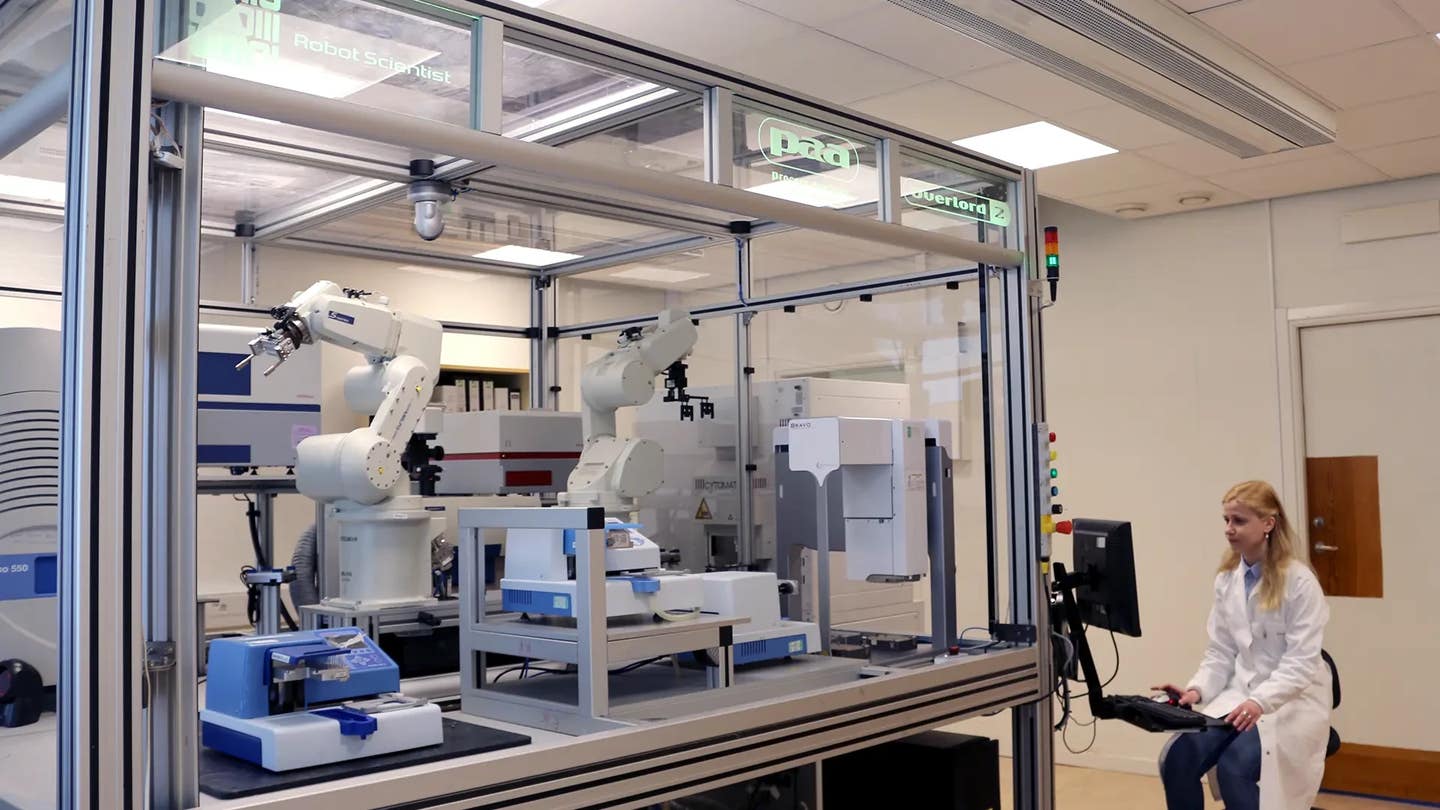
Researcher Ievgeniia Tiukova with the research robot Eve. (CREDIT: NIH Image Gallery/Chalmers University of Technology)
- Researchers built a closed-loop AI scientist that generated biological hypotheses, designed experiments, directed laboratory automation, analyzed results and used new evidence to refine later questions.
- Working with brewer’s yeast, the system generated 1,933 candidate hypotheses and experimentally uncovered previously underexplored interactions, including aminoadipate partially protecting cells from formic acid stress.
- The laboratory was not completely autonomous, because humans still handled some physical tasks and set research boundaries, but the study shows how AI reasoning can be connected directly with real experiments rather than stopping at predictions.
Artificial intelligence is moving beyond analyzing scientific data and proposing ideas. In a laboratory in Sweden, it has begun putting some of those ideas to the test itself.
Researchers at Chalmers University of Technology developed a closed-loop system that can generate biological hypotheses, decide how to test them, translate those plans into machine-readable instructions, analyze experimental results and use the findings to refine later questions. Laboratory robots then perform much of the physical work.
The system was tested on Saccharomyces cerevisiae, the yeast used in brewing and baking and one of biology's most extensively studied organisms. Yet even this familiar microbe contains far more genetic, metabolic and physiological information than a person could systematically explore.
Published in the Journal of the Royal Society Interface, the study brings large language models together with formal logic, biological databases, machine learning, automated cell cultivation and mass spectrometry.
Giving an AI scientist a structured biological memory
Simply connecting a chatbot to laboratory equipment would create major reliability problems. Large language models can produce inconsistent answers and unsupported claims, weaknesses that become particularly serious when software controls physical experiments.
The Chalmers team therefore built a hybrid system. Instead of asking an LLM to reason freely over scientific literature alone, researchers assembled approximately 60,000 structured relationships covering yeast phenotypes, physiology and metabolism.
Inductive logic programming searched those relationships for meaningful patterns. This method produces explicit logical rules rather than relying entirely on the opaque internal representations of a neural network.
The system generated 735 distinct logic programs. By combining these with metabolomics measurements, researchers produced 1,933 candidate hypotheses involving 16 amino acids.
The language model entered later in the process. It helped design experimental interventions while accounting for practical laboratory constraints, then translated those plans into instructions that automated equipment could execute.
“It is too much information for a human to analyze, but our AI scientist could identify promising biological questions, recommend experiments to test them, evaluate experimental outcomes and iteratively refine its understanding based on new evidence,” researcher Ievgeniia Tiukova told The Brighter Side of News.
Robots put the hypotheses to the test
The researchers selected hypotheses involving five amino acids: glutamate, arginine, proline, glutamine and lysine. The automated system then tested how supplementing those compounds affected yeast exposed to different chemical stresses.
Robotic equipment handled liquid transfers, cell cultivation and sampling. Growth was measured over time, while ion-mobility mass spectrometry examined the cells' metabolic profiles at the end of the experiments.
Several interactions emerged.
Adding arginine to caffeine-treated yeast produced stronger growth inhibition than expected from either treatment independently. Caffeine alone reduced growth substantially, but increasing arginine produced an additional synergistic decrease.
Glutamate produced another unexpected interaction. It increased the sensitivity of cells exposed to spermine, although the supplemented glutamate did not accumulate inside the cells as predicted. That result suggested another downstream metabolite may have been responsible.
Other hypotheses failed. Arginine, for example, did not rescue cells from lithium stress as the system predicted.
Those failures were not discarded. The platform stored negative and positive results together, allowing later hypotheses to be checked against existing evidence before spending resources on another experiment.
A failed prediction led to a new discovery
One experiment demonstrated why closing the loop between prediction and experimentation matters.
The system initially tested whether glutamate could protect yeast against formic acid stress. The outcome did not support the predicted mechanism. Instead of ending there, researchers fed the new metabolomic data back into the computational pipeline.
A regression model searched the resulting metabolic changes and ranked compounds that might better explain resistance. That process pointed toward aminoadipate, an intermediate involved in lysine metabolism.
The system generated another hypothesis and returned it to the experimental pipeline.
When aminoadipate was combined with formic acid, yeast growth improved by about 7% per millimolar increase in aminoadipate. The researchers describe this as the first demonstration that aminoadipate can confer resistance to formic acid stress.
The result illustrates an important difference between conventional AI analysis and an automated discovery cycle. The machine did not merely make a prediction. It encountered contradictory evidence, used that evidence to formulate a different explanation and experimentally tested the new idea.
Every experiment becomes part of the next one
A central part of the project involved building a scientific memory that machines could query.
Hypotheses, protocols, LLM prompts, results and experimental metadata were stored in a graph database using standardized scientific ontologies. This allowed the system to determine whether an apparently new question had already been partly answered by an earlier experiment.
In one case, the AI generated a hypothesis about proline and resistance to formic acid. The database revealed that relevant measurements already existed because proline had previously been used as a control.
Those data contradicted the new hypothesis, allowing the system to deprioritize another laboratory run.
That kind of reuse could become increasingly important if autonomous laboratories begin generating thousands of experiments. Physical experiments remain expensive, even when robots perform them.
The laboratory is not completely self-driving
The system still has important limits.
Humans defined its scientific scope, established safety boundaries and supplied the underlying architecture. Physical intervention was also required to move sample plates between workstations and replenish supplies.
The hypotheses investigated so far were relatively simple chemical and metabolic interactions in yeast. The study does not demonstrate an AI capable of independently choosing important research problems or interpreting their broader scientific significance.
The authors instead envision machines taking over repetitive cycles of hypothesis generation, experimentation and data management while people decide which questions deserve attention.
“Human scientists remain essential for defining research priorities, interpreting broader scientific significance and ensuring ethical oversight,” senior author Ross King said.
Future versions could incorporate transcriptomics, proteomics and additional biological measurements while more sophisticated reasoning systems choose experiments expected to provide the greatest amount of new information.
That could make the significance of the work less about replacing scientists than changing the scale at which science can operate. A human researcher cannot personally evaluate thousands of logical relationships, continuously run experiments and retain every result in a machine-readable knowledge network. A carefully constrained automated laboratory potentially can.
Dig deeper into autonomous scientific discovery
These studies and resources explore the rapidly developing field of AI scientists, self-driving laboratories and automated experimental research.
Towards end-to-end automation of AI research: Researchers developed an AI system capable of moving from research ideas through experiments, analysis, manuscript preparation and automated review, demonstrating end-to-end research automation in machine learning. (Nature, 2026)
The Virtual Lab of AI agents designs new SARS-CoV-2 nanobodies: A team of specialized AI agents collaborated on biological research and designed nanobodies that were subsequently synthesized and experimentally tested. (Nature, 2025)
Science acceleration and accessibility with self-driving labs: This perspective examines how autonomous laboratories can combine robotics, experiment selection and machine learning to accelerate scientific discovery while improving access to advanced research infrastructure. (Nature Communications, 2025)
Steering towards safe self-driving laboratories: Researchers examine the safety challenges created when autonomous software gains control over physical laboratory equipment and propose safeguards for increasingly capable self-driving laboratories. (Nature Reviews Chemistry, 2025)
Biological research and self-driving labs in deep space supported by artificial intelligence: This work explores how AI-controlled biological laboratories could autonomously plan, perform and analyze experiments where direct human intervention is difficult or impossible. (Nature Machine Intelligence, 2023)
Research findings are available online in the Journal of The Royal Society Interface.
The original story "Scientists build an AI that can propose experiments, run them and learn from the results" is published in The Brighter Side of News.
Related Stories
- The AI Scientist takes a big step toward end-to-end automation of scientific research
- Introducing Biomni: Stanford’s AI co-scientist built to accelerate biomedical research
- Duke scientists create an AI Raygun that shrinks, expands, and rewrites proteins
Like these kind of feel good stories? Get The Brighter Side of News' newsletter.
Shy Cohen
Writer