Astronomers observe six red dwarf stars ‘eating’ Earth-like planets
Six young red dwarfs carried unexpected lithium, pointing to possible engulfment of rocky planets during system formation.

 Edited By: Joshua Shavit

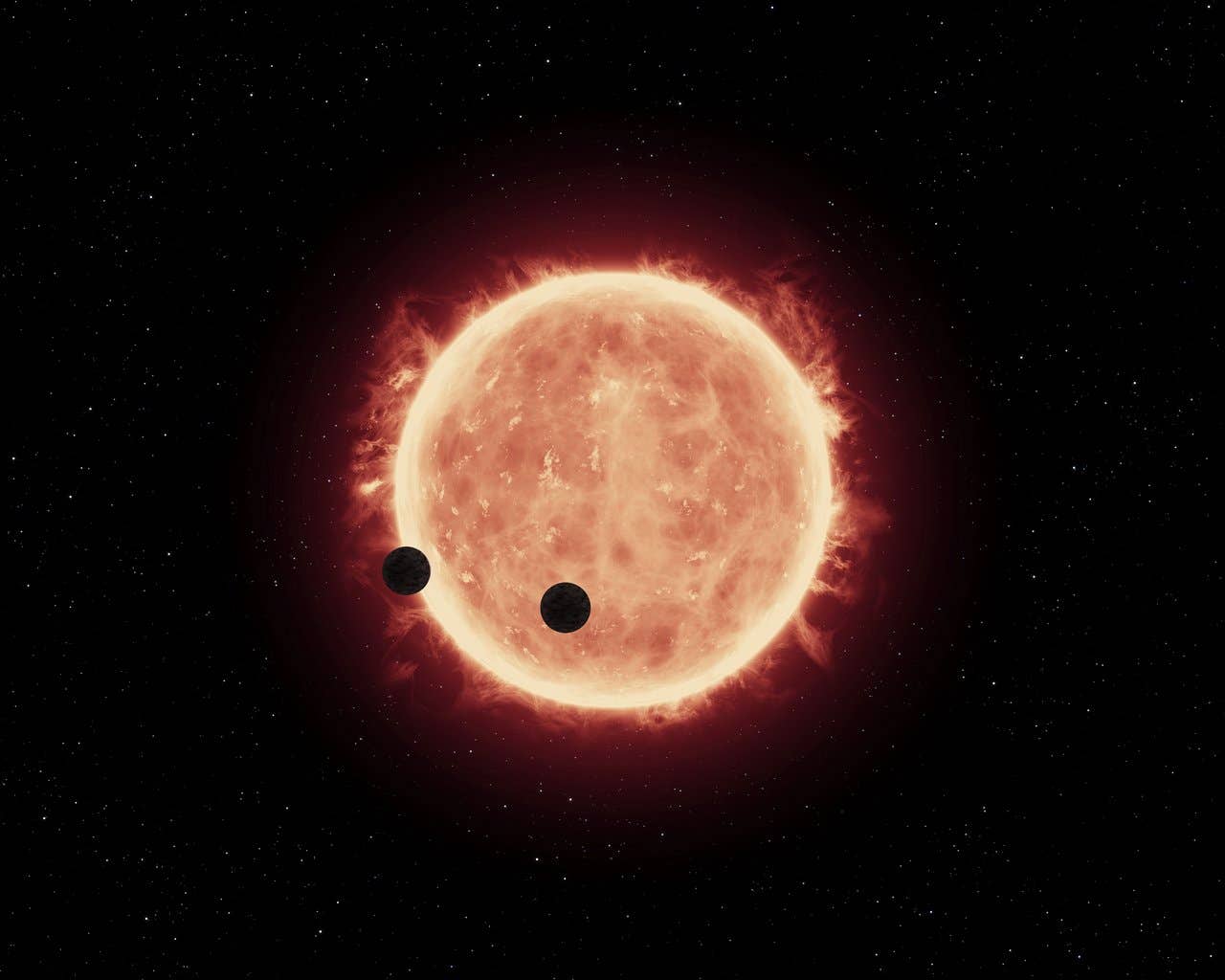
This artist’s impression shows two Earth-sized worlds passing in front of their parent red dwarf star, which is much smaller and cooler than our Sun. (CREDIT: ESA/Hubble)
A young red dwarf can look calm from a distance. But buried in its light may be the chemical remains of a wrecked world.
That is the picture emerging from a new analysis of stars in open clusters, where astronomers found some of the clearest evidence yet that certain young stars may swallow nearby rocky planets. The clue is lithium, a fragile element that should vanish early in these small stars, yet in a handful of cases is still sitting in plain view.
The stars in question are red dwarfs, the smallest and coolest stars in the universe, and by far the most common. They are dim compared with the Sun, but their interiors run hot enough to destroy lithium soon after they form. That makes any later detection of lithium stand out sharply.
“We found that a few of the red dwarf stars we studied contained lithium, a chemical element that should not be there,” lead author Professor Robin Jeffries of Keele University said. “Therefore even a small amount of lithium stands out clearly in these stars – a bit like throwing paint onto a blank canvas.”
A chemical clue in crowded stellar nurseries
The team, from Keele University and the University of Exeter, searched Gaia-ESO spectroscopic survey data covering thousands of stars in 15 open clusters. These clusters are especially useful because their stars formed at roughly the same time, from similar material, and have better constrained ages than isolated field stars.
That makes oddballs easier to spot.
The researchers focused on late-K and early-M dwarfs in clusters aged roughly 35 million to 622 million years, a window where lithium in these low-mass stars should already be heavily depleted. They used the lithium absorption line at 6708 angstroms as their main tracer and looked for stars whose signal rose far above the expected level for cluster siblings with similar temperatures.
They found seven unusually lithium-rich outliers in four clusters. After a closer look, six of those stood up as the strongest cases: four in NGC 2516, one in NGC 2451a, and one in Blanco 1. All sit in a narrow temperature band between about 3,550 and 4,050 kelvin.
The odds of seeing that many such outliers by chance were extremely small, according to the analysis. In that temperature range, the observed fraction came out to about 2 to 3 percent.
Why youth alone does not explain it
At first glance, lithium-rich stars might simply seem younger than their neighbors, since younger low-mass stars have had less time to burn the element away. But that explanation ran into trouble.
These stars do not look like interlopers from a younger population. Their parallaxes, motions, and positions on color-magnitude diagrams match the clusters they belong to. Their membership probabilities are very high, and most show no sign of binarity that might easily distort the measurements.
Just as important, their brightness does not fit the idea that they are much younger than the cluster. If their lithium content truly reflected a far younger age, they should sit noticeably higher in the diagrams than they do. Instead, they mostly lie right on the expected cluster sequences.
The team also checked whether the lithium signatures could be an artifact of contamination from neighboring stars during the observations. That possibility was ruled out.
Other explanations start to fray
The study walks through several competing ideas. One is that strong magnetic activity, starspots, or unusually rapid rotation somehow slowed the normal depletion of lithium during the stars’ early lives.
That mechanism has been discussed before for somewhat warmer stars. But here it looks like a poor fit. The clearest outliers are not fast rotators. Where rotation periods were available, they were actually among the slower rotators in their clusters, not the speedsters expected if rotation-driven effects had preserved the lithium.
Another possibility is that unusual birth conditions or long-lived accretion discs left these stars with more lithium than normal. The paper argues that explanation is also difficult to sustain. In stars of these masses, lithium destruction should remain effective long enough to erase most early differences, unless large amounts of fresh material arrived late.
That leaves a more dramatic option: the stars were polluted after their initial lithium had already been destroyed.
The case for swallowed planets
In this scenario, rocky planetary material spiraled into the star after a radiative core had developed. At that point, the star’s convection zone could still mix the added lithium into its outer layers, but conditions at the base might no longer be hot enough to erase the signal immediately. For a time, the star would wear a detectable chemical scar.
The numbers line up well enough to make that idea plausible. The researchers estimate that explaining the observed lithium levels would require roughly 3 to 10 Earth masses of rocky, Earth-like material.
That is not a trivial meal, but it is also not absurdly large. Close-in rocky planets are common around M dwarfs, and theoretical work has long suggested that migration, gravitational scattering, stellar encounters in clusters, tidal effects, or magnetic torques can send planets or planetesimals inward.
Professor Jeffries put the basic physics plainly: “Red dwarfs are smaller and cooler than our Sun but inside they are extremely hot. This heat should destroy all of their fragile lithium in nuclear reactions shortly after they form.”
Because of that, lithium can serve as a marker of later accretion. If a red dwarf has already cleared out its original supply, any fresh addition has a chance to stand out.
A glimpse of planetary systems in turmoil
The idea that stars sometimes eat their own planets is hardly new. What has been missing is observational evidence that is both clean and well timed. In many other stars, chemical abundance shifts are tiny and hard to interpret. Ages may also be poorly known.
These cluster red dwarfs offer something closer to a controlled test. Their shared environment narrows down the comparison set, and lithium gives a stronger contrast than subtler metal abundance changes seen in some binaries.
The case is not closed. The paper stresses that lithium survival times depend heavily on stellar mass and on which stellar models are used. In some versions, the lithium signal could fade quickly, in just a few million years for the lowest-mass stars. In others, especially if starspots alter the internal structure, the enhancement might last much longer.
That uncertainty matters because it affects how often engulfment must happen. If the signal lasts a long time, then the observed 2 to 3 percent fraction may be close to the real rate. If it fades fast, many more events could be taking place than astronomers currently catch.
Practical implications of the research
If this interpretation holds up, lithium-rich red dwarfs could become a new way to study the violent early history of planetary systems. Instead of only finding planets that survive, astronomers would gain a tool for identifying systems where some worlds were lost to the star.
That could help pin down when engulfment tends to happen, how much rocky material is involved, and whether M-dwarf planetary systems follow evolutionary paths different from Sun-like stars. It may also sharpen models of planet migration and instability during the first few hundred million years.
The result does not prove that every lithium-rich red dwarf has eaten a planet. But it does suggest that, in at least a small fraction of young systems, the final accounting may include missing worlds whose last trace is chemical rather than visible.
Research findings are available online in the journal Monthly Notices of the Royal Astronomical Society.
The original story "Astronomers observe six red dwarf stars 'eating' Earth-like planets" is published in The Brighter Side of News.
Related Stories
- Red dwarf stars are unlikely to host planets with advanced life and civilizations
- Nearby red giant challenges how stars spread the building blocks of life
- Red giant starquakes reshape what scientists think about quiet black holes
Like these kind of feel good stories? Get The Brighter Side of News' newsletter.
Joseph Shavit
Writer, Editor-At-Large and Publisher
Joseph Shavit, based in Los Angeles, is a seasoned science journalist, editor and co-founder of The Brighter Side of News, where he transforms complex discoveries into clear, engaging stories for general readers. With vast experience at major media companies like The Los Angeles Times, Times Mirror and Tribune Publishing, he writes with both authority and curiosity. His writing focuses on space science, planetary science, quantum mechanics, geology. Known for linking breakthroughs to real-world markets, he highlights how research transitions into products and industries that shape daily life.