Astronomers find an unusual triple-star system located 28 light-years from Earth
A planet search uncovered a hidden white dwarf just 28 light-years away. Its red dwarf companion survived a giant star’s expansion, leaving astronomers with an unusual stellar family and an unresolved history.
 University of Montreal Writer: Julie Gazaille

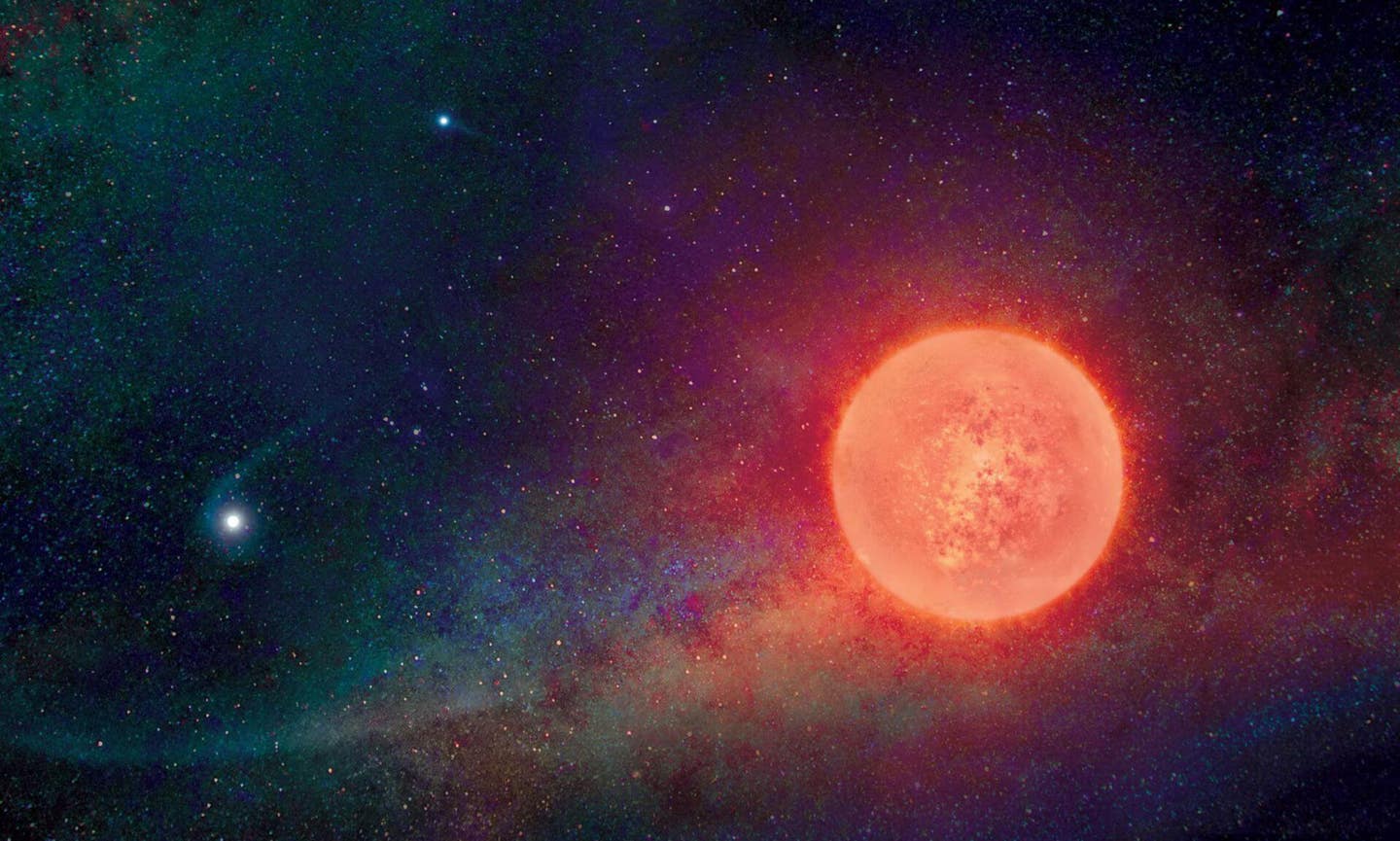
An artist’s illustration depicts the Welopōʻai triple-star system, located just 28 light-years from Earth. The system features a red dwarf star (right) closely orbiting a white dwarf (left), while a second white dwarf (upper) orbits the pair at a much greater distance. Welopōʻai is the closest known triple-star system containing two white dwarfs, the dense remnants of stars that have exhausted their nuclear fuel. The illustration is not to scale. (CREDIT: Benoît Gougeon/Université de Montréal)
Astronomers looking for planets around a nearby red dwarf found something much harder to explain: a stellar companion that had already died. Together with a more distant white dwarf, the discovery reveals an unusual family of three stars just 28 light-years from Earth. The system, named Welopōʻai, has no known counterpart within roughly 100 light-years.
An international team led by the Trottier Institute for Research on Exoplanets at Université de Montréal describes the discovery in Astronomy & Astrophysics. Like other searches for nearby planets, the investigation began by watching a star for signs of an unseen companion’s gravitational pull.
“We were actually looking for planets,” said lead author Étienne Artigau. “Instead, we found something much more surprising.” Astronomers have uncovered other hidden white dwarfs, but this one comes with a particular puzzle: how did its neighboring red dwarf survive when the dying star swelled into a giant?
A wobble too large for a planet
The first clue came from SPIRou, an instrument at the Canada-France-Hawaii Telescope on Maunakea, Hawaiʻi. It measures small shifts in a star’s light as the star moves toward and away from Earth. An orbiting planet can produce that motion, although binary stars can produce much larger signals.
In Welopōʻai’s case, the change was enormous: nearly 16 kilometers per second between the measured extremes. Observations spanning 4.8 years gradually revealed the curve of an orbit. Whatever was tugging on the red dwarf was far more massive than the planets the team had set out to find.
Yet the companion contributed surprisingly little light. A normal star with that much mass should have been readily noticeable, so the combination pointed toward a compact stellar remnant. Researchers studying a white dwarf binary face a related challenge: a faint object can reveal itself through what it does to its surroundings.
A white dwarf was the leading explanation, though the velocity measurements alone left other possibilities open. To find out what was actually there, the team needed an image that could separate the faint companion from the red dwarf’s glare.
Three stars come into focus
That next step brought the researchers to Gemini North, also on Maunakea. Its ‘Alopeke instrument combines rapid exposures to recover fine detail otherwise blurred by Earth’s atmosphere. The approach revealed a faint companion close to the red dwarf, confirming the missing member of this triple-star system.
An initial detection in December 2023 was followed by observations in 2024. Those later images showed the companion moving along its orbit. With the velocity data and additional infrared observations, the images established that the object was a white dwarf.
A second white dwarf was already known farther away. Such remnants are the dense cores left when stars like the Sun shed their outer layers. They can remain observable long afterward, as studies of aging white dwarfs illustrate.
The newly identified white dwarf and red dwarf circle one another every 9.83 years, with an orbital size about 4.64 times Earth’s distance from the Sun. The outer white dwarf appears roughly 124 Earth–Sun distances away in the sky. That projected separation does not reveal its full orbit, which remains incompletely measured.
An unusually precise stellar weigh-in
Finding the hidden star also gave researchers an opportunity to weigh it. A velocity curve shows how strongly a companion pulls on its partner, while resolved images help establish the orbit’s orientation. Bringing those measurements together lets astronomers move beyond an estimate based only on the star’s brightness.
The inner white dwarf has about 61.8 percent of the Sun’s mass, measured with an uncertainty of roughly 0.7 percent. Its red dwarf companion has about 41.9 percent. Precise measurements of white dwarf pairs help researchers connect stellar remnants with the stars that produced them.
Here, the value lies partly in the precision. White dwarfs pack a substantial fraction of a star’s mass into a small volume, and their behavior tests models of matter under extreme compression. A reliable mass gives those models a demanding observational check. The team also used the remnants’ cooling histories and estimates of their earlier lifetimes to place the stellar family’s age at roughly nine to eleven billion years.
The system also offers a view of stars at very different stages of life. While both white dwarfs have exhausted their nuclear fuel, the red dwarf remains a small, long-lived star. Other discoveries of stellar companions show how strongly the course of stellar evolution can depend on a neighboring star.
Surviving a giant’s expansion
The difficult part is explaining how this particular pair got here. Before becoming a white dwarf, the inner companion was probably about 40 percent more massive than the Sun. During its giant phase, its expanding outer layers would have brought it into much closer contact with the red dwarf.
That is a dangerous stage for an orbiting companion. Research on expanding stars shows how stellar growth changes the fate of nearby objects. A companion entering a giant’s envelope can lose orbital energy to drag, spiral inward and sometimes merge with the larger star.
Welopōʻai’s red dwarf survived, but its present orbit is surprisingly wide for the usual picture of a companion emerging from a shared envelope. Observations of stellar engulfment help illuminate these interactions, yet the researchers cannot establish whether this red dwarf was fully engulfed or instead grazed the giant’s outer regions.
In a simplified reconstruction based on mass loss, the earlier orbit was smaller than today’s, bringing the pair close enough for strong interactions. That calculation helps frame the problem, but it does not reconstruct exactly how gas moved between the stars.
“This system should not exist,” said co-author Patrick Dufour. “We have no clean explanation for how it got here. That is the question driving our next observations.” The puzzle concerns its evolutionary history, rather than evidence that the stars violate the laws of physics.
A family with an unfinished history
The third star may help explain that history. Over long periods, an outer companion can alter an inner pair’s orbit through gravitational interactions. Whether that happened here depends on orbital details the team has yet to measure.
Future observations could narrow those possibilities and test how the three stars influenced one another. The survival of planetary companions around stellar remnants poses related questions about what endures when a star changes dramatically. Welopōʻai brings that survival problem into a nearby stellar family.
For now, it joins discoveries of unusual stars that expose gaps between an observed system and its reconstructed past. Finding all three members was an essential first step; explaining their shared history will take more observations.
Its name reflects that connection. Chosen through the ‘Imiloa Astronomy Center of Hawaiʻi program A Hua He Inoa, Welopōʻai combines words associated with inherited family traits and an orbit or circular path. It evokes a family’s path, fitting for stars whose lives remain intertwined long after two of them stopped shining through nuclear fusion.
Dig deeper into white dwarfs and stellar families
These studies explore hidden companions, precise stellar masses and the connections between living stars and their remnants.
- A New Sirius-like System at Only 21 Parsecs: An Elusive White Dwarf Companion to the Nearby K-dwarf HD 38230: Reports another nearby white dwarf uncovered beside a brighter stellar companion, illustrating how such remnants can escape detection. (arXiv preprint, July 2026)
- First semi-empirical test of the white dwarf mass–radius relationship using a single white dwarf via astrometric microlensing: Uses the bending of background starlight to measure an isolated white dwarf’s mass and test the predicted relationship between mass and size. (Monthly Notices of the Royal Astronomical Society, March 2023)
- Planet Hunters TESS IV: a massive, compact hierarchical triple star system TIC 470710327: Examines a tightly arranged stellar triple, offering a comparison for the variety of configurations and evolutionary questions found in three-star families. (Monthly Notices of the Royal Astronomical Society, March 2022)
- How to Constrain Your M Dwarf. II. The Mass–Luminosity–Metallicity Relation from 0.075 to 0.70 Solar Masses: Develops a calibrated relationship between red dwarf masses, infrared brightness and composition using observations of binary stars. (The Astrophysical Journal, January 2019)
- The White Dwarf Initial–Final Mass Relation for Progenitor Stars from 0.85 to 7.5 M⊙: Connects white dwarf masses to the original masses of their parent stars, an important step in reconstructing a remnant’s past. (The Astrophysical Journal, October 2018)
Research findings are available online in the journal Astronomy and Astrophysics.
The original story "Astronomers find an unusual triple-star system located 28 light-years from Earth" is published in The Brighter Side of News.
Related Stories
- Astronomers detect mysterious radio pulses from a nearby binary star system
- Massive binary star system may be feeding the Milky Way’s central black hole
- Compact, massive triple star system detected for the first time
Like these kind of feel good stories? Get The Brighter Side of News' newsletter.
Joseph Shavit
Writer, Editor-At-Large and Publisher
Joseph Shavit, based in Los Angeles, is a seasoned science journalist, editor and co-founder of The Brighter Side of News, where he transforms complex discoveries into clear, engaging stories for general readers. With vast experience at major media companies like The Los Angeles Times, Times Mirror and Tribune Publishing, he writes with both authority and curiosity. His writing focuses on space science, planetary science, quantum mechanics, geology. Known for linking breakthroughs to real-world markets, he highlights how research transitions into products and industries that shape daily life.