Astronomers trace a star’s death spiral into its giant companion
A star in Andromeda brightened for years before erupting in 2025. Webb and other telescopes helped astronomers reconstruct a companion’s inward spiral through a giant’s gaseous envelope, with the evidence strongly favoring a merger.

 Editor: Joshua Shavit

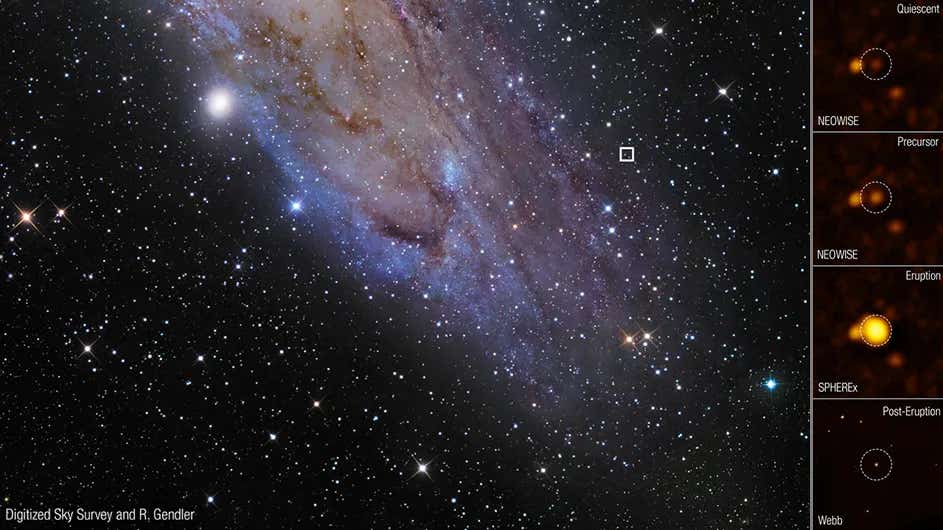
Using data from multiple telescopes, researchers were able to fully reconstruct what happened before, during, and after the merger of a binary star system nicknamed Bao at the edge of the Andromeda galaxy. (CREDIT: NASA, ESA, CSA, STScI, Viraj Karambelkar (Columbia), Kishalay De (Columbia))
For years, a star near the outskirts of Andromeda grew brighter without doing anything especially dramatic. Then its visible light faded while its infrared glow kept climbing. In late 2025, the system erupted, giving astronomers a rare opportunity to follow a stellar interaction through its violent turning point.
The source, formally called AT 2025abao and nicknamed Bao, appears to have been two stars becoming one. Viraj Karambelkar, a NASA Hubble Fellow at Columbia University, led the analysis published in Nature. The team combined observations from space and ground-based telescopes to reconstruct what happened.
Astronomers have studied stellar mergers before, and binary systems can take many forms. Bao offers something more specific: a continuously monitored view of a companion spiraling through an evolved giant’s extended envelope. Its light records a process usually hidden from observation.
A slow brightening gave the team a head start
The warning signs emerged from infrared surveys, including NASA’s NEOWISE mission. Researchers identified unusual behavior in 2023 and began closer monitoring. Archival observations later showed that the system had started brightening in 2018, following decades of relative stability. “We thought it would take centuries for an outburst to happen,” said co-author Nadia Blagorodnova of the University of Barcelona.
“Stellar mergers are very, very difficult to observe in real time because they are hard to predict,” Karambelkar said. “However, we noticed something unusual was going on in 2023 and continued to monitor the system to see what it would do.” That attention meant the team already had observations when the eruption arrived.
During the precursor, the star brightened in two broad episodes. Infrared measurements suggested growing amounts of surrounding dust, while the visible-light changes helped track its expanding, cooling surface. Studying dying stars often requires both kinds of evidence because dust changes what telescopes can see.
SPHEREx supplied a particularly useful observation in July 2025, before the eruption. By then, the source was fading visibly but still brightening in infrared. Such infrared observations reveal material that visible light alone can miss, helping distinguish a changing star from the dust surrounding it.
The smaller star was losing its orbit to gas
The team’s models identify the larger star as an asymptotic giant branch star, an evolved object with an extended gaseous envelope. Its progenitor properties correspond to roughly seven times the Sun’s mass and a radius about 350 times the Sun’s. The inferred companion was much smaller, around 0.7 solar masses. The envelope surrounds the star’s central regions; in this giant, convection could carry deposited heat toward the surface, helping explain its gradual brightening.
When the smaller star entered the giant’s outer layers, both objects occupied a shared envelope. Drag transferred energy from the companion’s orbit into the surrounding gas. Losing orbital energy drew the companion inward, allowing the interaction to intensify.
Initially, that added energy could reach the surface and escape as light while the envelope expanded. By July 2025, modelling suggested a radius around 860 solar radii. Interactions involving expanding stars can therefore alter both an orbit and the appearance of the host star.
The approximately seven-year precursor covered fewer than 10 estimated orbits near the giant’s surface. Those orbits were inferred from the system’s properties, rather than individually counted in resolved images. Related engulfment observations show why following the changing light is often essential when the interacting bodies cannot be seen separately.
Webb arrived soon after the eruption’s peak
In October 2025, Bao began its dramatic outburst. Over about 25 days, it brightened roughly a hundredfold in one visible-light band. The eruption developed the hallmarks of a luminous red nova, a class associated with stellar mergers.
The researchers obtained Webb observations on December 24, 2025, 47 days after peak brightness. These coincided with another SPHEREx survey, allowing the instruments to build a broader infrared picture together. Earlier observations then supplied the comparison needed to reconstruct the changes.
The measurements revealed a warmer stellar surface surrounded by a dust shell. That shell lay too far out for material expelled during the eruption, or even the seven-year precursor, to have reached it. Its location pointed to older mass loss, preserving evidence of the system’s history before the final interaction. That gave Webb a way to connect the eruption with an earlier period of enhanced mass loss, rather than treating all the surrounding dust as freshly formed.
Dust can keep records long after the event that produced it, as studies of dusty remnants illustrate. Meanwhile, rapid follow-up helps capture changes that later observations cannot recover. Bao benefited from having both a long archive and timely new measurements.
The escaping gas helps explain the likely merger
Sharing an envelope does not always force two stars to merge. If enough orbital energy helps expel the envelope, the exposed stars can survive in a much tighter orbit. Bao allowed researchers to investigate why this particular interaction seems to have taken the other path.
Spectra showed fast ejecta colliding with slower material already surrounding the system. Those collisions slowed the gas and could supply enough energy to power the eruption’s prolonged bright phase. Hydrogen-line measurements indicated that the emitting gas slowed from roughly 900 to 150 kilometers per second as those collisions unfolded. The observations also indicated that the interaction expelled only about 0.2–0.4 solar masses, roughly a tenth of the giant’s envelope.
The energy and ejecta together suggest that the companion plunged deep enough to reach the giant’s core, while most of the envelope remained. The paper therefore strongly favors a merger. It also describes future tests that could more conclusively rule out a surviving binary still interacting inside the remaining gas.
That distinction matters when interpreting unusual stellar outcomes. Common-envelope evolution also figures in models leading to compact binaries and other violent interactions, but those possibilities do not predict Bao’s fate. Here, the immediate question is how the observed interaction redistributed orbital energy.
A rare event can improve the next search
The observations suggest that energy escaped mainly as radiation during the slow precursor, then increasingly went into ejecta motion during the plunge. Standard models often compress this complicated exchange into an efficiency parameter. Bao supplies a direct observational test of how well that simplification captures the physics. The distinction matters because energy radiated into space is no longer available to remove the envelope and free the stars.
The result also strengthens the case for watching infrared sources over time. De’s group used NEOWISE observations in separate work on a disappearing massive star. Different outcomes can leave changing infrared signatures, making those surveys useful places to search for rare transitions.
SPHEREx and forthcoming observations from Roman’s surveys could expand that search. Roman launched in August 2026 and remains in commissioning, with science operations ahead. Such observations could identify more candidates for detailed follow-up.
Bao shows the value of noticing a gradual change before it becomes an eruption. The slow brightening gave researchers a starting point, and the later outburst gave them something to test it against. Continued monitoring can now examine what survived.
Dig deeper into stellar mergers and infrared clues
These resources explore merger precursors, engulfment, dusty binaries and the surveys that can uncover more examples.
- Instruments on NASA’s Roman Space Telescope Get in Sync for Science: Describes instrument alignment during commissioning, providing context for the observatory’s forthcoming infrared surveys. (NASA, November 2026)
- The Slow Brightening of WNTR23bzdiq/WTP19aalzlk: Possible Onset of Common Envelope Evolution in an Asymptotic Giant Branch Star?: Presents the earlier analysis of Bao’s gradual brightening, documenting the precursor that motivated continued monitoring. (The Astrophysical Journal, November 2025)
- NASA Webb’s Autopsy of Planet Swallowed by Star Yields Surprise: Explains how infrared observations revised the interpretation of a planetary engulfment, demonstrating the value of examining an event’s aftermath. (NASA Jet Propulsion Laboratory, April 2025)
- Star Duo Forms ‘Fingerprint’ in Space, NASA’s Webb Finds: Describes dust shells produced by the interacting winds of the Wolf-Rayet 140 binary, illustrating how dust preserves an orbital history. (NASA Jet Propulsion Laboratory, October 2022)
- Convection reconciles the difference in efficiencies between low-mass and high-mass common envelopes: Investigates how convection and radiative losses affect common-envelope evolution and the efficiency of envelope ejection. (Monthly Notices of the Royal Astronomical Society, August 2022)
Research findings are available online in the journal Nature.
The original story "Astronomers trace a star’s death spiral into its giant companion" is published in The Brighter Side of News.
Related Stories
- Einstein Probe catches a neutron star merger glowing far longer than expected
- AI helps scientists model kilonova-producing neutron star mergers
- Astronomers discover the first neutron star–black hole merger with an eccentric orbit
Like these kind of feel good stories? Get The Brighter Side of News' newsletter.
Joseph Shavit
Writer, Editor-At-Large and Publisher
Joseph Shavit, based in Los Angeles, is a seasoned science journalist, editor and co-founder of The Brighter Side of News, where he transforms complex discoveries into clear, engaging stories for general readers. With vast experience at major media companies like The Los Angeles Times, Times Mirror and Tribune Publishing, he writes with both authority and curiosity. His writing focuses on space science, planetary science, quantum mechanics, geology. Known for linking breakthroughs to real-world markets, he highlights how research transitions into products and industries that shape daily life.