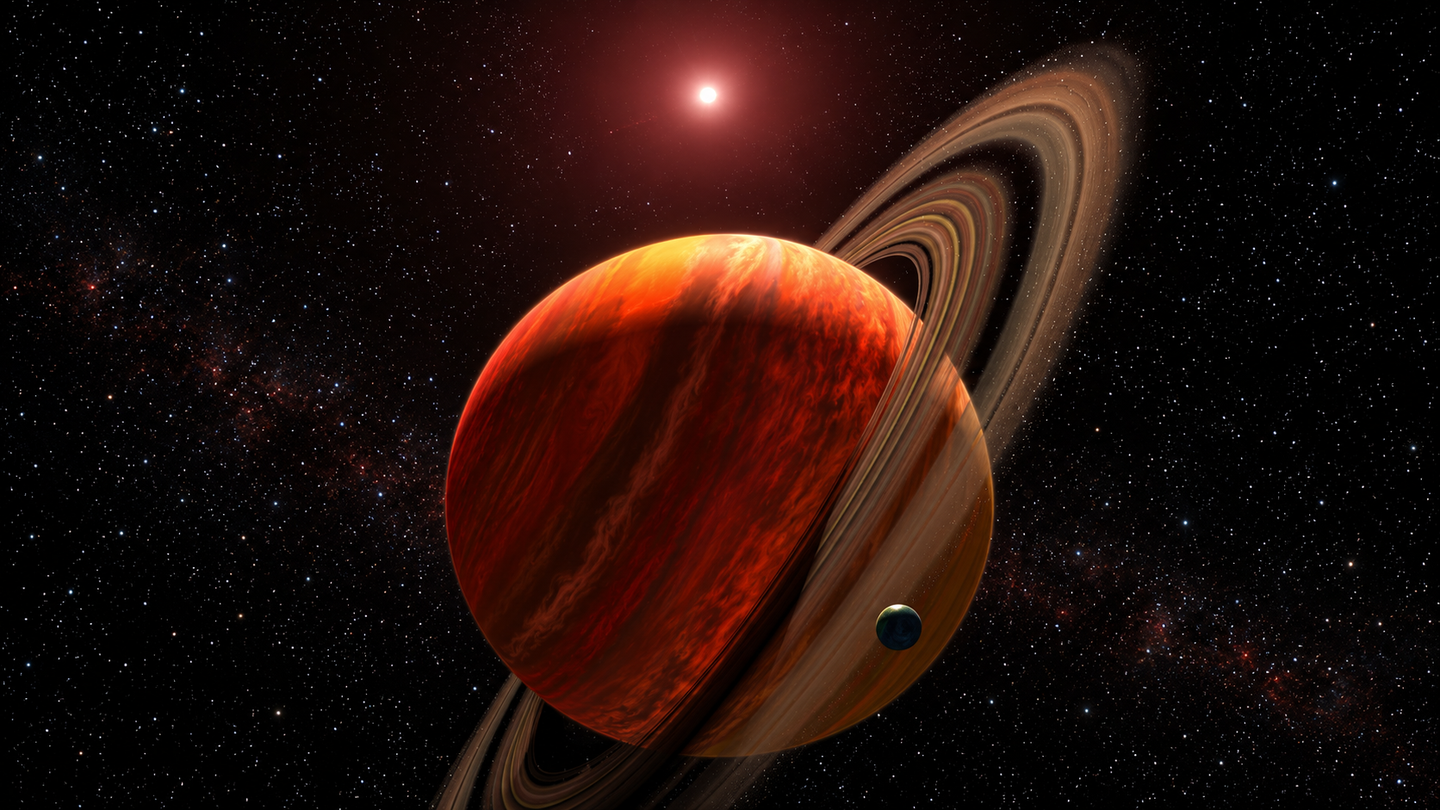
Jupiter-like exoplanet helping scientists rethink how solar systems form
A giant exoplanet 901 light years away is helping astronomers trace how massive worlds move through solar systems.

 Edited By: Joshua Shavit

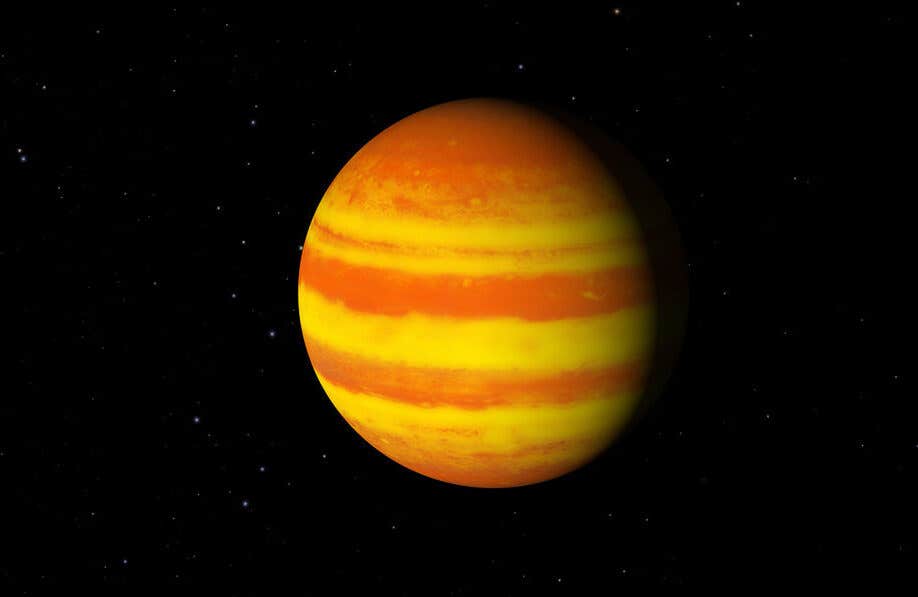
Exoplanet TOI-2031Ab is a lonely gas giant, the only planet in its solar system about 901 light years from Earth. An artist’s rendering shows what it might look like. (CREDIT: NASA)
A planet so distant that its starlight began traveling toward Earth around the Middle Ages has given one University of Cincinnati graduate student the kind of first look astronomers wait years for.
Last fall, Paul Smith sat up through the night as data from the James Webb Space Telescope started appearing on his computer. Webb, orbiting about a million miles from Earth, had been pointed at TOI-2031A, a faint star 901 light years away. If the team’s calculations were right, the giant planet circling that star would pass in front of it during their narrow observation window, letting them examine its atmosphere in unusual detail.
For Smith, who leads data analysis for the project’s first planet, the moment felt personal as well as scientific.
“It was a lifelong dream of mine coming true. I was up all night to get the first look at the data,” he said.
A giant world pressed close to its star
TOI-2031Ab belongs to a class of worlds that keeps puzzling astronomers. It is a gas giant, broadly similar in composition to Jupiter, yet it circles its star at a distance much smaller than the gap between Mercury and the sun. One year there lasts only six Earth days, meaning the planet races around its star roughly four times faster than Mercury moves around ours.
That orbit is one reason researchers find it so interesting.
Smith and collaborators across 19 other institutions are trying to understand why so many giant planets end up so close to the stars they orbit. These worlds do not fit neatly with the arrangement people know from the solar system, where the largest gas giants sit much farther out.
“We’re trying to figure out how these big gas giants got there. We’re studying the formation and migration pathways of big planets,” Smith said. “Where do they form in their solar systems and how do they get so close to their stars?”
TOI-2031Ab was discovered only last year, and so far it is the only known planet in its solar system. The world itself is large even by giant-planet standards. Researchers said it is about a quarter bigger in circumference than Jupiter, the largest planet in the solar system, though it has about 20 percent less mass.
That combination matters because size and mass together can offer clues about a planet’s structure and history. In this case, the team is looking closely at the atmosphere, which becomes easier to study when a planet passes directly in front of its star from Earth’s point of view.
Catching a transit at exactly the right time
That method, called transit observation, depends on timing. If the planet does not cross the star during the scheduled window, the chance is lost.
Competition for those chances is fierce. Smith and his partners had to win observing time on the James Webb Space Telescope through a peer-reviewed process in which roughly 90 percent of research proposals are turned down each year. Once they secured the slot, everything hinged on whether the planet would appear where they expected, when they expected.
Even a clear night on Earth offered no help to the naked eye. The star TOI-2031A is too faint to be seen without powerful instruments. But Webb does not need darkness over a backyard observatory or a human eye at a telescope. Using near-infrared spectrographic sensors, it can measure small changes in starlight as that light filters through a planet’s atmosphere during transit.
That filtered starlight is the key to the analysis. Different gases leave different marks in the light, allowing astronomers to piece together what the atmosphere contains. In the case of TOI-2031Ab, the early picture looks familiar in one sense and strange in another.
“The atmosphere is very similar to Jupiter’s, mostly hydrogen and helium, water and carbon dioxide,” Smith said.
The chemistry may echo Jupiter, but the planet’s location does not. Jupiter circles the sun from a cold outer region of the solar system. TOI-2031Ab, by contrast, hugs its star. That mismatch is exactly the kind of puzzle the group hopes to solve.
A growing map of worlds beyond our own
Planets outside the solar system are known as exoplanets, and astronomers have now identified about 6,400 of them. Each addition to that growing list widens the range of possible planetary systems and raises new questions about how common our own arrangement may be.
For Smith, this project also links institutions across several research hubs. He regularly travels to Ohio State University to meet with co-authors Everett McArthur, a graduate student, and Professor Ji Wang. He also stays in regular contact with Peter Gao of the Carnegie Science Institute.
Those collaborations reflect how modern exoplanet work often happens. Observing time is scarce, the instruments are highly specialized, and the questions are broad enough to draw in experts from many places at once.
Wes Ryle, an astronomer at Cincinnati Observatory who was not involved in the research, said studies like this do more than catalog faraway planets. They also help scientists understand how planetary systems take shape.
Exoplanets: The broader context
“Exoplanets are one of the hottest topics in astrophysics right now, with the ultimate goal of learning how our solar system compares to others and the likelihood of finding other habitable worlds,” Ryle said. “Studies like this help evaluate the role of gas giant planets and their migration in creating a planetary system.”
That broader context gives added weight to a single night of waiting for data. TOI-2031Ab is not being studied because anyone expects it to host life. It is a giant, close-orbiting world, not an Earth-like planet. But gas giants may influence how whole planetary systems develop, including where smaller rocky planets end up and what conditions those worlds face.
In that sense, this faraway planet is less a destination than a clue.
Its star’s light left 901 years ago. By the time it reached the James Webb Space Telescope and then Smith’s computer screen, it had become part of a much larger effort to understand why some solar systems look nothing like our own.
The original story "Jupiter-like exoplanet helping scientists rethink how solar systems form" is published in The Brighter Side of News.
Related Stories
- JWST finds a dark, airless exoplanet covered in rock like Mercury
- Astronomers map the climate of Earth-like exoplanets for the first time
- Astronomers find thick water-ice clouds on Jupiter-like exoplanet Epsilon Indi Ab
Like these kind of feel good stories? Get The Brighter Side of News' newsletter.
Joseph Shavit
Writer, Editor-At-Large and Publisher
Joseph Shavit, based in Los Angeles, is a seasoned science journalist, editor and co-founder of The Brighter Side of News, where he transforms complex discoveries into clear, engaging stories for general readers. With vast experience at major media companies like The Los Angeles Times, Times Mirror and Tribune Publishing, he writes with both authority and curiosity. His writing focuses on space science, planetary science, quantum mechanics, geology. Known for linking breakthroughs to real-world markets, he highlights how research transitions into products and industries that shape daily life.